
Philippine Policy & Regulation
How 2026 Government Decisions and Pending Bills Affect Philippine Startups
A founder- and investor-focused synthesis of the enacted laws, regulator circulars and pending bills reshaping Philippine technology business in 2026, with a scenario table and action checklist.

1Why late 2026 is a planning moment for founders and investors
The rules for building and funding a technology company in the Philippines changed faster between 2024 and 2026 than in the previous decade. CREATE MORE, a new fiscal-incentives law, is in force with implementing rules and regulator guidance. The connectivity market was opened to non-franchise players. The Bureau of Internal Revenue (BIR) began collecting value-added tax from non-resident digital service providers. The Securities and Exchange Commission (SEC) shortened its review clocks and is proposing to raise crowdfunding limits. And a political backlash against online gambling has produced central-bank orders that reach fintech and advertising-technology companies that never touch a bet.
This article synthesises those developments as of 29 October 2026, distinguishing enacted law, implementing rules and regulator circulars from proposals, and flagging where a measure's status could not be confirmed.
- CREATE MORE is operational. RA 12066's rules were signed on 17 February 2025 and the FIRB issued enhanced-deductions guidance in 2026; registered enterprises can plan around a 20 percent rate.
- Startup programs exist but are under-funded. DOST said in November 2025 that the Innovative Startup Act (RA 11337) still lacks adequate appropriations.
- Connectivity is being deregulated. The Konektadong Pinoy Act (RA 12234) lets qualified data transmission players operate without a legislative franchise.
- Digital tax rules are settling. VAT on digital services became collectible from non-resident providers on 2 June 2025; RMC 59-2026 closed open questions.
- Capital-raising rules are loosening, but the September 2026 crowdfunding proposal is still a draft.
- Gambling policy is the wild card. Payment restrictions already bind e-wallets; a statutory ban remains pending.
2CREATE MORE in practice: what registered enterprises actually get
The Corporate Recovery and Tax Incentives for Enterprises to Maximize Opportunities for Reinvigorating the Economy Act, or CREATE MORE (Republic Act No. 12066), was signed in November 2024 and amended the incentives chapter of the Tax Code introduced by CREATE in 2021. Its implementing rules and regulations were signed jointly by the Secretaries of Finance and Trade and Industry on 17 February 2025 and took effect on publication on 20 February 2025, according to PwC Philippines' summary of the IRR. For technology companies, the practical changes fall into four groups.
A 20 percent rate under the enhanced deductions regime
Registered business enterprises (RBEs) that elect the enhanced deductions regime (EDR) pay corporate income tax at 20 percent rather than 25 percent and stack additional deductions on ordinary expenses: an extra 50 percent for direct local labour and for domestic inputs, an extra 100 percent for research and development and for approved training of Filipino employees, a 100 percent deduction for power, and an enhanced net operating loss carry-over (first-three-year losses carried forward for five). In August 2026 the FIRB issued guidance under Section 294(C) of the Tax Code on how each deduction is computed and on the notarised comprehensive summary report RBEs must file with their Investment Promotion Agency (IPA), which forwards findings to the BIR, as summarised by KPMG in August 2026.
Longer incentive periods and a clearer approval ladder
Incentive periods run up to 27 years for the most favoured FIRB-approved projects. The FIRB approves projects with investment capital above PHP 15 billion; IPAs such as the Board of Investments and PEZA decide those at or below it, which is where nearly all software, platform and fintech startups will sit.
A capped local business tax
Local government units may impose a registered business enterprise local tax (RBELT) of up to 2 percent of gross income during the income tax holiday and EDR periods, in lieu of all other local taxes, fees and charges. For a company operating in several cities this replaces a patchwork of local assessments; it does not apply under the special corporate income tax.
VAT zero-rating tied to the registered project
Registered export enterprises and high-value domestic market enterprises must apply annually to their IPA for a VAT zero-rating certificate, limited to purchases directly attributable to the registered project. An exporter that misses the 70 percent export-sales test in one year loses duty and VAT privileges for the next, so export-oriented software startups should model that test before relying on zero-rated purchases.
- 17 Feb 2025
CREATE MORE IRR signed by DOF and DTI; effective on publication 20 Feb 2025 - 20%
Corporate income tax rate for RBEs under the enhanced deductions regime (general rate: 25%) - PHP 15 billion
Investment-capital threshold above which the FIRB, not the IPA, approves incentives - Up to 2%
Maximum RBE local tax on gross income in lieu of other local taxes during ITH and EDR
3The Innovative Startup Act: programs, funds and the funding gap
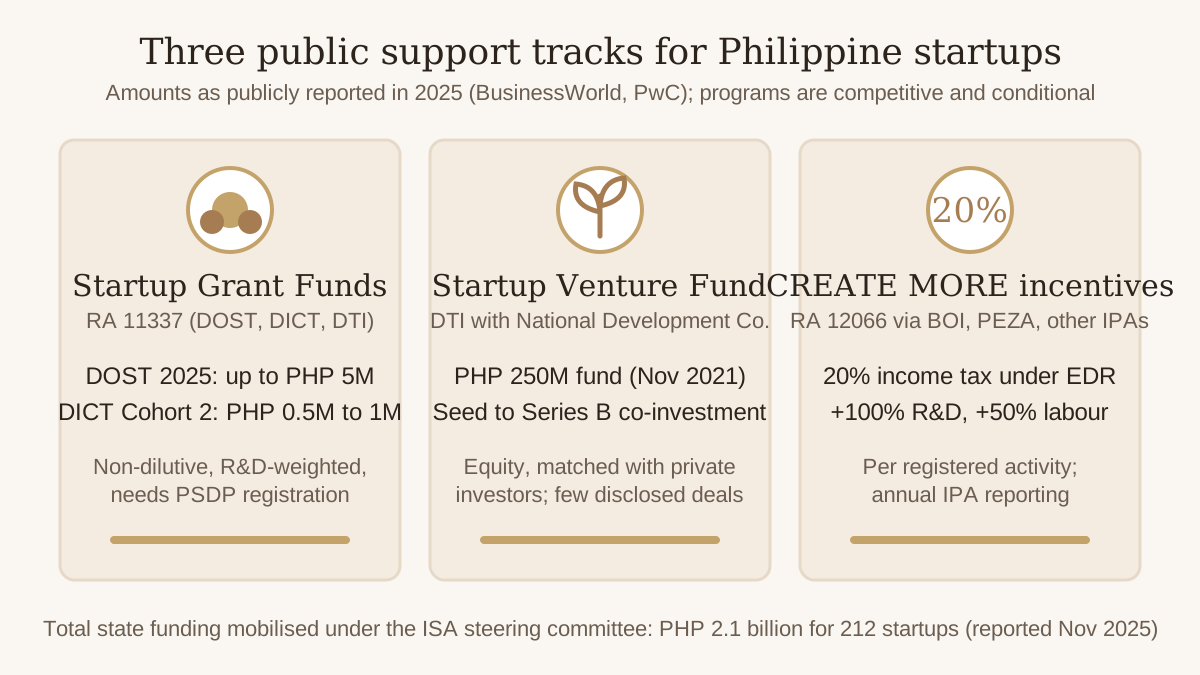
Republic Act No. 11337, the Innovative Startup Act, was signed in 2019 and its implementing rules were signed on 22 November 2019 by the Department of Trade and Industry (DTI), the Department of Science and Technology (DOST) and the Department of Information and Communications Technology (DICT); the text of the IRR is hosted by the Senate issuances library. The law created the Philippine Startup Development Program, agency-level Startup Grant Funds, a Startup Venture Fund run by DTI with the National Development Company, and a framework for startup ecozones and visas.
Six years on, the programs are real but modest. At Philippine Startup Week in November 2025, DOST Undersecretary Leah J. Buendia said the law still lacks sufficient funding and that DOST funds only startups whose products need research-and-development polish, according to BusinessWorld. The same briefing reported that DOST's 2025 Startup Grant Fund offers up to PHP 5 million per startup, DICT's Startup Grant Fund Cohort 2 offers PHP 500,000 to PHP 1 million, and the DTI-NDC Startup Venture Fund, launched in November 2021 with PHP 250 million, had disclosed an PHP 11 million investment in June 2024. The inter-agency steering committee said it had mobilised PHP 2.1 billion for 212 startups and incubated 2,233 more through 158 incubators and innovation hubs. Private capital was the harder story: Kickstart Ventures and DealStreetAsia data cited at the event put Philippine startup equity funding at USD 86.4 million in the first half of 2025, 55 percent below the prior year.
The practical takeaways are to register with the Philippine Startup Development Program early, since grants, ecozone benefits and startup visas flow from that registration; to treat grants-in-aid as non-dilutive supplements to a priced round rather than substitutes; and to check whether an R&D budget can qualify for both a DOST grant and the CREATE MORE 100 percent R&D deduction, which requires separate IPA registration.
4Konektadong Pinoy and the opening of the connectivity market
The Konektadong Pinoy Act (Republic Act No. 12234) lapsed into law on 24 August 2025 and took effect on 14 September 2025, according to GMA News. The DICT signed its implementing rules on 5 November 2025. The law's central change is that qualified data transmission industry participants may build and operate networks without a legislative franchise or a certificate of public convenience and necessity, provided they meet technical and security standards and register through the National Telecommunications Commission's faster authorisation procedures, including a "green lane" for applications. A law-firm analysis published by Chambers and Partners in July 2026 notes that participants must meet performance standards, publish pricing, file reports and comply with cybersecurity rules, with lighter duties for smaller players, and that the IRR mandates a Spectrum Management Policy Framework under which under-used spectrum can be recalled.
Two points matter for investors. First, foreign participation remains subject to the Foreign Investments Act and the Public Service Act; the 2022 PSA amendments (RA 11659) removed telecommunications from the "public utility" list reserved to 60 percent Filipino ownership but kept a national-security review of foreign investment in critical infrastructure, and DICT told GMA that foreign entrants remain subject to both laws. Second, incumbents oppose the regime: the Philippine Chamber of Telecommunications Operators warned, per GMA, that the law could create security vulnerabilities and weaken oversight, which bears on the pace of implementation and the risk of litigation or amendment. DICT expects USD 1 billion to 1.5 billion in annual telecom investment and targets nationwide affordable connectivity by 2028, with a "dig once" policy for fibre alongside public works. For software companies the effect is indirect but real: a cheaper broadband layer widens the market for cloud, edtech, telehealth and payments products outside Metro Manila.
5Tax administration: digital-services VAT, EOPT and CMEPA
VAT on digital services (RA 12023)
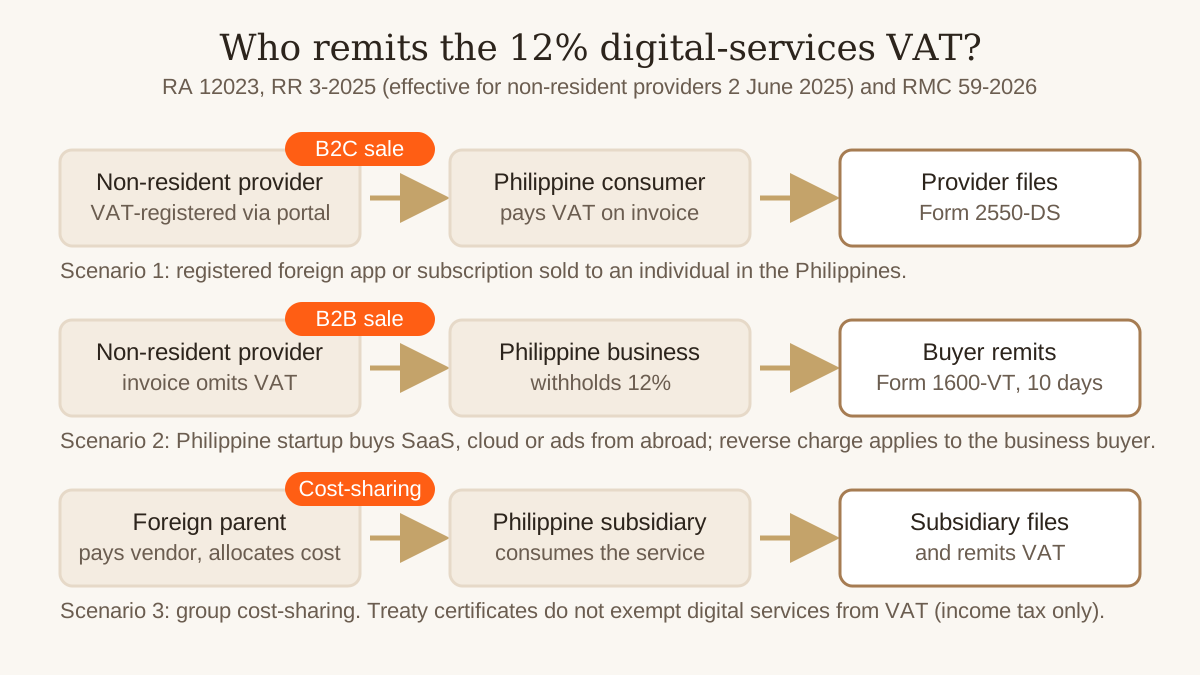
Republic Act No. 12023 imposed 12 percent VAT on digital services consumed in the Philippines regardless of where the provider is located. The BIR's Revenue Regulations No. 3-2025, dated 16 January 2025, required non-resident digital service providers to register through a VAT on Digital Services portal and made their supplies taxable 120 days after the registration window, which the BIR has since treated as 2 June 2025, as described in PwC's January 2025 alert on the regulations. A year later, Revenue Memorandum Circular No. 59-2026 of 2 June 2026 answered questions that had troubled startups: Philippine businesses buying software, cloud or advertising from non-resident providers must withhold and remit the 12 percent VAT on BIR Form 1600-VT within ten days after month-end; a foreign parent paying for SaaS consumed by its Philippine subsidiary creates a VAT-able transaction that the subsidiary remits; marketplaces that collect VAT on consumer sales can be treated as digital service providers filing Form 2550-DS; and a tax-treaty certificate does not exempt digital services, because treaties cover income tax only. In short, practically every foreign SaaS subscription now carries a 12 percent cost that either appears on the invoice or must be self-assessed, and a foreign provider must register even if its supplies are exempt.
Ease of Paying Taxes Act (RA 11976)
The Ease of Paying Taxes Act, approved on 5 January 2024, classifies taxpayers by gross sales into micro (below PHP 3 million), small (PHP 3 million to under PHP 20 million), medium (PHP 20 million to under PHP 1 billion) and large (PHP 1 billion and above); the full text is available at the Lawphil statute archive. Micro and small taxpayers, a group most seed-stage startups fall into, get civil penalties reduced to 10 percent, interest cut by half, compromise penalties for invoicing violations cut by at least 50 percent and a two-page income tax return. The law also allows filing and payment anywhere and requires the Commissioner to decide refund claims within 180 days (90 days for input-VAT refunds), with a 30-day appeal to the Court of Tax Appeals. Revenue Regulations No. 8-2024 and Revenue Memorandum Order No. 37-2024 implement the classification, and reclassification requests can be filed with the home Revenue District Office or through ORUS.
CMEPA (RA 12214)
The Capital Markets Efficiency Promotion Act took effect on 1 July 2025. According to P&A Grant Thornton's review of 2025 tax reforms, it cut the stock transaction tax from 0.6 to 0.1 percent, aligned capital gains tax on unlisted domestic and foreign shares at 15 percent, reduced documentary stamp tax on original share issuance from 1 to 0.75 percent, and set a uniform 20 percent final tax on interest. For venture investors the lower DST reduces the friction cost of each priced round and the single 15 percent rate simplifies exit modelling for secondary sales.
6SEC capital-raising reforms: from the 45-day rule to crowdfunding caps
Since Chairman Francis E. Lim took office in 2025 the SEC has issued a run of issuer-side process reforms. Memorandum Circular No. 9, Series of 2025 requires the Markets and Securities Regulation Department to review registration statements within 45 days of proof of payment, folds interdepartmental clearances into that clock, and allows denial and fee forfeiture where applicants miss response deadlines; it was paired with a 30 percent fee discount for filings until 31 December 2025, as reported by InsiderPH on 25 July 2025. The agency also extended shelf registration validity to five years and introduced tiered minimum public ownership standards.
On 24 August 2026 the SEC announced a second phase. According to Context.ph's report on the announcement, it includes a "one business start date" allowing commercial operations once SEC registration or the primary licence is in hand while other permits are completed in parallel, a "deemed approved" rule for applications not acted on within prescribed timelines, a World Bank-supported separation of disclosure rules for debt and equity, and a Capital Market Master Plan drafted with the Asian Development Bank. The SEC said document-request fees had fallen 62.5 percent since 2023, saving businesses an estimated PHP 211 million by June 2026.
“Our next task is to address these barriers and build a market that is easier to access, more liquid and more competitive.”
— SEC Chairman Francis E. Lim, 24 August 2026 (as reported by Context.ph)
The crowdfunding proposal
The measure of most direct interest to early-stage founders is still a draft. On 11 September 2026 the SEC published proposed amendments to Memorandum Circular No. 14, Series of 2019, the Rules and Regulations Governing Crowdfunding, with comments due by 20 September 2026, as summarised by Conventus Law. The proposal would raise the registration-exempt cap from PHP 10 million to PHP 25 million for offers to any investor, and to PHP 100 million (from PHP 50 million) where the offer is limited to qualified investors, a class that would expand to registered dealers, regulated fund managers, trust arrangements and foreign equivalents. It would also tighten the intermediary side: only registered broker-dealers and investment houses could run platforms, platforms could not host issuers linked to them or their 20 percent holders, issuer vetting would become more prescriptive, and a formal cessation-and-transition process would govern platform exits. As of the research date no final circular had issued; founders planning a 2027 crowdfunding round should not yet rely on the higher caps.
Founders should also review their shareholder agreements and vesting terms before any crowdfunded or priced round, and companies with foreign investors should keep their SEC foreign-ownership reporting current, because a crowdfunding offer that brings in foreign holders may change the ownership profile that other regulators review.
7Online gambling restrictions and their spillover onto fintech and adtech
The online gambling debate of 2025-2026 is about licensed domestic e-gaming, but its instruments reach payment, identity and advertising companies with no gaming business. In early July 2025 the Bangko Sentral ng Pilipinas (BSP) said it was preparing a circular requiring banks and e-money issuers to protect users from gambling risks, after Senators Sherwin Gatchalian, Juan Miguel Zubiri and Risa Hontiveros filed bills variously proposing an age-21 limit, minimum cash-in thresholds, a ban on gambling access through e-wallets and super apps, or an outright ban; trade press reports of 4 July 2025 also noted that Finance Secretary Ralph Recto was studying an online gaming tax. Then, on 15 August 2025, the BSP issued Memorandum No. M-2025-029 directing all supervised institutions to shut off gaming features in payment apps and websites within 48 hours, pending a final policy, as reported by Newsbytes.PH. The same day, the Senate Committee on Games and Amusement opened hearings at which its chair said the Senate "leans toward a full ban." PAGCOR had separately ordered licensees to remove billboards and other out-of-home gambling advertising by 15 August 2025, according to the Philippine Daily Inquirer.
A "Law on Online Gambling" appeared on the 53-item list of administration priority bills tallied by GMA News in July 2026, pending at committee level in both chambers. The 24-measure list reported after the 6 August 2026 Legislative-Executive Development Advisory Council (LEDAC) meeting did not name it, so its legislative priority as of the research date is unclear and should be confirmed with the Senate and House committee records.
Fintech founders serving licensed gaming merchants should read our note on payment aggregator compliance for iGaming and treat the BSP memorandum as a floor for 2027 planning.
8Pending bills and scenario planning for 2027
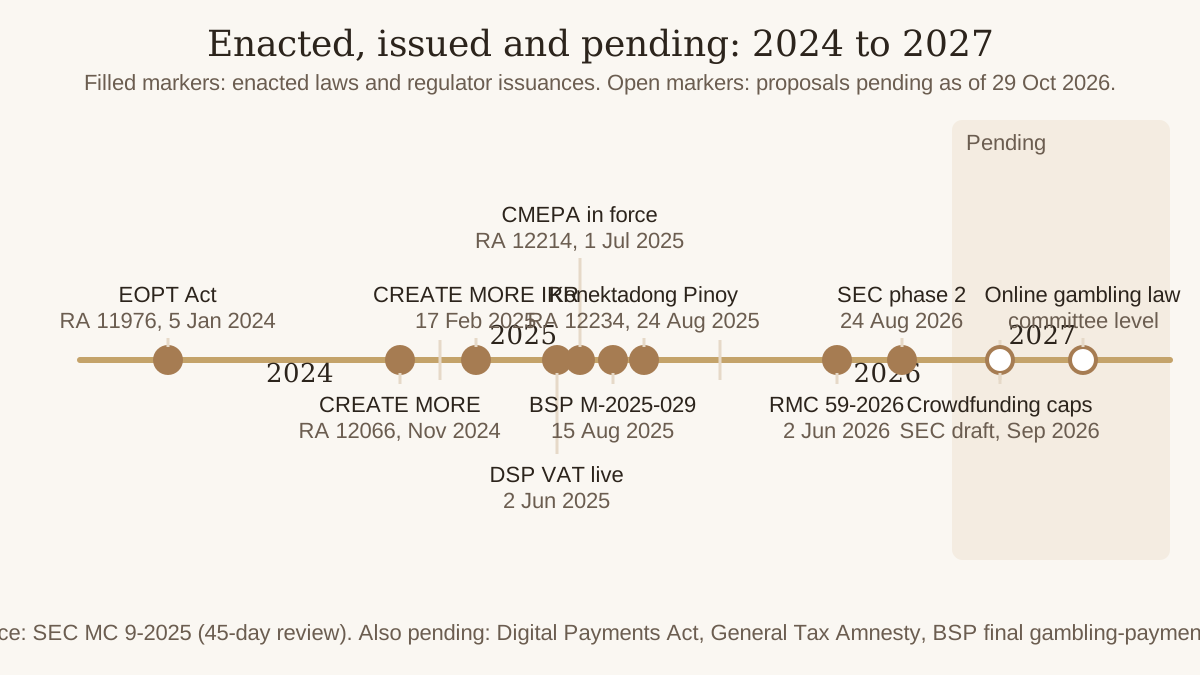
Congressional output has been slow. GMA News reported on 24 July 2026 that only two of 53 LEDAC priority bills had been enacted a year into the 20th Congress, with 20 still at committee level in both chambers. Digital-economy items on that list included a Digital Payments Act (passed the House, pending in the Senate committee), a Cybersecurity Act, Anti-Money Laundering Act amendments, MSME Magna Carta amendments and the online gambling measure. On 6 August 2026 the administration narrowed its push to 24 measures, as reported by the Daily Tribune, dominated by governance, energy and education bills; a General Tax Amnesty and amendments to the bank deposits secrecy law (the BRIGHT Act) are the items most relevant to investors, and other outlets reported the list as targeted for passage by June 2027.
Two further areas belong on the watch list although neither produced a verified new issuance in the research window. Labour: the Telecommuting Act (RA 11165) and Department of Labor and Employment rules continue to govern remote teams, and any 2025-2026 DOLE updates could not be verified for this article. Foreign ownership: the 2022 Foreign Investments Act amendments (RA 11647) lowered minimum paid-in capital for foreign-owned small enterprises that employ Filipinos or use advanced technology, but sectors still on the Foreign Investment Negative List, including mass media and most advertising, remain restricted regardless of the Public Service Act changes.
| Scenario (12-18 months) | Signals to watch | Effect on startups and investors | Preparation |
|---|---|---|---|
| Crowdfunding caps raised as proposed | Final SEC circular amending MC 14-2019 | Seed and Series A rounds up to PHP 25 million (or PHP 100 million from qualified investors) without registration | Line up a registered broker-dealer intermediary; refresh disclosure pack and cap table |
| Statutory online gambling ban or age-21 regime enacted | Senate and House committee reports; BSP final circular | Loss of gaming merchants for PSPs and ad networks; compliance cost for KYC vendors | Contract termination rights, merchant-category controls, revenue concentration limits |
| Status quo: LEDAC bills stall until the 2028 election cycle | Committee calendars; LEDAC meetings | Existing laws and regulator circulars continue to drive compliance; policy made by BIR, SEC, BSP and DICT rather than Congress | Track circulars monthly; build regulator-ready documentation |
| General Tax Amnesty enacted | Bicameral conference; BIR implementing regulations | Clean-up window for legacy tax exposure before a priced round or acquisition | Pre-audit legacy liabilities; prepare disclosure for investors |
9Action checklist and where to get help
The common thread is that obligations are increasingly set by regulator issuances with short effective dates rather than statutes with long transitions. A quarterly review owned by one officer should cover the following.
- Confirm the company's EOPT taxpayer classification and whether micro or small concessions apply for the current year.
- Inventory all foreign SaaS, cloud and advertising subscriptions; check whether the vendor charges 12 percent VAT or whether the company must self-assess and remit on Form 1600-VT.
- If pursuing CREATE MORE incentives, map each product line to the registered activity, calendar the annual VAT zero-rating application and prepare the FIRB comprehensive summary report.
- Register with the Philippine Startup Development Program if eligible, and track DOST, DICT and DTI grant calls.
- Before any round, re-read shareholder agreements, confirm foreign-ownership reporting is current, and decide whether a crowdfunding structure under the (final) amended rules fits.
- For payments, adtech or identity products, screen merchant and advertiser portfolios for gaming exposure and build contractual exits.
- For connectivity or infrastructure ventures, plan for NTC registration plus a Public Service Act national-security review of foreign participation.
- Assign someone to track LEDAC, Senate and House committee calendars monthly.
Abanto Law Firm advises founders, investors and technology companies on investment structures, SEC and BIR compliance, and the regulatory interfaces with payments and gaming. If you are planning a round, an incentive registration or a market entry in 2027, our corporate law practice can review the structure against the rules described here, and our team can assist with BIR assessment and appeal matters where digital-services VAT or classification questions arise. You can reach us through our contact page to arrange an initial consultation.
10Frequently asked questions
Does CREATE MORE apply to a software startup that is not an exporter?
It can. Domestic market enterprises, not only exporters, may avail of the enhanced deductions regime with its 20 percent income tax rate and additional deductions for labour, R&D, training and power. The company must register a specific activity with an Investment Promotion Agency such as the Board of Investments, and the activity must fall within the Strategic Investment Priority Plan. Periods and tiers depend on location and industry, so confirm eligibility with the IPA before modelling the reduced rate.
Must a Philippine startup pay VAT on foreign SaaS subscriptions?
Yes, since 2 June 2025. Under RA 12023, RR 3-2025 and RMC 59-2026, digital services consumed in the Philippines carry 12 percent VAT whether the provider is resident or not. If the non-resident provider invoices the VAT, the startup pays it and may claim input VAT if VAT-registered. If the invoice omits it, a business buyer must withhold and remit the 12 percent on BIR Form 1600-VT within ten days after month-end. Cost-sharing arrangements where a foreign parent pays for services used in the Philippines are also covered.
Have the SEC crowdfunding limits already been raised?
Not as of 29 October 2026. The SEC published proposed amendments to Memorandum Circular No. 14, Series of 2019 on 11 September 2026, with comments due 20 September 2026. They would raise the registration-exempt cap from PHP 10 million to PHP 25 million for offers to any investor and to PHP 100 million for qualified investors, while limiting intermediaries to registered broker-dealers and investment houses. Until a final circular issues, the 2019 limits apply.
What does the Konektadong Pinoy Act change for a foreign investor in a connectivity startup?
RA 12234, in force since 14 September 2025 with implementing rules signed on 5 November 2025, replaces the legislative franchise and certificate of public convenience requirement for qualified data transmission participants with registration and authorisation through the National Telecommunications Commission. Foreign investors remain subject to the Foreign Investments Act and the Public Service Act, including the national-security review introduced by the 2022 PSA amendments, and should expect technical, cybersecurity, reporting and pricing-transparency obligations scaled to their size.
Is online gambling banned in the Philippines, and does that affect a payments startup?
No statutory ban had been enacted as of the research date. What binds now is BSP Memorandum No. M-2025-029 of 15 August 2025, requiring supervised banks and e-money issuers to remove in-app gambling links pending a final policy, and PAGCOR's August 2025 order to remove out-of-home gambling advertising. Several Senate and House bills propose bans, age limits and e-wallet restrictions. A payments startup must comply with the BSP memorandum now and monitor the final circular and the pending online gambling bill, which sat at committee level on the administration's 2026 priority list.
Which startups benefit from the Ease of Paying Taxes Act concessions?
Those classified as micro (gross sales below PHP 3 million) or small (PHP 3 million to under PHP 20 million) under RA 11976. They get civil penalties reduced to 10 percent, interest cut by half, compromise penalties for invoicing violations reduced by at least 50 percent, and a two-page return. Classification follows gross sales for the taxable year under RR 8-2024 and RMO 37-2024; crossing PHP 20 million makes a company a medium taxpayer and ends the concessions, so recheck annually.
Sources and references
- Tax Alert No. 4: Implementing Rules and Regulations of the CREATE MORE Act (RA 12066) — PwC Philippines (2025-02-20)
- Implementing Rules and Regulations of Republic Act No. 11337 (Innovative Startup Act) — Senate of the Philippines (Issuances Library) (2019-11-22)
- DOST calls for higher funding for startup law — BusinessWorld (2025-11-12)
- Konektadong Pinoy law implementing rules signed, DICT says — GMA News (2025-11-05)
- Tax Alert No. 33: Revenue Memorandum Circular No. 059-2026 on VAT on digital services — PwC Philippines (2026-06-09)
- Republic Act No. 11976 (Ease of Paying Taxes Act) full text — Lawphil / Arellano Law Foundation (2024-01-05)
- Shifting landscapes: key tax reforms that shaped 2025 — P&A Grant Thornton
- SEC enforces 45-day rule, offers fee discounts to spur capital market — InsiderPH (2025-07-25)
- SEC advances to next reform phase to ease startups, boost capital market access and liquidity — Context.ph (2026-08-24)
- Philippines: Proposed amendments to the Rules and Regulations Governing Crowdfunding — Conventus Law (2026-09-22)
- BSP orders removal of gambling links in e-wallets as Senate conducts probe — Newsbytes.PH (2025-08-15)
- Only 2 of 53 Marcos priority bills enacted a year into 20th Congress — GMA News (2026-07-24)
This article is for general informational purposes only and does not constitute legal advice. Laws, regulations, and regulatory requirements may change, and reading this article does not create an attorney-client relationship with Abanto Law Firm. Readers should consult qualified Philippine legal counsel regarding their specific circumstances.
Related insights
 Philippine Policy & RegulationFintech and Online Payments in the Philippines: What Changed for 2026
 Philippine Policy & RegulationPhilippine Cybersecurity and Digital Governance Policy: 2026 Update
 Philippine Policy & RegulationOnline Platforms and Consumer Protection in the Philippines: What to Do Now

