
Philippine Policy & Regulation
Chief Justice Zalameda Sworn In: How the Supreme Court Succession Worked
Gesmundo retired at 70 on 6 November 2026 and Rodil Zalameda took his oath the same day. Here is how the JBC, the Constitution and the President shaped the succession.

1What happened: a new Chief Justice in 24 hours
On Thursday, 5 November 2026, Presidential Communications Office Secretary Lino Cayetano announced that President Ferdinand Marcos Jr. had appointed Associate Justice Rodil V. Zalameda as the 28th Chief Justice of the Supreme Court, as reported by Philstar.com and The Manila Times. Zalameda succeeds Chief Justice Alexander G. Gesmundo, who reached the compulsory retirement age of 70 on Friday, 6 November 2026.
The next day, 6 November, Zalameda took his oath in the Supreme Court Session Hall before Senior Associate Justice Marvic Leonen, according to the Daily Tribune. Because the appointment was announced a day before the vacancy arose, the Court moved from one Chief Justice to the next with no extended interim period. Zalameda, 63, is the first Chief Justice appointed by President Marcos; he was named to the Supreme Court by former President Rodrigo Duterte in August 2019 after years on the Court of Appeals.
- 5 Nov 2026
Appointment announced by the Palace - 6 Nov 2026
Gesmundo turns 70; Zalameda takes oath - 5 nominees
All sitting justices on the JBC shortlist - 2033
Reported end of Zalameda's term at age 70
This article explains how the seat became vacant, how the Judicial and Bar Council (JBC) built its shortlist, what the Constitution requires of the President, what an acting Chief Justice does, and what a Chief Justice can and cannot change.
2Why the seat opened: compulsory retirement at 70
Under Article VIII, Section 11 of the 1987 Constitution, members of the Supreme Court "hold office during good behavior until they reach the age of seventy years or become incapacitated to discharge the duties of their office." There is no fixed term for a Chief Justice: tenure is fixed by the appointee's birth date. Gesmundo, who joined the Court as an associate justice in 2017 and became its 27th Chief Justice in April 2021, reached 70 on 6 November 2026, a date the Supreme Court confirmed well in advance, as the Daily Tribune reported on 19 September.
Because retirement dates are known years ahead, the JBC can start the search before the vacancy exists. It opened the Chief Justice post on 29 August 2026. A second vacancy is also coming: Associate Justice Amy C. Lazaro-Javier retires on 16 November 2026, and the JBC has already sent the President an 11-name list for that seat, as the Daily Tribune reported on 29 October.
Zalameda's promotion has a knock-on effect. The Court is composed of "a Chief Justice and fourteen Associate Justices" (Art. VIII, Sec. 4(1)), so moving an associate justice into the top post leaves his former associate justice seat open. As of 6 November 2026, how and when the JBC will open that third seat had not been announced in the sources we reviewed.
3How the JBC built the shortlist
The JBC is the constitutional body that screens candidates for judicial posts. Under Article VIII, Section 8, it is chaired ex officio by the Chief Justice and includes the Secretary of Justice and a representative of Congress, plus regular members representing the Integrated Bar, law professors, retired Supreme Court members and the private sector. Its "principal function" is "recommending appointees to the Judiciary."
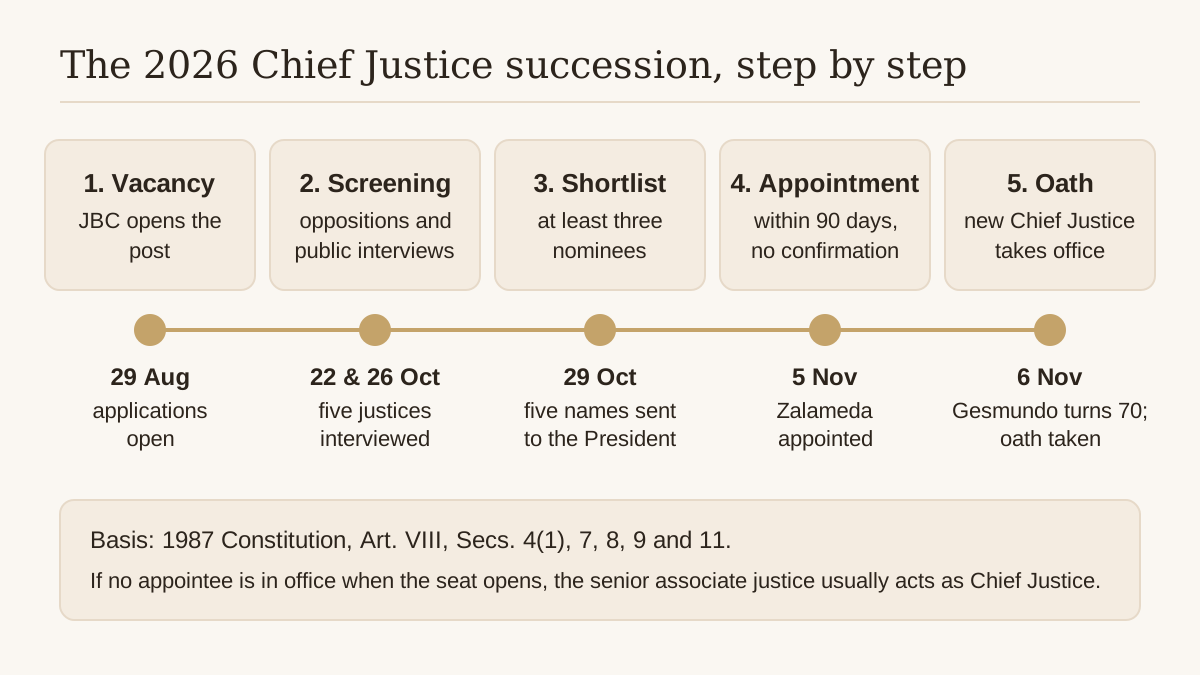
The 2026 sequence
- Post opened. The JBC announced the search; senior associate justices were invited to apply, and outside nominations followed.
- Outside applicant excluded. The Supreme Court spokesperson confirmed that the JBC did not consider lawyer-physician Jose Cabrera Montemayor Jr.; she said she was "not privy to the JBC's deliberations," per the Daily Tribune.
- First public interviews. Senior Associate Justice Leonen and Associate Justice Alfredo Benjamin Caguioa.
- Second public interviews. Associate Justices Zalameda, Japar Dimaampao and Jose Midas Marquez (schedule).
- Oppositions deadline. Sworn complaints or oppositions against any candidate were due by 4:30 p.m.
- Shortlist sent to Malacañang. Five names for Chief Justice and eleven for the Lazaro-Javier seat.
The final shortlist named all five interviewed justices: Leonen, Caguioa, Zalameda, Dimaampao and Marquez (Daily Tribune, 29 October). GMA News reported that Associate Justices Ramon Paul Hernando and Henri Jean Paul Inting, who had been invited, withdrew their acceptance of nominations. The interviews, per the Daily Tribune, focused on public trust, case backlogs, anti-corruption efforts and the handling of high-profile cases involving public funds. Endorsements were reported for several candidates, including from the National Commission on Muslim Filipinos (for Dimaampao) and from retired justice Arturo Brion (for Marquez).
4The constitutional rules on appointment
Three provisions of Article VIII define the President's role:
| Rule | Provision | How it applied in 2026 |
|---|---|---|
| Appointment only from the JBC list | Sec. 9: from "a list of at least three nominees" for every vacancy | The President chose from the five-name list submitted on 29 October. |
| No confirmation | Sec. 9: "Such appointments need no confirmation" | No Commission on Appointments hearing; the appointee simply takes his oath. |
| 90-day deadline | Sec. 4(1): a vacancy "shall be filled within ninety days from the occurrence thereof" | The vacancy arose on 6 November; the appointment was made on 5 November, inside the window. |
| Fixed retirement | Sec. 11: office held until age 70 | Gesmundo retired on his 70th birthday; Zalameda's term reportedly runs to 2033. |
Two features stand out. First, the President cannot go outside the JBC list; the Council's screening is the gate. Second, unlike Cabinet secretaries or ambassadors, justices are not subject to legislative confirmation. That is why the transition could be completed within a day of the announcement.
The appointment ban in Article VII, Section 15, which bars a President from making appointments two months before a presidential election, was not in play: the next presidential election is in 2028.
5What an acting Chief Justice does
If no appointee is in office when a Chief Justice retires, the Court does not stop. Supreme Court spokesperson Atty. Camille Ting told reporters in September that "There will be an acting Chief Justice, which is usually the Senior Associate Justice" (Daily Tribune, 19 September 2026). In 2026 that would have been Justice Leonen, and the Daily Tribune's 29 October report said he would serve temporarily if no appointment was in place by 6 November.
In practice an acting Chief Justice presides over en banc sessions, signs administrative orders needed to keep the courts running, and represents the judiciary. The role is generally understood as caretaking: the long-range programmes, major policy shifts and the shape of the Court's administrative agenda usually wait for the permanent appointee. The Constitution itself does not list an acting Chief Justice's powers; the arrangement rests on the Court's seniority practice and internal rules, so the precise limits should be confirmed against those rules for any specific question.
This time, the question was largely academic. The Palace named Zalameda on 5 November and he took his oath on 6 November, administered by Leonen.
6What a new Chief Justice can change, and what he cannot
A Chief Justice has one vote among fifteen in the en banc. He cannot overturn a precedent alone, and decisions of the Court's divisions are made by those divisions. His real leverage lies elsewhere:
- Court administration. The Supreme Court has administrative supervision over all courts and their personnel, and the Chief Justice leads that machinery: case-management directives, court technology, personnel policy and the judiciary's budget priorities.
- The JBC. As ex officio chair, the Chief Justice presides over the screening of every future judicial nominee, including those for the three Supreme Court seats now open or opening.
- Agenda-setting. Which reform programmes are prioritised, how rules of procedure are revised, and how quickly the backlog is addressed are heavily shaped by the Chief Justice's office.
- Impeachment trials of a President. Under Article XI, Section 3(6), when the President is on trial before the Senate, the Chief Justice presides but does not vote.
Zalameda's stated priorities
During his 26 October JBC interview, Zalameda described a phased, results-based approach to reform: set baselines, pilot initiatives and expand those that work, measuring success by the effect on ordinary Filipinos rather than the number of projects launched. He also proposed a specialised anti-graft monitoring group and measures to speed up trials, according to the Daily Tribune's 5 November analysis. Coverage of his oath summarised four commitments: phased anti-corruption reforms, judicial independence, better welfare and protection for court personnel, and faster case resolution (Daily Tribune, 6 November). These are statements of intent, not issuances; what matters for litigants will be the administrative orders and rules that follow.

7Reactions and the record under scrutiny
The appointment drew both support and criticism, and readers should weigh each against its source. The Palace, through Secretary Cayetano, said the President "recognizes the importance of experienced and principled leadership in preserving public confidence" (The Manila Times). Metro Manila chief prosecutors had publicly endorsed Zalameda before the appointment.
Commentary has also focused on decisions Zalameda wrote. The Daily Tribune noted that he penned a 4 July 2023 decision granting a writ of amparo to activist Siegfred Deduro, which held that red-tagging that risks abduction or extrajudicial killing can threaten life, liberty and security. It also noted that he wrote a First Division decision dated 10 June 2026 that acquitted former First Lady Imelda Marcos of seven graft counts and reversed her 2018 Sandiganbayan conviction, finding that the prosecution had not proved guilt beyond reasonable doubt. Lawyer Ruben Carranza was quoted as warning that the selection could "further erode public confidence in the courts." Supporters point to his long service as a prosecutor and appellate justice. We take no position on these assessments; we record them because they shape public discussion of the Court.
The four other nominees, Leonen, Caguioa, Dimaampao and Marquez, remain associate justices. Any remark about the composition of the Court after the coming appointments would be speculation: as of 6 November 2026 the Lazaro-Javier seat and Zalameda's former seat had yet to be filled.

8What this means for litigants and businesses
For companies and individuals with cases in court, a leadership change rarely alters the law overnight. Doctrine changes only through decided cases, and pending cases continue under the rules in force. The practical effects tend to come through administration:
- Watch for new administrative matters and circulars on case management, e-filing and hearing schedules; these affect deadlines directly. Our guide to e-filing requirements in Supreme Court civil cases covers the current framework.
- Expect continued emphasis on anti-graft and trial-speed measures; litigants in public-funds cases should follow developments described in our note on Sandiganbayan priority anti-graft cases.
- Petitions that challenge executive or regulatory acts are decided by the Court as a whole; see our explainer on judicial review of presidential executive orders.
- Track the two pending associate justice appointments, since the en banc's composition affects close constitutional questions.
- Do not change litigation strategy based on media predictions about how the new Court will rule.
- Rodil Zalameda was appointed the 28th Chief Justice on 5 November 2026 and took his oath on 6 November, the day Gesmundo turned 70.
- The President must appoint from a JBC list of at least three nominees; no confirmation is needed, and a Supreme Court vacancy must be filled within 90 days.
- The JBC shortlisted all five interviewed justices after public interviews on 22 and 26 October.
- Two more Supreme Court seats need filling: Lazaro-Javier's (from 16 November) and Zalameda's former associate justice seat.
- A Chief Justice's influence is mainly administrative and agenda-setting; he holds one vote among fifteen.
For broader context on how political transitions affect investor sentiment, see our overview of Philippine political developments and business confidence. If you have a pending case and want to know whether new Supreme Court issuances affect your deadlines or remedies, our civil litigation team can review it; you can reach us through our contact page.
9Frequently asked questions
Who is the new Chief Justice of the Philippines?
Rodil V. Zalameda, previously an associate justice, was appointed by President Ferdinand Marcos Jr. on 5 November 2026 and took his oath on 6 November 2026 as the 28th Chief Justice, according to Philstar.com and the Daily Tribune.
How long will the new Chief Justice serve?
There is no fixed term. Justices serve until age 70 or incapacity under Article VIII, Section 11. Reports place the end of Zalameda's tenure in 2033, when he reaches 70.
Can the President appoint anyone as Chief Justice?
No. The President must choose from a list of at least three nominees prepared by the Judicial and Bar Council for the vacancy, and the appointee must meet the constitutional qualifications in Article VIII, Section 7. The appointment does not need confirmation by the Commission on Appointments.
What happens if the President does not appoint within 90 days?
The Constitution says a Supreme Court vacancy shall be filled within 90 days, but the seat does not remain leaderless in the meantime: the senior associate justice usually serves as acting Chief Justice. The consequences of a missed deadline have not been tested in this appointment, because the President acted before the vacancy arose.
Will the new Chief Justice change how my pending case is decided?
Not directly. Cases are decided under existing law and rules by the division or en banc assigned to them. A Chief Justice mainly influences court administration, procedural reforms and the pace of case resolution, which can affect hearing schedules and filing practices.
Sources and references
- Marcos appoints Zalameda as chief justice — Philstar.com (2026-11-05)
- Marcos names Rodil Zalameda new chief justice — The Manila Times (2026-11-05)
- Justice Zalameda takes oath as 28th Chief Justice of the Philippines, pledges reforms — Daily Tribune (2026-11-06)
- Where is SC headed under CJ Zalameda? — Daily Tribune (2026-11-05)
- JBC submits shortlist of chief justice, associate justice candidates to Marcos — GMA News (2026-10-29)
- JBC submits shortlist for next chief justice — Daily Tribune (2026-10-29)
- JBC submits 11 nominees for Supreme Court associate justice post — Daily Tribune (2026-10-29)
- PBBM to pick next CJ as JBC wraps up screenings — Daily Tribune (2026-10-27)
- JBC excludes 'Doctorney' from chief justice race — Daily Tribune (2026-10-19)
- JBC to interview five chief justice aspirants — Daily Tribune (2026-10-17)
- Leonen set to become acting chief justice — Daily Tribune (2026-09-19)
- The 1987 Constitution of the Republic of the Philippines — Lawphil Project (Arellano Law Foundation)
This article is for general informational purposes only and does not constitute legal advice. Laws, regulations, and regulatory requirements may change, and reading this article does not create an attorney-client relationship with Abanto Law Firm. Readers should consult qualified Philippine legal counsel regarding their specific circumstances.
Related insights
 Philippine Policy & Regulation2027 National Budget Nears Bicam: What Contractors and LGUs Should Watch
 Philippine Policy & RegulationBARMM's First Parliament Election: Legal Framework and Business Impact
 Philippine Policy & RegulationBSKE Moved to 2028: RA 12326, Five-Year Terms and the Court Challenge

