
Philippine Policy & Regulation
Philippine Politics 2025–2026: What It Means for Business Confidence
From the May 2025 midterms to the ICI wind-down and a 2.3% second quarter, a sourced guide to how the political cycle is shaping rule-of-law, procurement and investment expectations in the Philippines.

1Why the 2025–2026 political cycle matters to business readers
Between the May 2025 midterm elections and the research date of this article (29 October 2026), the Philippines went through an unusually dense sequence of political events: a Senate result that confounded pre-election polling, a Supreme Court ruling that halted the impeachment of the Vice President, a flood-control infrastructure controversy that forced leadership changes in both chambers of Congress and in the Cabinet, a presidential fact-finding commission that opened and closed within seven months, and a sharp slowdown in measured economic growth. None of these events is purely political. Each has a direct bearing on how domestic and foreign investors assess rule-of-law risk, procurement integrity and policy continuity in the Philippines.
This article is a neutral, sourced overview. Where a claim is an allegation rather than a finding, it is attributed to the person or body that made it, and the responses of those named are recorded. Where a matter is pending before the Ombudsman, the Sandiganbayan or the Supreme Court, it is described as pending. Readers tracking anti-graft litigation may also wish to read our separate note on Sandiganbayan priority anti-graft cases in 2026.
- The May 2025 Senate result produced no clear administration majority, which has made legislative outcomes less predictable than in the 19th Congress.
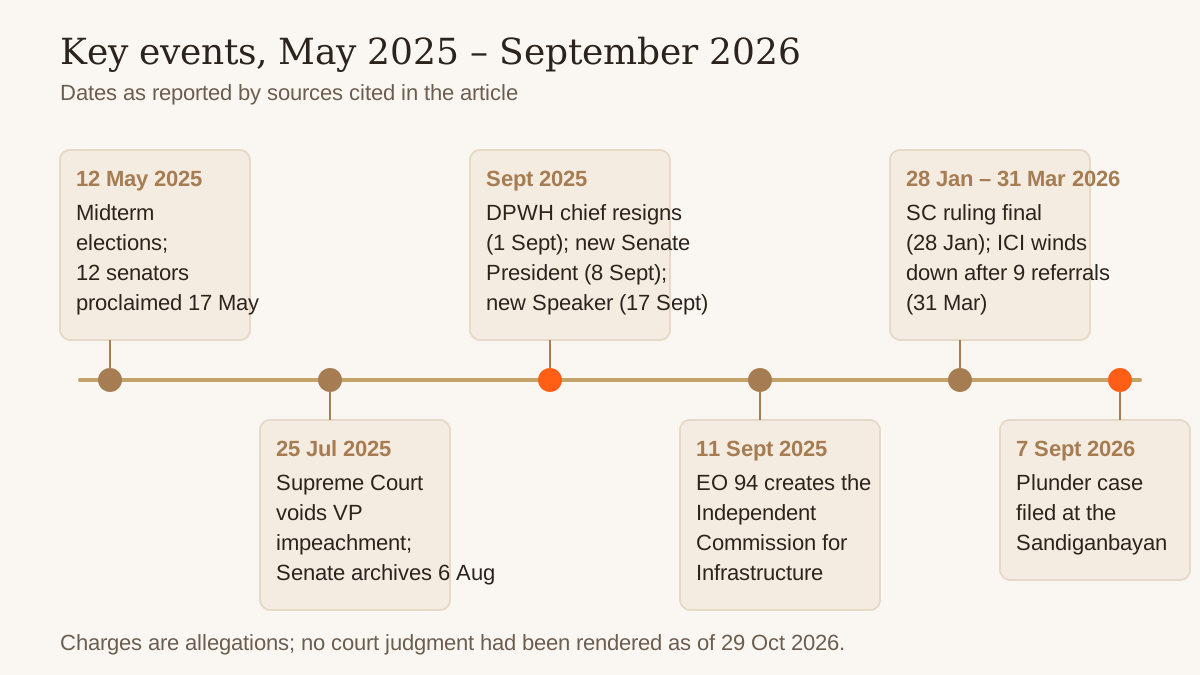
- On 25 July 2025 the Supreme Court declared the fourth impeachment complaint against Vice President Sara Duterte unconstitutional; the Senate archived the articles on 6 August 2025 and the Court affirmed its ruling with finality on 28 January 2026.
- The flood-control controversy triggered the resignation of the House Speaker and the Public Works Secretary, a change of Senate President, and the creation of the Independent Commission for Infrastructure (ICI) by Executive Order No. 94 on 11 September 2025.
- Growth slowed to 2.8% in Q1 2026 and 2.3% in Q2 2026; S&P and Moody's kept investment-grade ratings but S&P moved its outlook from positive to stable in April 2026.
- For business, the practical issues are procurement reform, the pace of prosecutions, and whether the policy framework for investment survives the political turbulence intact.
2The May 2025 midterms and a Senate that is harder to read
The midterm elections were held on 12 May 2025, and the Commission on Elections proclaimed the twelve winning senators on 17 May 2025. According to the official canvass reported by the Inquirer, Senator Christopher "Bong" Go topped the race with about 27.1 million votes, followed by Bam Aquino, Ronald dela Rosa, Erwin Tulfo, Francis Pangilinan, Rodante Marcoleta, Panfilo Lacson, Vicente Sotto III, Pia Cayetano, Camille Villar, Lito Lapid and Imee Marcos.
The composition mattered because the Senate was expected to sit as an impeachment court. A CSIS analysis counted six seats for candidates on the administration slate (fewer than polls had suggested), four for Duterte-endorsed candidates and two for the liberal opposition, with Aquino and Pangilinan finishing far above their polling. Several winners, including Sotto, Lacson and Marcoleta, were not neatly aligned with either camp. The result was a 24-member chamber in which no bloc could pass or block a measure without coalition-building, a feature that has shaped every major Senate decision since.
For businesses, the immediate relevance of a fragmented Senate is legislative throughput. Tax, investment-liberalisation and regulatory bills need floor time and a reliable majority; both became scarcer once the chamber's attention turned to the impeachment question and, from August 2025, to the flood-control inquiry.
3The impeachment case and the Supreme Court's July 2025 ruling
The House of Representatives impeached Vice President Sara Duterte in February 2025 and transmitted the articles to the Senate on 5 February 2025. On 25 July 2025 the Supreme Court, in a decision penned by Senior Associate Justice Marvic Leonen, declared the articles of impeachment unconstitutional. The Court held that the complaint was barred by the one-year rule in Article XI, Section 3(5) of the Constitution, because three earlier complaints filed in December 2024 had already "initiated" proceedings, and that the process violated the Vice President's right to due process. It ruled that the Senate had not acquired jurisdiction, declared the decision immediately executory, and stated that a new complaint could be filed from 6 February 2026. The Court was explicit that the ruling did not absolve the Vice President of the allegations against her. Associate Justice Alfredo Benjamin Caguioa inhibited and Associate Justice Filomena Singh was on leave.
The Senate responded on 6 August 2025. Sitting as a legislative body rather than as an impeachment court, it voted 19-4-1 to archive the articles. Senators Aquino, Hontiveros, Pangilinan and Sotto voted against, arguing the chamber should wait for the Court to rule on the House's motion for reconsideration filed on 4 August; Senator Lacson abstained. The House sought reversal, but on 28 January 2026 the Court unanimously denied the House petition and affirmed its decision with finality, clarifying that "session days" means any calendar day on which the House holds session and that initiation must occur within the term of the Congress concerned. The Vice President's office said the matter was "now closed". As of the research date we found no verified report of a new impeachment complaint having been filed after 6 February 2026; readers should confirm current status directly with House records.
4The flood-control controversy: allegations, denials and the first institutional responses
The controversy that reshaped the second half of 2025 concerned flood-control projects funded through the Department of Public Works and Highways (DPWH). In August 2025 President Ferdinand Marcos Jr. ordered an investigation into "ghost" and substandard flood-control works, and after inspecting a project in Bulacan said he was "very angry", according to SunStar's report. On 31 August 2025 Malacañang announced that DPWH Secretary Manuel Bonoan had resigned effective 1 September and that Transportation Secretary Vince Dizon would take over with instructions to conduct a "full organizational sweep" of the department. The report did not accuse Secretary Bonoan of personal wrongdoing.
The allegations became personal on 8 September 2025, when contractors Pacifico "Curlee" and Sarah Discaya read a joint sworn statement before the Senate Blue Ribbon Committee describing what they called a "system" of payments to House lawmakers. They named several DPWH officials and legislators, including then Speaker Martin Romualdez and former Appropriations Committee chair Elizaldy "Zaldy" Co, and Pacifico Discaya alleged that each received at least 25 percent of project value. These are allegations by witnesses who were themselves under investigation. Speaker Romualdez denied the claims the same day, calling them "false, malicious, and nothing more than name-dropping" and stating, "I have never, and I will never, accept a bribe from anybody." Representative Co also denied any link to kickbacks in separate statements to the press.
Within ten days the leadership of both chambers changed. On 8 September 2025, fifteen senators signed a resolution replacing Senate President Francis Escudero with Senator Sotto, with Senator Lacson elected President Pro Tempore; Philstar reported that the reasons were not formally stated but noted public scrutiny of the impeachment handling and a running dispute between the chambers. On or shortly before 17 September 2025, Speaker Romualdez resigned and Isabela Representative Faustino "Bojie" Dy III was elected Speaker. Former Senate President Escudero commented that "leadership changes must lead to institutional reform, not selective amnesia."
5The Independent Commission for Infrastructure: mandate, output and criticism
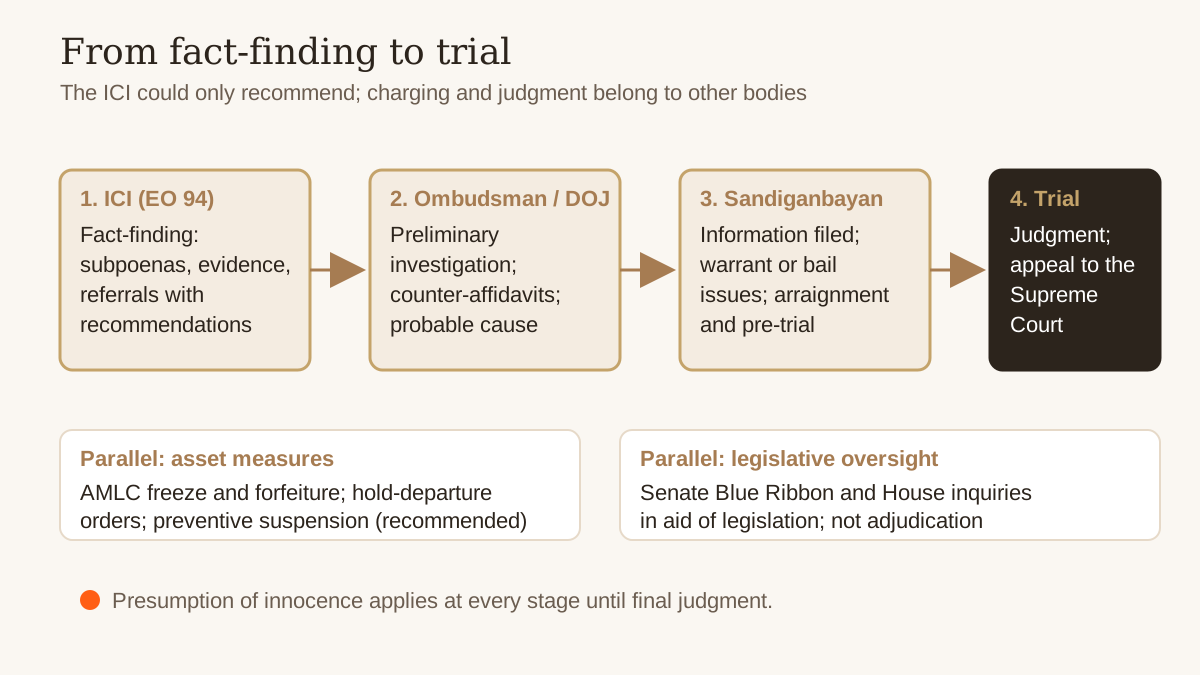
On 11 September 2025 the President signed Executive Order No. 94 creating the Independent Commission for Infrastructure (ICI), chaired by retired Supreme Court Associate Justice Andres Reyes Jr. As PTV reported, the ICI was constituted as a fact-finding body with authority to subpoena documents and witnesses, to recommend criminal, civil and administrative cases to the Department of Justice, the Ombudsman and the Civil Service Commission, and to recommend asset freezes, hold-departure orders and preventive suspensions. Its priority was flood-control works of the preceding ten years, with a wider mandate over other infrastructure. The ICI was not a court and had no power to convict; every referral still had to pass through preliminary investigation and, where warranted, trial.
The commission's active life was short. Commissioner Rogelio Singson, a former Public Works Secretary, resigned in December 2025 citing health and security reasons, and Commissioner Rossana Fajardo resigned after stating the body had done what it could, according to Philstar. On 16 January 2026 the President said the ICI was "coming toward the end" of its work and that the focus would shift to the DOJ and the Ombudsman, per GMA News. On 13 March 2026 Chairman Reyes announced that the ICI had made nine referrals covering 65 individuals, including former public works officials, engineers and several lawmakers, had turned over its remaining evidence and methodology to the Ombudsman, and would wind down by 31 March 2026. BusinessWorld reported that case records were also delivered to the DOJ, whose spokesperson said the department would "study these documents and see if they point to leads", and that the Anti-Money Laundering Council would lead any asset freezing or forfeiture.
The wind-down drew criticism. Representative Leila de Lima and the Akbayan party-list said the probe risked ending without "big fish" being held accountable, as the Daily Tribune reported. The Palace countered on 31 March 2026 that the Ombudsman and DOJ were "overwhelmed" by the volume of referred cases and that investigations were continuing regardless of rank. A taxpayer petition questioning the ICI's constitutionality was reported to have been filed with the Supreme Court in late October 2025; we could not retrieve the primary report and its disposition should be confirmed.
The most prominent case to emerge from the referrals, as of the research date, is the plunder complaint against former Speaker Romualdez. According to DZRH, the Office of the Ombudsman filed a plunder information with the Sandiganbayan on 7 September 2026. Mr Romualdez has consistently denied involvement; his counsel has raised due-process objections about access to witness statements, and his camp says there is no credible evidence linking him to any scheme. Some witnesses, including a former aide, have recanted earlier affidavits. Separately, the Ombudsman filed malversation and graft charges in January 2026 against former Senator Ramon Revilla Jr. and six DPWH officials over a project in Pandi, Bulacan. All of these are accusations; no court had rendered judgment on them as of the research date, and every respondent is presumed innocent.
6Cabinet turnover and what it signals about policy continuity
The flood-control controversy was not the first reshuffle of the period. On 22 May 2025, ten days after the midterms, the President asked all Cabinet secretaries to submit courtesy resignations, describing it as a reset after the election result. Several senior officials, including then Transportation Secretary Dizon and Education Secretary Juan Edgardo Angara, were retained in the weeks that followed. The September 2025 appointment of Secretary Dizon to DPWH placed a political troubleshooter at the centre of the agency under investigation, and the department's spending was subsequently curtailed.
Continuity in the economic team has been one of the more reassuring signals for investors, but the fiscal consequence of the controversy has been material. Public construction spending fell 32.4 percent year on year in the second quarter of 2026, according to the Philippine Statistics Authority data reported by GMA News, and S&P Global noted in June 2026 that infrastructure disbursements were down roughly half year on year. In other words, the policy response to alleged misuse of infrastructure funds was itself a drag on growth, a trade-off that both the administration and its critics acknowledge, though they disagree on who bears responsibility.
| Position | Before | After | Date of change |
|---|---|---|---|
| Senate President | Francis Escudero | Vicente Sotto III | 8 Sept 2025 |
| Speaker of the House | Martin Romualdez | Faustino Dy III | 17 Sept 2025 |
| Secretary of Public Works | Manuel Bonoan | Vince Dizon | 1 Sept 2025 |
| Chair, ICI | — | Andres Reyes Jr. (body wound down 31 Mar 2026) | 11 Sept 2025 |
7Economic and fiscal signals: growth, ratings and sentiment
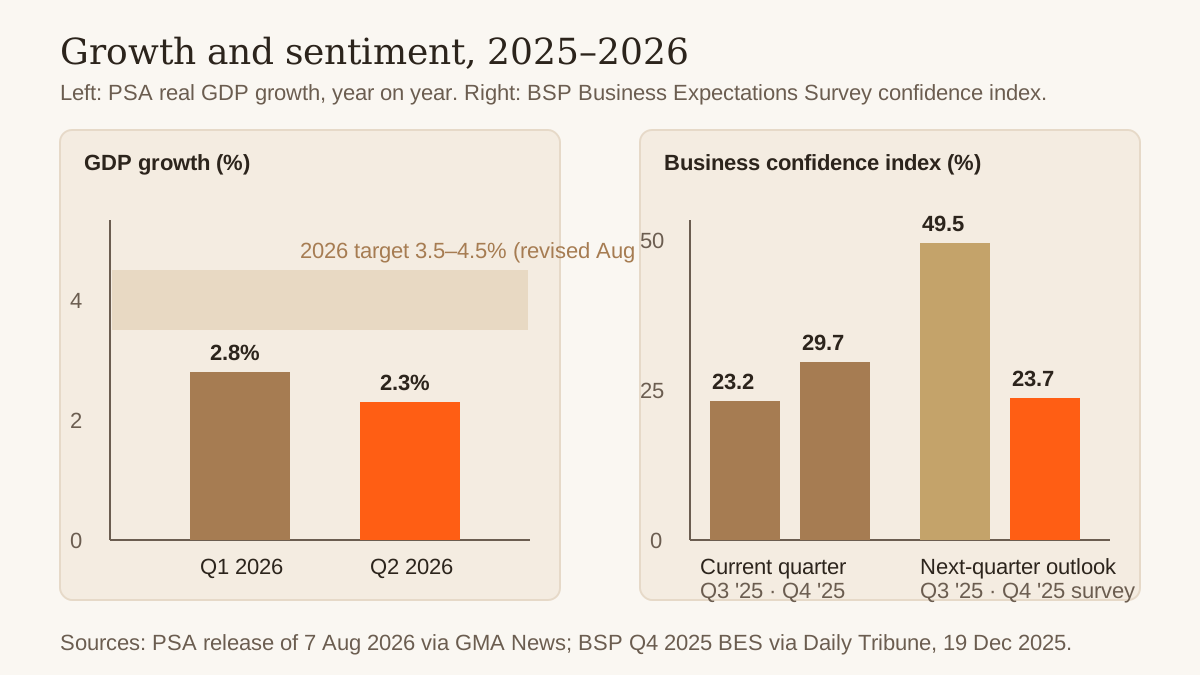
The macroeconomic data through the research date show a pronounced slowdown with two distinct causes that are difficult to separate. The first is external: energy and food price shocks linked to the Middle East conflict pushed headline inflation to 6.2 percent in July 2026, above the Bangko Sentral ng Pilipinas target band. The second is domestic: the pullback in public investment and the sentiment effects of the corruption controversy. The PSA reported GDP growth of 2.8 percent in the first quarter of 2026 and 2.3 percent in the second, the weakest reading since 2009 outside the pandemic, with Economy, Planning and Development Secretary Arsenio Balisacan revising the full-year target to 3.5–4.5 percent.
- 2.3%
Q2 2026 GDP growth (PSA, 7 Aug 2026) - -32.4%
Public construction, Q2 2026 year on year - BBB+ / stable
S&P rating; outlook cut from positive, 9 Apr 2026 - Baa2 / stable
Moody's affirmation, 25 Aug 2026 - 9 referrals, 65 persons
ICI output at wind-down, 13 Mar 2026 - 19-4-1
Senate vote to archive impeachment, 6 Aug 2025
Credit-rating agencies have so far separated governance headlines from sovereign credit quality. On 9 April 2026 S&P affirmed the Philippines at BBB+ but revised its outlook from positive to stable, citing global uncertainty rather than domestic politics, and praised the central bank's oversight and reserves of US$107.5 billion. In June 2026 the same agency cut its 2026 growth forecast to 4.1 percent from 5.8 percent, the steepest revision among the Asia-Pacific economies it covers, pointing to weak consumption and the infrastructure pullback. On 25 August 2026 Moody's affirmed its Baa2 rating with a stable outlook, expecting fiscal metrics to stabilise over two years while noting that confidence "may take time to recover" and linking slow public investment to the flood-control probe.
Sentiment surveys tell a similar story. The BSP's Business Expectations Survey for the fourth quarter of 2025 recorded a current-quarter confidence index of 29.7 percent, but the outlook index for the first quarter of 2026 fell to 23.7 percent from 49.5 percent, with the BSP citing natural disasters and the "negative impact of corruption allegations on investor and business sentiment", as reported in December 2025. PIDS senior research fellow John Paolo Rivera argued in January 2026 that good governance is "the most powerful macroeconomic stabilizer" and that the scandal had dented investor confidence. By mid-2026 the picture was mixed: the BSP's June 2026 survey showed the overall index recovering to roughly neutral from -25.2 percent in May, driven mainly by easing oil prices rather than by political developments.
8What this means for businesses operating or investing in the Philippines
Three themes stand out for boards, general counsel and foreign investors assessing the Philippines in late 2026.
Rule-of-law expectations
The period has tested, and in several respects demonstrated, the functioning of constitutional checks: a unanimous Supreme Court decision enforced against a political branch, a Senate that complied with it, a fact-finding commission whose output was handed to independent prosecutors, and charges filed against a sitting legislator and former Speaker. Critics argue the process has been slow and selective, and they point to the ICI's early closure and the resignations of two of its three commissioners. Supporters argue that fact-finding has properly given way to prosecution. Both positions are consistent with the same facts, and investors should weigh the eventual disposition of cases at the Sandiganbayan, not the volume of referrals, as the real test. Firms with government contracts should expect heightened scrutiny of past projects and should review document-retention and anti-bribery controls; our overview of the DOJ and Ombudsman prosecution strategy explains how such cases are built.
Procurement reform
The controversy has accelerated attention to procurement integrity, including the publication of project-level data, the role of legislators in budget insertions, and contractor accreditation. Businesses that supply the public sector should assume that bid documentation, beneficial-ownership disclosure and performance monitoring will be enforced more strictly, and that the New Government Procurement Act framework will be read conservatively by procuring entities wary of audit findings. We discuss the current rules in our article on public procurement transparency reforms in 2026.
Policy continuity
The investment-liberalisation statutes enacted in recent years remain in force and have not been the subject of reversal proposals in the 20th Congress. The economic team has been largely stable, the central bank retains credibility with rating agencies, and the fiscal consolidation path has been maintained even as growth undershot. The principal continuity risk is not a change of direction but a loss of momentum: a Congress occupied with investigations and a fragmented Senate pass fewer economic measures, and public investment has been cut while controls are rebuilt. The outcome of the 2028 presidential election, and the positioning of candidates around the impeachment and flood-control issues, will shape investor expectations well before the vote.
- Map exposure to DPWH and other infrastructure procurement, including subcontracting chains and joint-venture partners.
- Refresh anti-corruption, gifts and third-party due-diligence policies against the standards now being applied in Ombudsman investigations.
- Stress-test 2026–2027 revenue assumptions for the 3.5–4.5 percent growth range rather than the 6 percent-plus consensus of early 2025.
- Monitor Sandiganbayan dockets and Supreme Court rulings on procurement-related matters rather than relying on hearing headlines.
- Build political-cycle scenarios into contracts: change-in-law clauses, payment security for government receivables and dispute-resolution forums.
Abanto Law Firm advises domestic and foreign companies on corporate structuring, regulatory compliance and disputes involving government counterparties. If your organisation needs an assessment of how these developments affect a transaction, a government contract or a compliance programme, you can review our corporate law practice or contact the firm to arrange a consultation.
9Frequently asked questions
Did the Supreme Court clear Vice President Sara Duterte of the impeachment charges?
No. The 25 July 2025 decision, affirmed with finality on 28 January 2026, held that the fourth complaint was unconstitutional because it breached the one-year bar in Article XI, Section 3(5) and the Vice President's right to due process. The Court said expressly that the ruling did not absolve her of the allegations, and that a new complaint could be filed from 6 February 2026. Whether any new complaint has since been filed should be checked against current House records.
What exactly was the Independent Commission for Infrastructure, and does it still exist?
The ICI was a presidential fact-finding body created by Executive Order No. 94 on 11 September 2025 and chaired by retired Justice Andres Reyes Jr. It could subpoena witnesses and recommend cases, asset freezes and suspensions, but it could not file charges or convict. It announced nine referrals covering 65 persons and wound down on 31 March 2026, transferring its records to the Ombudsman and the Department of Justice, which now decide whether to prosecute.
Have any of the flood-control allegations resulted in convictions?
Not as of the research date. The Ombudsman has filed cases, including a plunder information against former Speaker Martin Romualdez at the Sandiganbayan on 7 September 2026 and malversation and graft charges against former Senator Ramon Revilla Jr. and six DPWH officials in January 2026. All respondents deny wrongdoing and are presumed innocent. Trial outcomes, not the filing of cases, will determine accountability.
Has the political turmoil affected the Philippines' credit rating?
Not directly. S&P affirmed BBB+ on 9 April 2026 but moved its outlook from positive to stable, citing Middle East-related global uncertainty, and in June 2026 cut its 2026 growth forecast to 4.1 percent. Moody's affirmed Baa2 with a stable outlook on 25 August 2026, noting that the flood-control probe had slowed public investment and that confidence may take time to recover. Both agencies continue to treat the central bank and external position as strengths.
What should a company with Philippine government contracts do now?
Review past DPWH and other infrastructure engagements for documentation gaps, refresh anti-bribery and third-party due-diligence policies, confirm that bid and performance records would withstand an Ombudsman or Commission on Audit review, and build change-in-law and payment-security clauses into new contracts. Specific exposure should be assessed with counsel; this article is general information, not legal advice.
Sources and references
- Comelec proclaims Senate winners — Philippine Daily Inquirer (2025-05-17)
- SC declares unconstitutional VP Sara's impeachment — Manila Bulletin (2025-07-25)
- Sara Duterte's impeachment archived: Senate 'adheres' to Supreme Court ruling — Philstar.com (2025-08-06)
- Supreme Court upholds 'unconstitutionality' of VP Sara impeachment — Philstar.com (2026-01-29)
- Romualdez tags Discayas' name-dropping as 'lies' — SunStar (2025-09-08)
- New infra commission armed with sweeping powers to probe corruption (EO 94) — PTV News (2025-09-12)
- ICI seeks closure after 9 referrals covering 65 people — Philstar.com (2026-03-13)
- Ombudsman files plunder raps vs Romualdez over flood control scam — DZRH (2026-09-07)
- PH economy grows slower at 2.3% in Q2 2026 — GMA News (2026-08-07)
- PH keeps 'BBB+' rating; outlook cut to stable amid Middle East risks — SunStar (2026-04-09)
- Moody's affirms PH Baa2 rating, stable outlook — GMA News (2026-08-25)
- 'Floodgate' fallout tempers Philippine business outlook (BSP Q4 2025 BES) — Daily Tribune (2025-12-19)
This article is for general informational purposes only and does not constitute legal advice. Laws, regulations, and regulatory requirements may change, and reading this article does not create an attorney-client relationship with Abanto Law Firm. Readers should consult qualified Philippine legal counsel regarding their specific circumstances.
Related insights
 Philippine Policy & RegulationFintech and Online Payments in the Philippines: What Changed for 2026
 Philippine Policy & RegulationHow 2026 Government Decisions and Pending Bills Affect Philippine Startups
 Philippine Policy & RegulationPhilippine Cybersecurity and Digital Governance Policy: 2026 Update

