
Technology & Digital Business
AI-Generated Content, Code and Designs: Where Philippine IP Law Stands
IPOPHL's revised registration rules and its September 2026 draft AI guidelines confirm a human-authorship test. Here is what that means for software, creative and brand assets built with AI.
1Why AI output is now an ownership question, not just a tooling question
Philippine software houses, design studios, marketing agencies and BPO teams now produce code, copy, images, logos and product designs with generative AI as a matter of routine. The business assumption is usually simple: we paid for the tool, we typed the prompt, so the output is ours. Philippine intellectual property law does not work that way. Copyright under the Intellectual Property Code (Republic Act No. 8293) attaches to works created by a natural person, patents require a human inventor, and trademark rights depend on use and registration rather than on who or what drew the logo. Whether a company actually owns what its AI pipeline produces depends on how much human creative input went in, how that input is documented, and what the contracts say.
Two developments make this a live compliance topic as of the research date (29 October 2026). First, the Intellectual Property Office of the Philippines (IPOPHL) has put revised copyright registration rules into force and released, for public comment, draft Guidelines on the Registrability of AI Systems and AI-Related Works, with the comment period closing on 30 October 2026. Second, comparable regulators abroad, notably the United States Copyright Office and the US federal courts, have now settled on a human-authorship position that Philippine practitioners increasingly cite. This article explains where Philippine law stands on each category of AI output, what remains unsettled, and how a technology company can structure its work so that the assets it builds are actually defensible.
- RA 8293 defines an author as a natural person; fully machine-generated output has no human author and, under IPOPHL's current practice, is not registrable.
- IPOPHL's September 2026 draft guidelines would protect only the human-created portions of AI-assisted, AI-enhanced and hybrid works, assessed case by case; a bare prompt is not enough.
- AI cannot be named as an inventor under IPOPHL's patent examination guidelines, but AI-assisted inventions with a human inventor remain patentable if the usual tests are met.
- Trademark and industrial design registration do not depend on authorship, which makes them the most reliable protection for AI-made logos and product looks.
- Vendor terms that "assign" output rights cannot create copyright that Philippine law does not recognise; contracts, documentation and registration strategy fill the gap.
2The statutory baseline: human authorship under RA 8293
The Intellectual Property Code of the Philippines, Republic Act No. 8293 (1997, as amended, most significantly by RA 10372 in 2013), protects "original intellectual creations in the literary and artistic domain" from the moment of creation. Several provisions frame the AI question directly:
- Section 171.1 defines an "author" as "the natural person who has created the work". The Code nowhere contemplates a machine, a company or a software developer as author in the first instance.
- Section 172 lists protected works, including books and other writings, computer programs, drawings, photographs and audiovisual works. Protection requires originality, understood in Philippine doctrine as independent creation with a minimum of creativity.
- Section 175 excludes ideas, procedures, systems, methods of operation, concepts, principles, discoveries and "mere data as such" from protection. A prompt that describes an idea ("a minimalist logo of a carabao in gold") is, on its face, closer to an unprotected idea than to protected expression.
- Section 178 governs ownership. Works created by an employee in the course of regularly assigned duties belong to the employer absent contrary agreement (Section 178.3(b)); for commissioned works, the commissioning party owns the physical object but copyright stays with the creator unless there is a written stipulation to the contrary (Section 178.4).
The practical consequence is that there are two distinct questions for every AI-touched asset. Is there a human author at all, and if so, which portions of the work can be traced to that author's creative choices? Only once authorship exists does Section 178 and the parties' contracts decide who owns it. A company that commissions a freelancer to produce AI-assisted marketing art, with no written assignment, may find that it owns the files but not the copyright in the human-created elements, and that nobody owns the purely machine-generated remainder.
IPOPHL's registration practice has reflected the human-authorship rule for some time. In October 2024 the then Director General, Rowel Barba, told the Philippine International Copyright Summit that the office does not register works "made by machines" and requires applicants to disclose how much of a work was produced by AI, according to a Philippine Star report dated 22 October 2024. That practice has since been formalised. IPOPHL's Memorandum Circular No. 2026-007, the Revised Rules and Regulations on Copyright Registration and Copyright Related Services, is listed among the office's administrative issuances; practitioners at SyCip Salazar Hernandez & Gatmaitan, writing in Asia IP on 29 September 2026, report that the rules took effect on 20 March 2026, define the author as the natural person who created the work or any portion of it, and allow registration to be refused for lack of human authorship, originality or minimum creativity. The effective date should be confirmed against the circular itself before being relied on.
3IPOPHL's draft AI guidelines (September 2026): four categories of work
In September 2026 IPOPHL's Bureau of Copyright and Related Rights (BCRR) presented draft Guidelines on the Registrability of AI Systems and AI-Related Works at an initial public consultation, and then posted a call for written comments with a deadline of 30 October 2026. The draft had not been finalised as of the research date; MLex reported on 16 October 2026 that IPOPHL aims to issue the final guidelines by the end of 2026. Any description below is of a proposal, and its final text may differ.
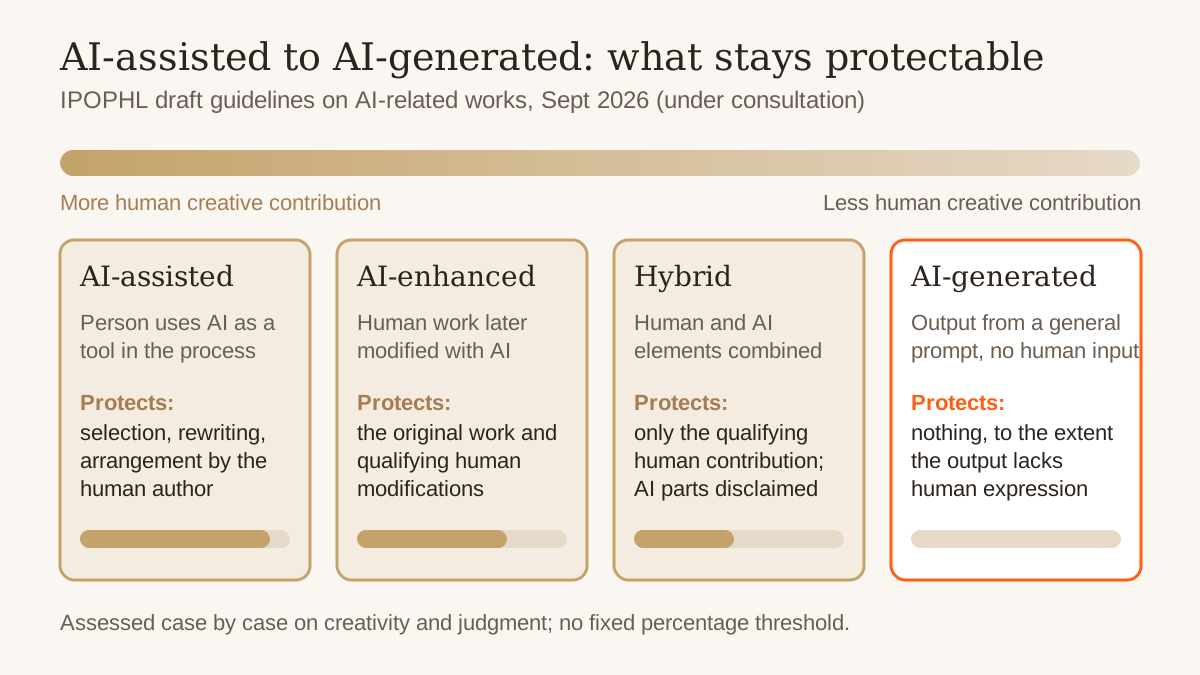
According to Newsbytes.PH (19 September 2026) and SunStar (20 September 2026), the draft's central rule is that using an AI system does not automatically bar registration, but protection extends only to the parts of a work that reflect a natural person's original creative contribution. IPOPHL would assess originality case by case, looking at independent creation, intellectual creativity and judgment, rather than applying a fixed percentage threshold. The draft sorts works into four categories:
| Category (draft) | What it covers | Scope of registrable protection |
|---|---|---|
| AI-assisted | A person uses AI as a tool within a creative process | The person's selection, rewriting and arrangement |
| AI-enhanced | A human-created work is later modified with AI | The original work plus qualifying human modifications |
| Hybrid | Human-made and AI-generated elements are combined | Only the qualifying human contribution |
| AI-generated output | Output from a general prompt without sufficient human input | Not registrable to the extent it lacks human expression |
Examiners would weigh the applicant's creative contribution, the role the AI system played, and how AI material was selected, altered, arranged or incorporated, and may request additional information. Two limits in the draft matter for software companies in particular. For an AI system submitted as a computer program, registration would cover only the copyrightable expression in the program as filed, not the training data, training materials or model outputs. And registration would not decide whether using copyrighted material to train a model is fair use or otherwise lawful; that question is left to the courts and to any future legislation.
"We want a framework that provides clarity without getting ahead of the technology."
— Emerson Cuyo, Director, IPOPHL Bureau of Copyright and Related Rights, as quoted by Newsbytes.PH, 19 September 2026
Director General Teodoro C. Pascua has stressed that the guidelines "do not regulate AI generally or make a definitive determination" on copyrightability; they are meant to tell applicants how the registry will treat their filings. Applicants would carry the burden of showing that a work contains original expression attributable to a human author. For companies, that translates into an evidence problem: prompt iterations, drafts, layer files, edit histories and designer instructions become the record that supports a claim of authorship.
4The comparison point: the US Copyright Office and Thaler
Philippine copyright doctrine has long borrowed from US law, and the US position on AI output is now relatively settled at the administrative level. On 29 January 2025 the US Copyright Office released Part 2 of its report Copyright and Artificial Intelligence, on copyrightability. Its conclusions track closely with IPOPHL's later draft: existing copyright principles are flexible enough to handle generative AI; outputs are protectable only where "a human author has determined sufficient expressive elements"; this can occur where a human-authored work is perceptible in the output or where a human makes creative arrangements or modifications of it; and the "mere provision of prompts" does not make the prompter an author. The Office also concluded that the case had not been made for legislation granting additional protection to AI-generated material.
The courts have agreed. In Thaler v. Perlmutter, the US Court of Appeals for the D.C. Circuit held in 2025 that a work whose sole listed author was an AI system could not be registered because US copyright requires a human author, and on 2 March 2026 the US Supreme Court declined to review that ruling, according to a Mayer Brown summary dated 11 March 2026. A separate Part 3 of the US report, on the use of copyrighted works to train generative models, was released in a pre-publication version in May 2025; its final status should be checked before it is cited as settled guidance.
US law does not govern here, but the two systems are converging on the same operative test, so documentation built for IPOPHL's draft categories will generally also support US filings.
- IPOPHL practice disclosed. Director General Barba states IPOPHL does not register machine-made works and requires disclosure of the AI share.
- US Copyright Office Part 2. Human authorship required; prompts alone insufficient; no new legislation recommended.
- Thaler certiorari denied. US Supreme Court leaves the D.C. Circuit's human-authorship ruling in place.
- IPOPHL MC 2026-007 in force (per practitioner reports). Revised copyright registration rules define author as a natural person.
- Draft AI registrability guidelines. BCRR presents the four-category framework at public consultation.
- Comment deadline. Written comments on the draft due to IPOPHL; final issuance targeted for end of 2026.
5Software and code: copyright, patents and the inventorship rule
For technology companies the most valuable AI output is often code. Three regimes interact.
Copyright in AI-generated code
Computer programs are protected literary works under Section 172 of RA 8293, but the same human-authorship rule applies. A function emitted in full by a coding assistant from a one-line instruction is, on the IPOPHL draft's logic, AI-generated output. A module where a developer specified the architecture, wrote and reorganised substantial portions, chose data structures and corrected the generated code is AI-assisted, and the developer's contribution is protectable. The difficulty is that commercial codebases blend the two at the line level. Version control history is therefore the natural evidence of human authorship, and companies should treat commit messages, pull-request reviews and design documents as IP records, not just engineering hygiene. Customer licences should describe title to AI-assisted code honestly, since copyright may not exist in every line.
Patents for AI-assisted inventions
Section 22.2 of RA 8293 excludes "programs for computers" as such from patent protection, but computer-implemented inventions with a technical contribution can be patented, and IPOPHL maintains dedicated examination guidelines for information and communications technology inventions and, separately, Examination Guidelines for inventions, utility models and industrial designs relating to artificial intelligence. Practitioners describe these AI guidelines as 2025 issuances under which AI cannot be named as an inventor; an AI-assisted invention may still be patented where a natural person is properly identified as inventor, the claimed subject matter makes a technical contribution, and novelty, inventive step and industrial applicability are established. The guidelines' exact issuance date and circular number are not stated on IPOPHL's guidelines page and should be confirmed from the document itself.
The practical issue is identifying the human inventor when a model proposed the solution. A team that merely ran an optimisation and accepted the result has a weak inventorship claim; a team that framed the technical problem, designed the experiment, selected among candidate outputs and recognised the inventive significance of one of them has a much stronger one. Invention disclosure forms should capture those steps contemporaneously.
Trade secrets as the fallback
Where neither copyright nor patent fits, secrecy often protects the real value: fine-tuning methods, evaluation datasets, system prompts and orchestration logic. The Philippines has no standalone trade-secrets statute; protection rests on contractual confidentiality, the Civil Code, provisions of the Revised Penal Code on revealing secrets, and the Supreme Court's recognition of trade secrets as privileged information (notably in Air Philippines Corp. v. Pennswell, Inc., 2007). That makes the enforceability of confidentiality clauses and access controls the practical ceiling of protection.
6Logos, brand assets and product designs made with AI
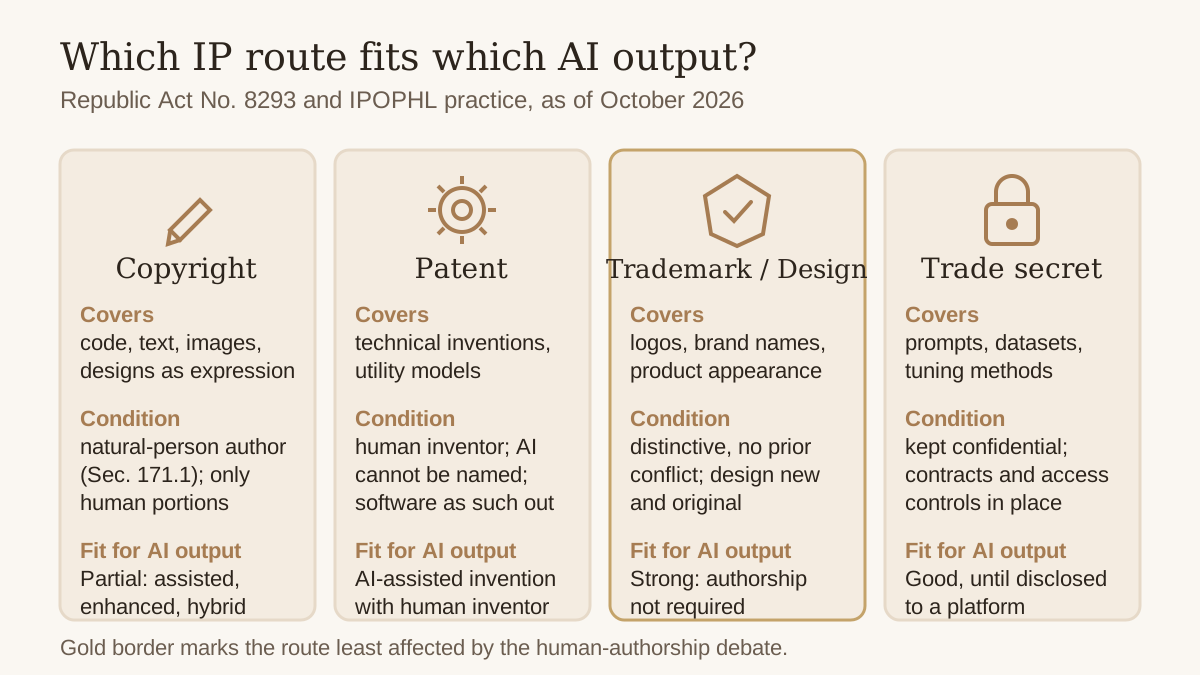
Marketing teams generate logos, mascots and packaging concepts with image models daily. Here the authorship debate matters less than many assume, because the Philippine system offers two registration routes that do not ask who created the design.
Trademarks. Section 121.1 of RA 8293 defines a mark as "any visible sign capable of distinguishing the goods or services of an enterprise". The test is distinctiveness and the absence of conflict with prior marks, not creative authorship. An AI-generated logo adopted and used as a brand identifier can be filed with IPOPHL's Bureau of Trademarks like any other, subject to availability searches and the usual grounds for refusal. Trademark protection also travels with the brand rather than with the artwork, so it survives even where the underlying image has no copyright owner. Companies that rely on AI for brand assets should budget for clearance searches and watch services, since the same models tend to produce similar outputs for similar prompts across different users, raising the risk of confusingly similar marks and opposition proceedings before IPOPHL.
Industrial designs. Product shapes, patterns and ornamentation may be registrable as industrial designs if new or original and industrially applicable. IPOPHL's AI-related examination guidelines expressly cover industrial design applications alongside inventions and utility models, so AI-generated product looks can be considered for registration with a human applicant and, where the law requires it, a named human designer.
The residual risk for AI-made brand assets is infringement in the other direction: an image model may reproduce protected elements of a third party's logo or character, and a company cannot defend an infringing mark by pointing to the tool that drew it. Documented human review before adoption is the control that addresses this.
7Training data, fair use and prompts: the unsettled ground
The question most often asked by Philippine AI developers is whether they may train or fine-tune models on copyrighted text, images or code. Philippine law provides no clear answer as of the research date. Section 185 of RA 8293 codifies fair use for "criticism, comment, news reporting, teaching... scholarship, research, and similar purposes" and adopts the four familiar factors: purpose and character of the use (including whether it is commercial), nature of the work, amount and substantiality used, and effect on the potential market. RA 10372 added that decompilation of a lawfully obtained program to achieve interoperability may also be fair use. Nothing in the Code addresses text-and-data mining, and no Philippine court has ruled on model training.
IPOPHL's draft guidelines deliberately leave the training question outside the registration process. US litigation on the point continues, and the US Copyright Office's pre-publication Part 3 report of May 2025 took the position that training on copyrighted works is not categorically fair use and depends on the facts, including market substitution. Philippine courts asked to apply Section 185 would likely weigh the same four factors, and a commercial developer whose model outputs compete with the ingested works would face the hardest case. Until legislation or jurisprudence clarifies the position, licensed datasets, documented provenance and opt-out mechanisms are the defensible path, and the data-protection overlay should not be forgotten: training on personal data engages the Data Privacy Act of 2012 regardless of copyright, and the National Privacy Commission has, according to practitioner reports, issued a notice on AI-generated images of identifiable people created without consent.
Prompts themselves are a mixed case. A short instruction is an idea excluded by Section 175. A lengthy, carefully structured system prompt may contain enough original expression to be a literary work, but its chief commercial value is usually secrecy rather than exclusivity, and once it is disclosed to a third-party platform its confidentiality depends entirely on that platform's terms. Companies should classify prompt libraries as confidential information in employee and vendor agreements, and should check what each AI provider's terms say about using customer inputs to improve its models.
Legislation remains at an early stage. Several AI bills were pending in the 20th Congress as of May 2026, including Senate Bill No. 852 (Artificial Intelligence Regulation Act) and House Bill No. 7627 (National Artificial Intelligence Code), as catalogued by the Foundation for Media Alternatives on 28 May 2026; these focus on governance, deepfakes and liability rather than on IP ownership of AI output. Separately, IPOPHL's Director General told Asia IP in June 2026 that the office is studying how the IP Code might be amended for new technologies, but no AI-specific IP amendment had passed either chamber as of the research date. Deepfake-related liability is addressed in our note on criminal and civil liability for deepfake defamation.
8Contracts, platform terms and a practical IP strategy for Philippine tech companies
Because the statute will not hand a company ownership of machine output, contracts and process have to do the work. Three contract layers matter.
Platform terms. Most generative AI providers' terms state that, as between the provider and the customer, the customer owns or is assigned the output. That clause allocates whatever rights the provider may have; it cannot create a Philippine copyright in material that has no human author, and it rarely warrants that the output is free of third-party rights. Enterprise agreements should be reviewed for indemnities, restrictions on training on customer data, and confidentiality of inputs, and the review should be refreshed when the provider changes its terms.
Employment and contractor agreements. Section 178.3 vests copyright in the employer only for works produced in regularly assigned duties, and Section 178.4 leaves copyright in commissioned works with the creator unless there is a written stipulation otherwise. Every developer, designer and agency contract should therefore contain an express present assignment of copyright in human-created portions, modifications and derivatives, a waiver or non-assertion of moral rights to the extent the law allows, an obligation to document AI use, and warranties about the provenance of inputs. Founders should also address AI-assisted contributions in their shareholder and founder IP assignment arrangements, since investors' diligence increasingly asks the question.
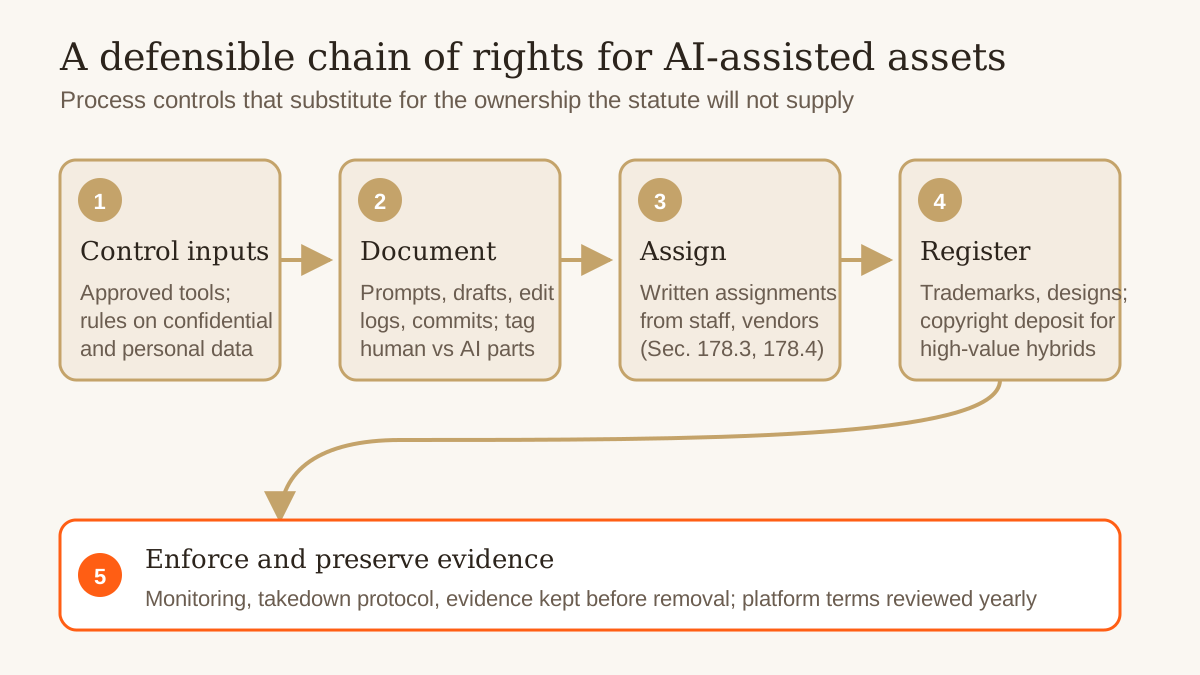
- Approve a list of permitted AI tools and define what confidential or personal data may be entered into each.
- Require staff to keep prompt histories, drafts and edit logs for assets intended for registration or licensing.
- Record, for each significant asset, which elements were human-created, AI-generated or hybrid, following IPOPHL's draft categories.
- Insert present assignments and AI-disclosure duties into employment, freelancer and agency contracts.
- Register key brand elements as trademarks and consider industrial design filings for AI-generated product looks.
- Decide deliberately whether to seek IPOPHL copyright registration for high-value hybrid works, and prepare the authorship evidence before filing.
- Review platform terms for indemnity, training-use and confidentiality provisions at least annually.
- Build a takedown and evidence-preservation protocol for AI-generated imitations of your own assets.
Philippine law on AI-generated content is at an inflection point: the registration rules are in force, the AI guidelines are weeks from finalisation, and the training-data question is open. Companies that document human contribution now will be positioned for whichever final text IPOPHL adopts. Abanto Law Firm's intellectual property practice advises technology companies, studios and agencies on copyright registration strategy, trademark clearance and filing, AI vendor and contractor agreements and IPOPHL proceedings, alongside our corporate law team for founder and investor IP arrangements. To discuss how these rules apply to your pipeline, contact the firm.
9Frequently asked questions
Can I copyright an image I generated with an AI tool in the Philippines?
Not on the strength of the prompt alone. Under RA 8293 the author must be a natural person, and IPOPHL's current registration practice and its September 2026 draft guidelines treat output produced from a general prompt without further human creative input as unregistrable. If you then select, edit, combine or arrange the output in a way that reflects your own creative judgment, the human-created portions can be protected and registered, with the AI-generated remainder disclaimed. Keep the drafts and edit history as evidence.
Does my company own the code our developers write with AI coding assistants?
The human-authored portions written by employees in their regularly assigned duties belong to the employer under Section 178.3(b) of RA 8293, unless agreed otherwise. Portions generated wholly by the assistant have no human author and may not be protected at all. Because the two are mixed in practice, companies should keep version control records that show developer contribution, include express copyright assignments and AI-disclosure duties in employment and contractor agreements, and draft customer licences with this layered ownership in mind.
Can an AI system be named as inventor on a Philippine patent application?
No. IPOPHL's examination guidelines on AI-related inventions, as described by practitioners, do not permit an AI system to be named as inventor. An AI-assisted invention can still be patented if a natural person is properly identified as inventor and the invention makes a technical contribution and meets novelty, inventive step and industrial applicability. Contemporaneous records of who framed the problem, designed the experiments and recognised the inventive result are the key evidence of human inventorship.
Is it legal to train an AI model on copyrighted Philippine content?
Philippine law does not yet give a clear answer. There is no text-and-data-mining exception in RA 8293, no court has ruled on model training, and IPOPHL's draft guidelines expressly leave the question outside the registration process. Any defence would rest on the four fair use factors in Section 185, and commercial training that produces competing outputs would face the hardest case. Licensed datasets, documented provenance and compliance with the Data Privacy Act are the defensible approach until legislation or jurisprudence clarifies the position.
Can I trademark a logo that was generated by AI?
Generally yes. Trademark registration under RA 8293 depends on whether the sign is distinctive and does not conflict with prior marks, not on who or what created the artwork. An AI-generated logo adopted as a brand identifier can be filed with IPOPHL like any other mark, after a clearance search. Trademark protection is often the most reliable route for AI-made brand assets precisely because it does not depend on copyright authorship.
What is the status of IPOPHL's AI copyright guidelines?
As of 29 October 2026 the Guidelines on the Registrability of AI Systems and AI-Related Works were a draft under public consultation, with written comments due on 30 October 2026 and final issuance targeted by IPOPHL for the end of 2026. The revised copyright registration rules (Memorandum Circular No. 2026-007) are already in force. Businesses should check IPOPHL's issuances page for the final AI guidelines before relying on the draft's categories.
Sources and references
- Republic Act No. 8293, Intellectual Property Code of the Philippines (full text) — The LawPhil Project (Arellano Law Foundation) (1997-06-06)
- Invitation to Public Consultation: Call for Comments on the Draft Guidelines on the Registrability of AI Systems and AI-Related Works — Intellectual Property Office of the Philippines
- Administrative Issuances, including Memorandum Circular No. 2026-007 (Revised Rules and Regulations on Copyright Registration and Copyright Related Services) — Intellectual Property Office of the Philippines
- Patent Examination Guidelines, including Examination Guidelines of Inventions, Utility Model and Industrial Design Applications Relating to Artificial Intelligence — Intellectual Property Office of the Philippines
- IPOPHL: AI-generated works need human contribution to qualify for copyright — Newsbytes.PH (2026-09-19)
- AI works face new copyright rules — SunStar Cebu (2026-09-20)
- Philippines' IP office clarifies copyright rules for AI-assisted works — MLex (2026-10-16)
- Government tightening AI use in creative works — The Philippine Star (2024-10-22)
- Copyright Office Releases Part 2 of Artificial Intelligence Report (NewsNet Issue 1060) — United States Copyright Office (2025-01-29)
- Supreme Court Denies Review in AI Authorship Case (Thaler v. Perlmutter) — Mayer Brown (2026-03-11)
- Protecting AI-enabled assets in the Philippines: A practical IP strategy — Asia IP (SyCip Salazar Hernandez & Gatmaitan) (2026-09-29)
- Regulating Risk: The 20th Congress of the Philippines Response to Artificial Intelligence — Foundation for Media Alternatives (2026-05-28)
This article is for general informational purposes only and does not constitute legal advice. Laws, regulations, and regulatory requirements may change, and reading this article does not create an attorney-client relationship with Abanto Law Firm. Readers should consult qualified Philippine legal counsel regarding their specific circumstances.
Related insights
 Technology & Digital BusinessApp Store and Google Play Policy Changes 2025–2026: A Philippine Guide
 Technology & Digital BusinessData Privacy and Cybersecurity Rules for Mobile Apps in the Philippines
 Technology & Digital BusinessHow AI Is Changing App Development, Testing and Automation: A Legal View

