
Technology & Digital Business
App Store and Google Play Policy Changes 2025–2026: A Philippine Guide
Apple and Google rewrote fees, review rules, identity checks and age-assurance duties in 2025–2026. Here is what applies in the Philippines, what is EU- or US-only, and what to fix in your contracts.

1Why the 2025–2026 platform changes matter in the Philippines
Between early 2025 and October 2026, Apple and Google rewrote large parts of the rulebook that governs how mobile apps are distributed, monetised and reviewed. Some of those changes were forced by courts and regulators in the United States and the European Union. Others were policy decisions the platforms made on their own and rolled out worldwide. For a Philippine studio, fintech, media publisher or outsourcing firm that ships apps for clients, the practical difficulty is separating the three: what applies only in the EU, what applies only on the US storefront, and what now applies to every developer account regardless of where the company is incorporated.
This article walks through the verified changes as of 29 October 2026, explains which of them bind Philippine developers directly, and ends with a compliance checklist and the contract clauses that publishers, white-label vendors and client-facing agencies should revisit. It is written for business owners and in-house teams; it is not a substitute for advice on a specific app, and platform policies change often enough that each item should be re-checked against the live developer pages before a release decision is made.
- Apple's reduced EU commissions and the US "zero-fee link-out" litigation do not change the standard 30 per cent (15 per cent for Small Business Program members) commission on the Philippine storefront.
- Google's Android developer verification applies to every developer whose app installs on certified Android devices; it took effect in four pilot countries on 30 September 2026 and Google says it expands globally in 2027, which will include the Philippines.
- Google Play's October 2025 Age-Restricted Content policy now requires apps with dating, matchmaking or real-money gambling features to block minors using Play Console tools, worldwide.
- Google Play's Personal Loans policy names the Philippine SEC: lending apps must hold SEC registration and a Certificate of Authority and display both numbers in the listing.
- Apple's App Review Guidelines were revised in June 2026 and again on 16 October 2026; developers of user-generated-content and template apps face stricter removal language.
2Apple's commission structure: three regimes, one of which applies here
The baseline that still governs the Philippine storefront
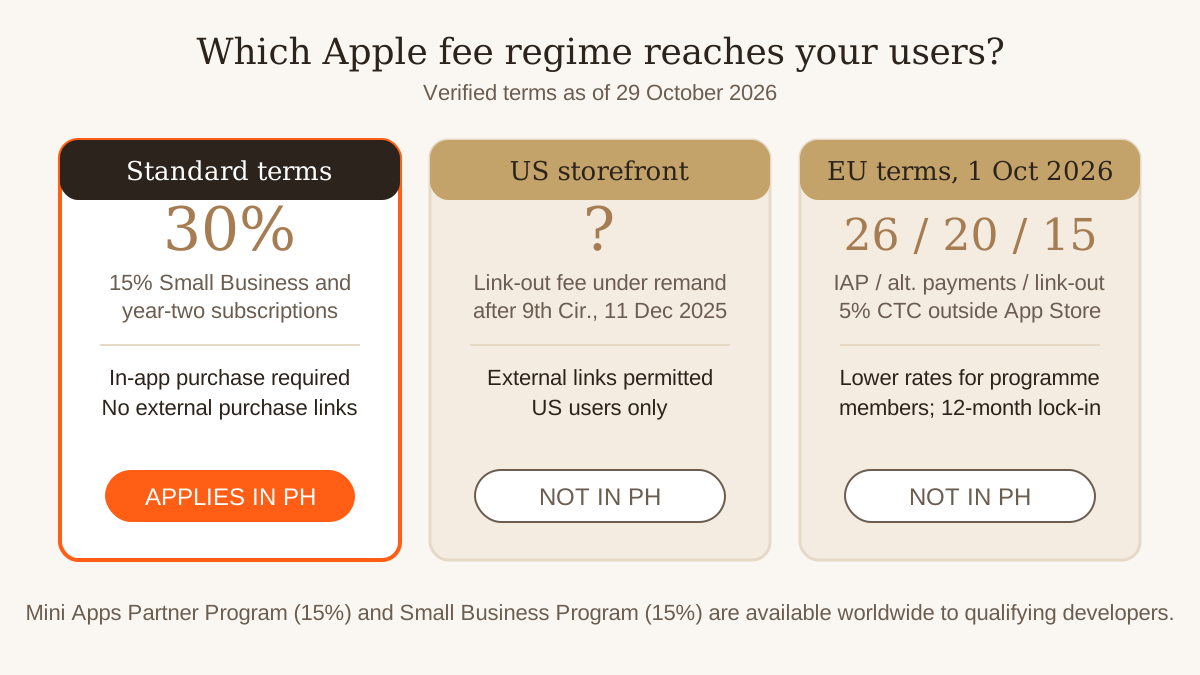
Apple's standard business terms remain a 30 per cent commission on paid apps and in-app purchases of digital goods, falling to 15 per cent for developers in the App Store Small Business Program (roughly those earning under US$1 million a year) and for auto-renewing subscriptions after the first year. Nothing announced in 2025 or 2026 alters those headline figures for apps sold on the Philippine storefront. Guideline 3.1.1 of the App Review Guidelines still requires in-app purchase for unlocking digital content and, outside the United States storefront, still prohibits "buttons, external links, or other calls to action that direct customers to purchasing mechanisms other than in-app purchase".
The United States: Epic v. Apple and the link-out fee
The most-reported development is the contempt ruling in Epic Games v. Apple. On 30 April 2025 the US District Court for the Northern District of California found that Apple had wilfully violated the 2021 anti-steering injunction and barred it from collecting any commission on purchases made through external links in US apps. Apple then amended guideline 3.1.1(a) and 3.1.3 so that apps on the US storefront may include external purchase links without an entitlement. On 11 December 2025 the Ninth Circuit largely affirmed the contempt finding but reversed the total fee ban, holding that Apple's earlier 27 per cent link-out commission was "prohibitive" while sending the case back to the district court to set a non-prohibitive rate. Apple sought a stay pending a petition to the Supreme Court; on 28 April 2026 the Ninth Circuit reversed that stay, so proceedings on the permissible commission continue before Judge Gonzalez Rogers. As of the research date the final US link-out fee has not been fixed.
For a Philippine developer the US regime matters only to the extent the app is distributed on the US storefront. A Manila-based publisher can, in principle, add external purchase links to its US build, but the same build must not show those links to Philippine users, and the eventual commission Apple is permitted to charge remains uncertain. Any revenue model that assumes a zero-fee US link-out should be treated as provisional.
The European Union: new single business terms from 1 October 2026
On 18 August 2026 Apple announced revised EU business terms, developed, in Apple's words, after "close collaboration" with the European Commission, and effective 1 October 2026. The per-install Core Technology Fee is replaced by a 5 per cent Core Technology Commission on digital transactions in apps distributed outside the App Store; the Initial Acquisition Fee and Store Services Fee are eliminated; App Store apps using Apple In-App Purchase pay 26 per cent (15 per cent for Small Business, Mini Apps Partner and Video Partner Program members, and for subscriptions after year one); apps using alternative payment processing pay 20 per cent (10 per cent for programme members); and apps that link out to a website pay 15 per cent (10 per cent for programme members). Developers must keep their chosen payment option for 12 months, and every alternatively distributed app still goes through Notarization. Apple's developer announcement of the same date directs members to accept the updated Developer Program License Agreement.
These terms apply to apps distributed to EU users. A Philippine developer with EU customers can opt in, but the lower rates have no effect on sales in Southeast Asia. Epic Games publicly called the new EU structure "junk fees", a characterisation Apple disputes; the Commission has indicated it accepts the changes.
Programme-based reductions that do apply globally
Two Apple programmes are worth noting because they are not region-locked. The Small Business Program continues to offer 15 per cent to qualifying developers everywhere. On 13 November 2025 Apple launched the Mini Apps Partner Program, which gives a 15 per cent commission on qualifying in-app purchases to host apps that run third-party mini apps and mini games built with web technologies, provided the host adopts the Declared Age Range API and the Advanced Commerce API and the mini apps are not controlled by the host developer. Philippine super-app and e-wallet operators that embed third-party HTML5 games fit this profile and should assess eligibility.
| Regime | Who it covers | Headline terms (as of 29 Oct 2026) | Applies to PH storefront? |
|---|---|---|---|
| Standard App Store terms | All storefronts outside EU/US carve-outs | 30% / 15% (Small Business, year-two subscriptions); IAP mandatory; no external purchase links | Yes |
| US storefront after Epic | Apps distributed to US users | External links permitted; commission on link-out purchases under remand | No |
| EU business terms (1 Oct 2026) | Apps distributed to EU users | 26% IAP / 20% alt. payments / 15% link-out / 5% CTC outside App Store; lower rates for programme members | No |
| Mini Apps Partner Program (13 Nov 2025) | Host apps worldwide that qualify | 15% on qualifying IAP; Declared Age Range and Advanced Commerce APIs required | Yes, if eligible |
3App Review Guidelines: what changed in 2025–2026
Apple revises the App Review Guidelines several times a year and the live page as of the research date shows a "Last Updated" stamp of 16 October 2026. Three substantive revisions in the period deserve attention from Philippine developers because they bear on common local business models: template and white-label apps, community and marketplace apps, and apps with gaming elements.
Spam and look-alike apps (guideline 4.3(b)). In the week of 9 June 2026 Apple tightened its spam rule. The guideline now reads: "Don't submit apps that are indistinguishable from what's already widely available." Dating, flashlight, sound-effect, wallpaper, simple timer and fortune-telling apps are named as saturated categories where new submissions will be refused unless they offer "a meaningfully different or improved experience", and Apple reserves the right to remove existing apps in those categories that are not updated or attracting customers. Agencies that ship near-identical builds for multiple clients should expect more rejections and should document the differentiating features of each build before submission.
User-generated content (guideline 1.2). The same revision made developers explicitly responsible for removing content that violates the guidelines, their own terms of service or community standards. If Apple finds violating content it will ask for removal and for a written plan to improve compliance; apps may be pulled until improvement is shown and egregious or repeated violations can lead to removal from the Developer Program. For Philippine community, livestreaming and marketplace apps this converts moderation from a best-practice into a condition of distribution, and it should be reflected in content-moderation staffing and in the service-level terms agreed with moderation vendors.
Live Activities (guideline 4.5.3). Developers may not use Live Activities to spam, phish or send unsolicited messages.
Two long-standing rules remain central for the gaming sector. Guideline 5.3.4 requires that apps offering real-money gaming or lotteries "have necessary licensing and permissions in the locations where the app is used, must be geo-restricted to those locations, and must be free on the App Store", and guideline 5.3.3 bars the use of in-app purchase to buy credit for real-money gaming. Guideline 5.6.2 on developer identity requires that representations about the business be "truthful, relevant, and up-to-date". Together these mean a PAGCOR-licensed operator cannot rely on a reseller's or agency's developer account to publish its app; the account holder, the licence holder and the entity named in the listing should match. The firm's note on when online game platforms that are not casinos still trigger licensing covers the borderline cases.
4Google's Android developer verification: a global identity requirement
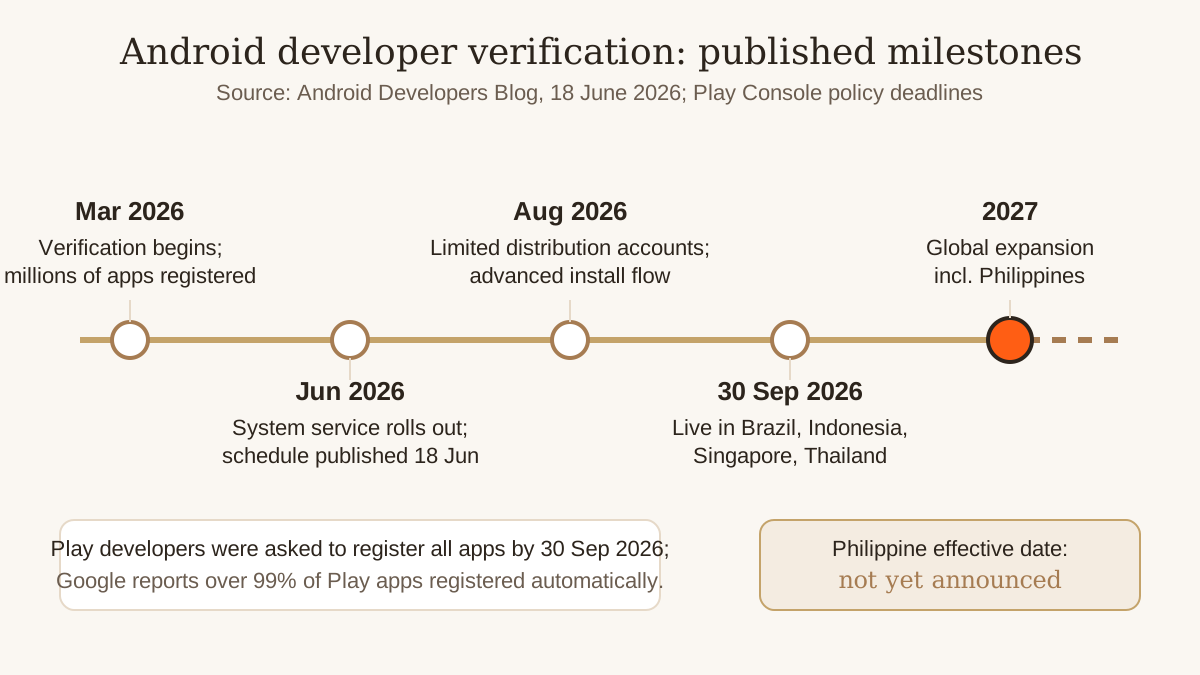
The single most consequential Google change for Philippine developers is not a Play Store policy at all but an Android platform requirement. Google is requiring that every app installed on a certified Android device be registered by a verified developer, whether the app is distributed through Google Play, a manufacturer store or sideloaded. The programme was announced in 2025, began verification in March 2026 and was given a detailed schedule in an 18 June 2026 Android Developers Blog post by Matthew Forsythe, Google's Director of Product Management for Android App Safety.
- Schedule published. A new Android system service begins rolling out to most devices; it will later check developer registration.
- Play Console deadline notice. Google's policy deadlines page tells Play developers to register any remaining apps by 30 September 2026 to avoid removal; Google states that over 99 per cent of Play apps were registered automatically.
- Limited distribution accounts and Console API launch globally. Students and hobbyists may share apps with up to 20 devices without a government ID or fee. An "advanced flow" for installing apps from unverified developers also launches.
- Verification takes effect in Brazil, Indonesia, Singapore and Thailand, starting with Google Play, Samsung Galaxy Store, Xiaomi GetApps, HONOR App Market, OPPO App Market, vivo V-Appstore and Transsion Palm Store.
- Global expansion. Google states the requirement "expands globally" in 2027; a specific Philippine date had not been published as of the research date.
In practice this means three things for a Philippine company. First, the legal entity behind each app must be verifiable: Play Console organisation accounts already require a D-U-N-S number and corporate details, and Google's July 2024 policy requires financial-services, health, VPN and government developers to register as organisations rather than individuals. Second, apps distributed outside Play, including enterprise apps pushed to field staff, loyalty apps distributed by QR code and test builds sent to clients, will need registration through the Android Developer Console once the requirement reaches the Philippines. Third, the "advanced flow" for unverified apps is designed to be deliberate and slow; it is not a viable distribution channel for a commercial product.
Google's own announcement frames the measure as a response to malware and "coercion scams", and it has drawn criticism from open-source and alternative-store advocates. Whatever one's view, the practical consequence is that developer identity is now a compliance artefact on both platforms. Companies that publish on behalf of clients should decide, and document in the engagement contract, whose entity will be the registered developer and who bears responsibility if that entity's verification lapses.
5Google Play policy updates with direct Philippine effect
Google publishes its policy changes on a running announcements page with a compliance window of at least 30 days. The entries from 2025 and 2026 that reach Philippine developers are set out below.
Age-restricted content and the Age Signals API
The 30 October 2025 announcement introduced a new Age-Restricted Content and Functionality policy: apps with matchmaking, dating, or real-money gambling, games or contests features must use Play Console tools to block minors. On 19 November 2025 Google added that from 1 January 2026 data from the Play Age Signals API may be used only to deliver age-appropriate experiences within the app that receives it. On 15 July 2026 the policy was extended to anonymous and random chat apps, which are also barred from targeting children under the Families policy. These rules are not confined to any country.
Personal loans: the Philippine SEC written into platform policy
Google's Personal Loans policy contains a Philippine-specific requirement. Financing and lending companies offering loans through online lending platforms must hold Securities and Exchange Commission registration and a Certificate of Authority, and the app description must display the corporate name, business name, SEC registration number and CA number. Lending-based crowdfunding must run through SEC-registered crowdfunding intermediaries. The general rules also apply: a Finance category, disclosure of minimum and maximum repayment periods, maximum APR and a representative total-cost example, a privacy policy, and a prohibition on loans requiring full repayment within 60 days. Since 30 October 2025 every app on an account must complete the Financial Features Declaration before updates can be published. The policy was expanded to line-of-credit apps on 10 April 2025, and the Thailand disclosure rules added on 28 January 2026 show how quickly country-specific overlays are introduced; Philippine lenders should expect further tightening rather than relaxation.
Real-money gambling
Google Play permits licensed real-money gambling apps only in countries it has approved through its gambling application process. The developer must hold a valid licence for the specific product in each country, geo-block unlicensed territories, age-gate, rate the app Adult Only, make it free to download without Play Billing, and display responsible-gambling information. The policy page does not publish the eligible country list, so whether a PAGCOR-licensed operator can distribute a native Android app through Play in the Philippines must be confirmed through the application itself. For context on the Philippine licensing side, see the firm's gaming licence practice page.
Permissions, account transfers and the US external-links programme
The 15 April 2026 update introduced a Contacts Permissions policy requiring apps without a genuine need for broad contacts access to use the Android Contact Picker, and an Account Transfer policy requiring the official ownership-transfer process for moving apps between accounts, a point that matters when an agency hands an app over to a client. On 9 December 2025 Google announced US-only changes to its Payments policy, expanding alternative billing and launching an external content links programme for developers serving US users, with a compliance deadline of 28 January 2026. Like Apple's US regime, these are storefront-specific and do not alter Play Billing requirements for Philippine users.
- 30 Oct 2025
Age-Restricted Content policy and mandatory Financial Features Declaration - 1 Jan 2026
Age Signals API data limited to in-app age-appropriate experiences - 15 Apr 2026
Contacts Permissions and Account Transfer policies - 30 Sep 2026
Play app registration deadline; verification live in four pilot countries
6Age assurance: US state laws with extraterritorial reach through the platforms
Age assurance is the area where a Philippine developer is most likely to be bound by a foreign statute it has never read. Texas's App Store Accountability Act (SB 2420), signed in May 2025, required app stores to verify age and obtain parental consent for minors from 1 January 2026. Apple announced on 8 October 2025 that Texas users would have to confirm they are 18 or older when creating an Apple Account, that under-18 accounts must join a Family Sharing group, that parents must consent to downloads and in-app transactions, and that the Declared Age Range API would supply the statutory age categories to developers. Utah, Louisiana and California have enacted comparable laws, and a practitioner analysis notes that Google's counterpart is the Play Age Signals API, with "significant change" flags and consent-revocation reports in Play Console. Litigation over the Texas law was pending as of late 2025 and its enforcement status should be confirmed before relying on it.
The statutes bind app stores and, in some respects, developers whose apps are offered to users in those states. The platforms have implemented them by building APIs that any developer can call and by requiring their use in specific programmes, such as Apple's Mini Apps Partner Program. A Philippine developer with no US users is not directly affected, but one that distributes to the US storefront must handle the age category and consent signals the platforms deliver, restrict access when consent is revoked, and prompt for renewed consent on significant changes to the app.
In the Philippines there is no equivalent app-store age-verification statute as of the research date. Age-related obligations arise instead from the Data Privacy Act of 2012 (RA 10173) and National Privacy Commission guidance on processing children's data, from the Special Protection of Children Against Abuse, Exploitation and Discrimination Act and the Anti-OSAEC law (RA 11930) for content and platform duties, and from PAGCOR rules that prohibit gambling by persons under 21. Legislative proposals to regulate minors' social-media use have been filed in the 20th Congress, but none had become law as of the research date; their status should be checked with the Senate and House bill trackers.
7The Philippine legal overlay
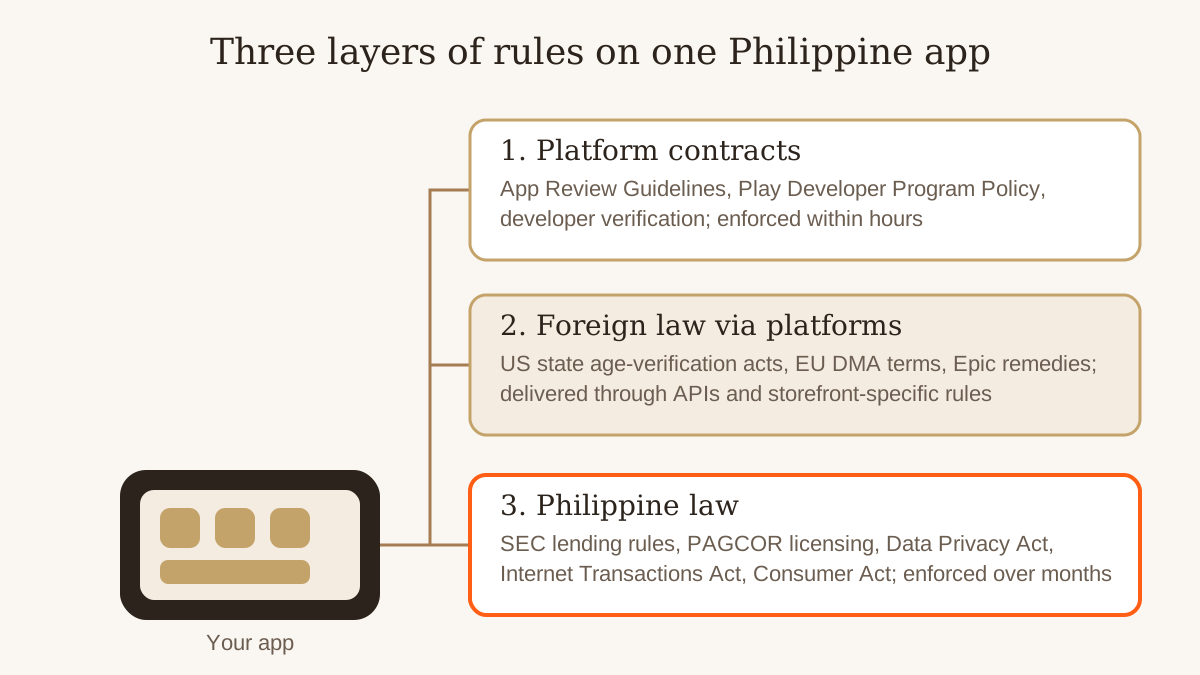
Platform policies are contractual. Behind them sits Philippine law, and the two interact in ways that are easy to miss. Four areas stand out.
Lending and financial apps. The SEC has regulated online lending platforms since Memorandum Circular No. 19, Series of 2019, which requires registration of each platform and prohibits operating an unregistered one; Google's Personal Loans policy now effectively makes that registration a Play Store listing requirement. The Financial Products and Services Consumer Protection Act (RA 11765, 2022) adds disclosure and fair-treatment duties enforced by the SEC and the Bangko Sentral ng Pilipinas. A lending app that passes Google's review has not thereby satisfied the SEC; the two reviews are independent and the SEC has in past years ordered delisting of apps and revoked certificates of authority for abusive collection practices.
Gaming. PAGCOR licensing, not platform approval, determines whether a real-money gaming app may be offered to Philippine players, and both Apple guideline 5.3.4 and Google's gambling policy make the licence a precondition of distribution. Operators should also note that in 2025 members of the 20th Congress filed bills seeking to ban or sharply restrict online gambling and e-wallet access to gaming sites; as of the research date none had been enacted, and their status should be verified before any licensing or product decision. The firm's article on the 2024–2026 policy shift from POGOs to Internet Gaming Licences tracks that debate.
Data privacy. Both platforms require a privacy policy, in-app account deletion (Apple guideline 5.1.1(v)) and declared data-safety labels. Under RA 10173 and NPC issuances, Philippine controllers must also register their data processing systems where thresholds are met, appoint a data protection officer and notify breaches within 72 hours. The firm's DPO checklist on breach notification covers the latter. Age-signal data received through the Apple or Google APIs is personal information of a minor and should be mapped in the privacy impact assessment.
Consumer and e-commerce law. The Internet Transactions Act of 2023 (RA 11967) created the E-Commerce Bureau within the DTI and imposes duties on online merchants and platforms dealing with Philippine consumers; implementing rules were issued in 2024. Subscription disclosures, refund handling and dark-pattern restrictions in platform policy should be read alongside those duties and the Consumer Act (RA 7394).
8Compliance checklist and contract implications
The following checklist consolidates the verified requirements above into actions a Philippine development team or publisher can take now.
- Confirm which legal entity holds each Apple and Google developer account, that it matches the entity named in the listing and in any licence, and that corporate details and D-U-N-S records are current ahead of Android developer verification reaching the Philippines in 2027.
- Register every Android app, including enterprise, test and client builds distributed outside Play, in Play Console or the Android Developer Console; check the Play Console Home page for unregistered packages.
- Model revenue on the standard App Store and Play Billing terms for Philippine users; treat US link-out and EU alternative-payment savings as storefront-specific and, in the US case, still unsettled.
- If the app hosts third-party mini apps or games, assess eligibility for Apple's Mini Apps Partner Program and budget for Declared Age Range and Advanced Commerce API integration.
- If the app has dating, matchmaking, gambling-style or anonymous-chat features, implement the Play Console minor-blocking tools and the Age Signals API, and set an Adult Only or equivalent rating where required.
- For lending apps, display SEC registration and Certificate of Authority numbers in the Play listing, complete the Financial Features Declaration for every app on the account, and align APR and term disclosures with both Google's policy and RA 11765.
- For user-generated content, document a moderation and takedown procedure that satisfies Apple's revised guideline 1.2 and keep evidence of enforcement.
- Review template or white-label portfolios against Apple's June 2026 guideline 4.3(b) and record the differentiating features of each build.
- Re-read the App Review Guidelines revision dated 16 October 2026 and the Play policy deadlines page before every major release.
Contract clauses to revisit
Platform changes of this scale should flow into the paper. Development and publishing agreements should state who owns the developer account and who is responsible for verification, with a cooperation duty and a defined process for transferring the app using Google's official account-transfer mechanism. Fee-sharing clauses that reference "the platform commission" should define it by storefront, because the same app now carries different effective rates in the Philippines, the EU and the US. Client-facing agencies should exclude or cap liability for rejections under subjective guidelines such as 4.3(b), while accepting responsibility for objective compliance items they control, such as declarations and listings. Content-moderation vendors need service levels tied to Apple's compliance-plan mechanism. Licensing agreements for gaming products should make platform approval a condition subsequent, not a warranty, and should allocate the cost of geo-blocking and age-gating. Finally, data processing agreements should expressly cover age-signal data received from the platforms.
Abanto Law Firm advises technology companies, publishers and regulated operators on platform compliance, commercial contracts and the Philippine regulatory overlay described above. Businesses reviewing their app portfolios in light of these changes can consult the firm's corporate law practice or contact the firm to discuss a specific product.
9Frequently asked questions
Do Apple's lower EU commissions or the US zero-fee ruling apply to apps sold in the Philippines?
No. Apple's EU business terms effective 1 October 2026 apply only to apps distributed to EU users, and the external-link provisions that followed the Epic Games v. Apple contempt ruling apply only on the US storefront. Sales to Philippine users remain under the standard terms: 30 per cent, or 15 per cent for Small Business Program members and year-two subscriptions, with in-app purchase mandatory for digital goods and no external purchase links permitted.
When will Android developer verification affect developers in the Philippines?
Google's 18 June 2026 announcement states that verification took effect in Brazil, Indonesia, Singapore and Thailand on 30 September 2026 and "expands globally" in 2027. No Philippine-specific date had been published as of 29 October 2026. Google Play developers were nonetheless asked to register all apps in Play Console by 30 September 2026, and Google reports that over 99 per cent of Play apps were registered automatically. Developers distributing outside Play should prepare to register through the Android Developer Console.
What does Google Play require of a Philippine lending app?
Google's Personal Loans policy requires financing and lending companies operating online lending platforms in the Philippines to hold SEC registration and a Certificate of Authority and to display the corporate name, business name, SEC registration number and CA number in the app description. The general requirements also apply: Finance category, disclosure of repayment periods, maximum APR and a representative total cost, a privacy policy, no loans requiring full repayment within 60 days, and a completed Financial Features Declaration. Separately, the lender must comply with SEC Memorandum Circular No. 19 (2019) and RA 11765; platform approval does not substitute for SEC compliance.
Can a PAGCOR-licensed operator publish a real-money gaming app on the App Store or Google Play?
Both platforms permit licensed real-money gaming apps only in approved jurisdictions and only with a valid licence for the product offered, geo-restriction to licensed territories, age-gating and free download without platform billing. Apple's guideline 5.3.4 states the rule directly; Google requires an application through its gambling approval process and does not publish the eligible-country list. Whether the Philippines is approved for a given product must therefore be confirmed with each platform, and the licence itself remains a matter for PAGCOR. Pending bills in the 20th Congress on online gambling should also be monitored.
Do the US age-verification laws apply to a Philippine developer?
Only if the app is distributed to users in the enacting states. Texas's App Store Accountability Act took effect on 1 January 2026, and Utah, Louisiana and California have enacted comparable laws, though litigation over enforcement was pending as of late 2025. Apple and Google have implemented them through the Declared Age Range API and Play Age Signals API, which deliver age categories and parental-consent status to developers. A Philippine developer on the US storefront must handle those signals and restrict access when consent is revoked. There is no equivalent Philippine statute as of the research date, but children's data remains protected under the Data Privacy Act.
Which contract clauses should Philippine agencies and publishers update first?
Start with developer-account ownership and verification responsibility, including a cooperation duty for Google's official account-transfer process; define "platform commission" by storefront rather than as a single rate; allocate rejection risk under subjective guidelines such as Apple's 4.3(b); set moderation service levels that match Apple's revised guideline 1.2; and extend data processing agreements to cover age-signal data received from platform APIs.
Sources and references
- Apple announces changes for apps in the European Union — Apple Newsroom (2026-08-18)
- App Review Guidelines (Last Updated 16 October 2026) — Apple Developer (2026-10-16)
- Apple Updates App Store Guidelines With Stricter Rules for Low-Quality Apps — MacRumors (2026-06-09)
- Apple Announces App Store Mini Apps Partner Program — MacRumors (2025-11-13)
- Apple Details App Store Changes to Comply With Texas Age Verification Law — MacRumors (2025-10-08)
- Appeals Court Reverses Zero-Commission Ban on Apple, Says 27% Fee Is Too High — iClarified (2025-12-11)
- Epic Games Wins Reversal of Stay in App Store Fee Legal Battle — MacRumors (2026-04-29)
- Android developer verification: Building a safer ecosystem together — Android Developers Blog (Google) (2026-06-18)
- Google Play Developer Program Policy announcements (archive) — Google Play Console Help
- Personal Loans policy (Google Play Developer Program Policy) — Google Play Console Help
- Real-Money Gambling, Games, and Contests policy — Google Play Console Help
- Countdown to Jan. 1, 2026: Mobile Developers Must Adopt Apple, Google APIs to Comply with App Store Accountability Acts — Mondaq
This article is for general informational purposes only and does not constitute legal advice. Laws, regulations, and regulatory requirements may change, and reading this article does not create an attorney-client relationship with Abanto Law Firm. Readers should consult qualified Philippine legal counsel regarding their specific circumstances.
Related insights
 Technology & Digital BusinessAI-Generated Content, Code and Designs: Where Philippine IP Law Stands
 Technology & Digital BusinessData Privacy and Cybersecurity Rules for Mobile Apps in the Philippines
 Technology & Digital BusinessHow AI Is Changing App Development, Testing and Automation: A Legal View

