Technology & Digital Business
How AI Is Changing App Development, Testing and Automation: A Legal View
Agentic coding tools and AI-driven automation are reshaping Philippine software teams. Here is how ownership, privacy, liability and pending AI bills apply as of October 2026.

1What has actually changed in how software gets built
Three years ago an "AI coding tool" meant autocomplete. By 2025 a second class of tools, usually called agentic development tools, could take a task description, work through a codebase, run the tests and return a finished change for review. GitHub's Copilot coding agent, announced on 19 May 2025, illustrates the shift: a developer assigns a GitHub issue to the agent, it clones the repository in a virtual machine, writes and validates code, and "submits its work as a pull request" that a person must approve before any deployment pipeline runs. OpenAI's Codex, Anthropic's Claude Code and the Cursor editor occupy the same territory.
Testing has moved in parallel. The same models can read a function and propose unit tests, generate edge-case inputs, convert a plain-English acceptance criterion into a browser script, or triage a failing build. Teams that once skipped tests now produce them in volume, which raises a quieter problem: generated tests tend to confirm what the code does rather than what it should do, so review discipline matters more, not less.
The third front is business automation. Philippine BPO operators, banks and logistics firms have long used robotic process automation to move data between systems; large language models are now being added to read unstructured documents, draft customer responses, classify tickets and route cases. Once an automated step makes a judgment about a person, such as approving a claim or shortlisting an applicant, the legal analysis changes, because Philippine data protection law treats automated decision-making as a distinct risk.
For a Makati startup or a Manila development agency, AI now touches four legally sensitive points at once: what goes into the tool, what comes out, what the product then does to end users, and who answers when it goes wrong. The sections below take those in turn.
- Agentic tools now write, test and submit code; human approval remains the control point.
- Copyright protects human expression; IPOPHL guidelines on AI-assisted works were still in draft as of October 2026.
- NPC Advisory No. 2024-04 (19 December 2024) applies the Data Privacy Act to AI systems, including training and testing.
- No Philippine AI statute was in force as of 29 October 2026; several bills were pending in the 20th Congress.
- Contracts, not legislation, currently allocate most AI risk.
2Who owns AI-assisted code?
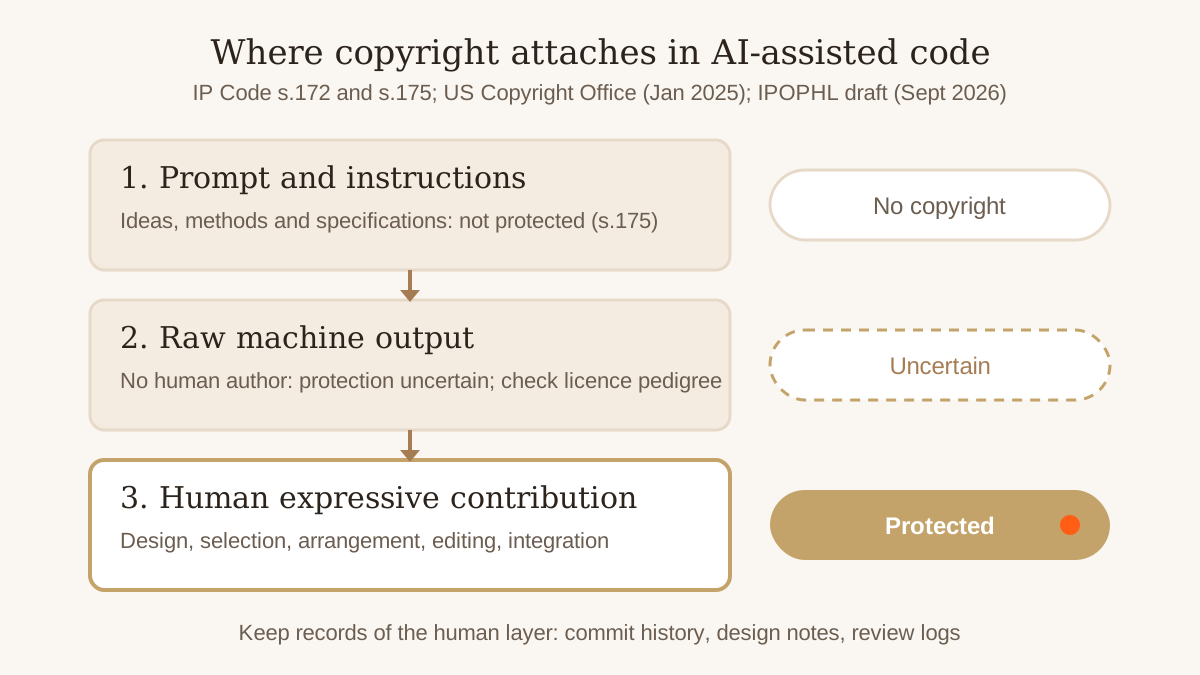
The starting point is Republic Act No. 8293, the Intellectual Property Code. Section 172.1(n) lists computer programs among protected literary works; Section 175 excludes ideas, procedures, systems and methods, so copyright covers the expression, not the algorithm. The Code assumes an author is a natural person, and Section 178 follows that assumption: a work created by an employee in the course of regularly assigned duties belongs to the employer unless agreed otherwise, while for a commissioned work the copyright stays with the creator absent a written stipulation.
None of that answers what happens when a prompt produces 200 lines of working code. Philippine courts have not ruled on the point, and IPOPHL has only begun to address it. In September 2026 its Bureau of Copyright and Related Rights presented draft guidelines on AI-assisted works at an initial public consultation; SunStar reported on 20 September 2026 that the draft would protect works with "sufficient original human creative input", would not bar registration merely because AI was used, and would weigh the extent of human input, the role of the AI system and how generated elements were selected, altered or arranged. Director General Teodoro C. Pascua told MLex on 16 October 2026 that issuance was targeted for year-end. As of the research date the guidelines remained a consultation draft.
Comparative guidance points the same way. The United States Copyright Office's January 2025 copyrightability report concluded that prompts alone do not give a user enough control to be an author, but that human expressive contributions, including creative selection, arrangement and modification of AI output, remain protectable. "Copyright protects the original expression in a work created by a human author," it states, and copyrightability "is determined on a case-by-case basis."
What the tool vendors say
Vendor terms fill part of the gap by contract. The three most commonly used in Philippine development shops take similar positions.
| Vendor terms | Position on output | Training on customer data | Notes |
|---|---|---|---|
| OpenAI Business Terms | "We hereby assign to you all our right, title, and interest, if any, in and to Output." | "We will not use Customer Content to develop or improve the Services." | Business products, not consumer accounts. |
| Anthropic Commercial Terms (effective 17 June 2025) | "Anthropic hereby assigns to Customer its right, title and interest (if any) in and to Outputs." | Bars use of customer materials to train models. | Conditional defence against certain third-party IP claims. |
| GitHub Copilot Product Specific Terms | GitHub does not claim ownership of suggestions; the customer remains responsible for its code. | Business and Enterprise plans exclude prompts and suggestions from training. | IP defence tied to the duplicate-code filter (verify current text). |
Two cautions follow. The words "if any" appear in every assignment clause for a reason: a vendor can only transfer rights it holds, and if generated code has no author it may have no copyright to transfer. And these are business-tier terms; consumer or free plans often reserve broader data-use rights, so a developer using a personal account on client work may be breaching the client's confidentiality clause.
3Open-source licence compliance in generated code
Models trained on public repositories can reproduce fragments of existing code, some of it licensed under terms that carry obligations. Permissive licences such as MIT or Apache 2.0 require attribution and notice preservation; copyleft licences such as the GPL can require that derivative works be released under the same licence. A generated snippet that matches a GPL-licensed function, pasted into a proprietary mobile app, is exactly what an acquirer's due diligence team or an enterprise client's procurement lawyer will look for.
The response is procedural. Vendor-side filters that block suggestions matching public code reduce but do not eliminate the risk. The software-composition-analysis tools already used to scan dependencies can scan generated code for licence matches, and a software bill of materials should record which components came from a model and which scan was run. For agencies building for clients, the contract should say who bears the cost if a licence conflict surfaces after delivery; silence usually means the developer does.
4Confidentiality of prompts and the data fed to the model
Every prompt is a disclosure. When a developer pastes a client's database schema, an API key or an unreleased feature into an AI tool, that information leaves the client's environment and enters the vendor's. Whether that is a breach depends on three documents: the client contract and its confidentiality clause; the firm's acceptable-use policy, which may be silent on AI; and the vendor's terms on retention, human review and training.
Trade-secret protection in the Philippines is not codified in a single statute; it rests on contract, the Civil Code, Article 292 of the Revised Penal Code on revealing industrial secrets, and the duty of confidentiality recognized in employment and commercial relationships. The common thread is that protection depends on the owner taking reasonable steps to keep the information secret. Routinely pasting proprietary code into a consumer chatbot with default data-sharing settings is hard to describe as a reasonable step.
Practical controls are familiar: business-tier accounts with no-training commitments, prompt history disabled where possible, no credentials or personal data in prompts, and a log of which tools are approved for which projects. Clients increasingly ask for a written AI-use disclosure before signing; a firm that can produce one quickly has a commercial as well as a legal advantage.
5The Data Privacy Act when AI processes personal data
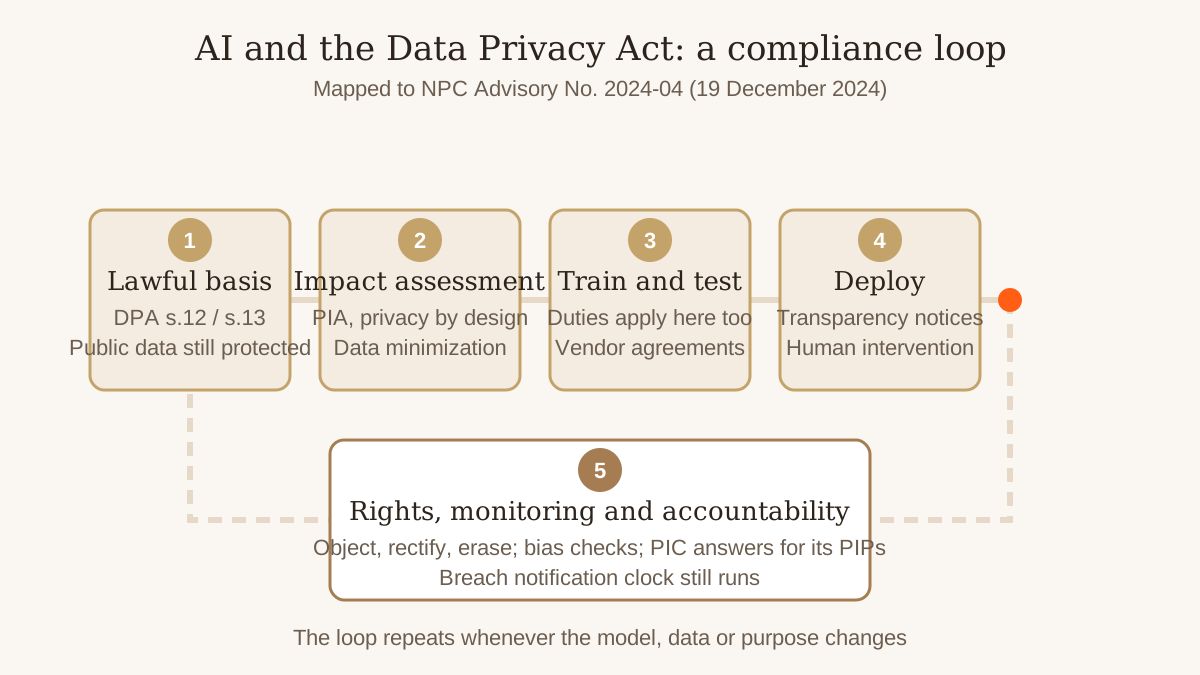
The National Privacy Commission removed any doubt about whether the Data Privacy Act of 2012 reaches AI systems when it issued NPC Advisory No. 2024-04 on 19 December 2024, on the application of the DPA to AI systems processing personal data. The advisory applies whenever personal data is processed in developing or deploying an AI system, expressly including training and testing. Several points matter for developers and the businesses that deploy their work.
- Lawful basis first. A personal information controller must identify a basis under Sections 12 or 13 of the DPA before processing. The advisory adds that "publicly available personal data do not lose the protection afforded by the DPA", which bears directly on scraping training sets from Philippine websites.
- Transparency. Controllers must tell data subjects about the processing and be able to explain its purpose, inputs, risks, expected outputs and dispute mechanisms. The advisory warns against "AI washing", which it describes as overstating AI involvement to the detriment of data subjects.
- Human intervention. Where automated decisions could significantly affect rights and freedoms, the advisory requires "meaningful human intervention carried out by persons with the necessary competence and authority" and a route for data subjects to contest the result. A customer-service agent who can only re-run the model does not satisfy this.
- Data minimization and accuracy. Data unlikely to improve the system should be excluded by default; bias must be monitored and limited; records kept current.
- Rights survive training. Objection, rectification and erasure must be exercisable before, during and after deployment, and incorporating data into a dataset "does not automatically make the exercise of data subject rights unreasonable".
- Accountability for vendors. Controllers "shall remain accountable for the actions of their PIPs". Using a foreign model provider does not shift responsibility, and the outsourcing agreement required by Section 14 of the DPA and the IRR must cover the AI processing.
The advisory also lists expected governance measures: privacy impact assessments, privacy by design and by default, industry-standard security, continuous monitoring and a dedicated AI ethics body. For a company already handling the duties covered in our guide to Data Privacy Act breach notification, the sensible approach is to fold AI systems into the existing privacy management programme. A leaked prompt log containing customer records is a personal data breach like any other, with the same 72-hour notification clock.
6Liability when AI-assisted software fails
No Philippine statute allocates liability for AI errors as such; ordinary private law does. Between developer and client, the development agreement governs: Articles 1170 to 1173 of the Civil Code make a party liable for damages caused by fraud, negligence or delay in performing an obligation, with the diligence of a good father of a family as the default standard. Whether a model wrote the defective function is irrelevant to the client; the developer warranted the deliverable. Towards third parties, Article 2176 on quasi-delicts supplies a negligence cause of action, and where software is embedded in a consumer product the Consumer Act's defective-product provisions may also be engaged.
What changes with AI is the evidence. A court or arbitrator assessing due diligence will ask what review the generated code received, what tests were run, whether the tool's known limitations were considered and whether the client was told AI was used. Firms that keep pull-request histories showing human review, test coverage reports and a written AI-use policy will be far better placed than those that cannot reconstruct how a component came to exist. The same applies to automated business processes: a lender whose model declines applications must show the human-intervention mechanism the NPC advisory requires actually operated.
7Contract clauses that now belong in every software agreement
Because most AI risk in the Philippine market is allocated by contract, development agreements, vendor subscriptions and employment policies are the main compliance lever. The following clauses are becoming standard.
- AI-use disclosure and approval. Which tools may be used, on which tiers, and whether the client must consent before a new one is introduced.
- Ownership and assignment. An express assignment of deliverables to the client, a warranty that the tools used permit that assignment, and a fallback licence for material that proves not to be copyrightable.
- Open-source code. A warranty that deliverables were scanned for licence conflicts, a schedule of components, and an allocation of remediation cost.
- Confidentiality. Whether client information may be input to third-party AI services at all and, if so, only under no-training, no-retention terms.
- Data protection. A DPA-compliant outsourcing agreement wherever the developer or its AI vendor processes personal data, with sub-processor disclosure and breach-notification timelines.
- Testing and acceptance. Minimum coverage, human review of generated code, and acceptance criteria that do not rely on model-generated tests alone.
- Liability and insurance. Caps, carve-outs for IP infringement and data breach, and professional indemnity cover that does not exclude AI-assisted work.
- Employee policy. A written acceptable-use policy aligned with Section 178.3 of the IP Code so employer ownership is not undermined by informal tool use.
Founders should expect these points in investor due diligence alongside the matters covered in our note on startup shareholder agreements in Manila; an IP warranty that the company owns all code in its product is hard to give if nobody knows what proportion was generated, under which terms.
8The policy landscape: roadmap, bills and what to watch
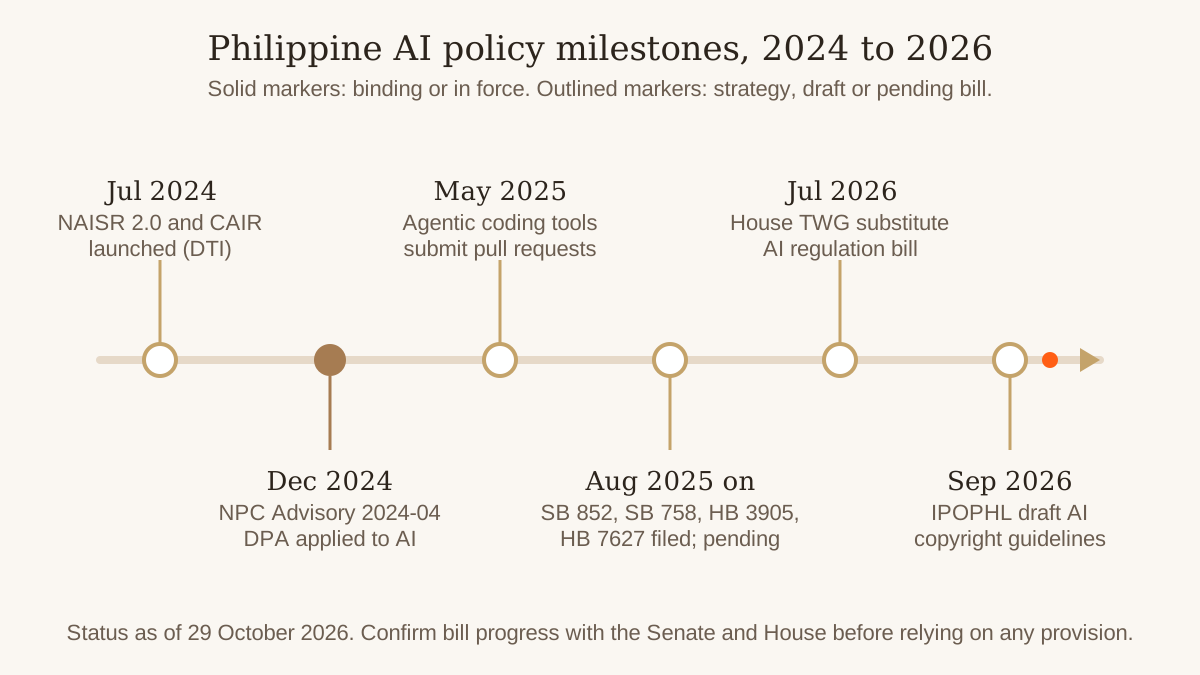
Government policy has so far favoured promotion over regulation. The Department of Trade and Industry launched the National AI Strategy Roadmap 2.0 and the Center for AI Research on 3 July 2024, updating the 2021 roadmap to cover generative AI and adding ethics and governance as themes; it is a strategy document, not a binding instrument. The only AI-specific issuance with direct legal force remains the NPC advisory.
Congress has been more active in filing than in passing. A 28 May 2026 survey by the Foundation for Media Alternatives recorded Senate Bill No. 852 (Sen. Jinggoy Estrada, August 2025), which would create a Philippine Council on Artificial Intelligence and an "AI Bill of Rights"; House Bill No. 7627 (Rep. Ma. Nina Francesca Lacson, February 2026), proposing a Bureau of Artificial Intelligence Systems to classify high-risk AI and impose penalties; House Bill No. 3905 (Rep. Zia Alonto Adiong, August 2025), which would make AI use an aggravating circumstance in crimes; and two deepfake measures, Senate Bills No. 758 and 1714. All were pending in committee at that date. Separately, Sen. Pia Cayetano filed a bill in July 2025 that would penalize deploying unregistered AI systems with fines of P500,000 to P5 million and imprisonment.
The most advanced House measure is a consolidated substitute, the proposed Artificial Intelligence Development and Regulation Act, steered by Rep. Javier Miguel Benitez as chair of the technical working group under the Committee on Information and Communications Technology. Philstar reported on 14 July 2026 that the draft merges 26 bills, three resolutions and a privilege speech, would require registration and safety checks only for high-risk systems such as those deciding loans, jobs or health matters, provides for a regulatory sandbox, bars dismissal of workers by algorithm alone and requires 60 days' notice and retraining before AI-driven displacement. Benitez's framing to business leaders on 30 June 2026, as reported by The Manila Times, was: "We should not stifle innovation, but we regulate the risk." As of the research date the substitute had not been reported out of committee; its text and status should be confirmed with the House Secretariat.
- NAISR 2.0 and CAIR launched by DTI.
- NPC Advisory No. 2024-04 applies the DPA to AI systems.
- US Copyright Office Part 2 report on copyrightability (January 2025).
- GitHub Copilot coding agent announced.
- First 20th Congress AI bills filed (SB 852, SB 758, HB 3905).
- House TWG deliberates substitute AI Development and Regulation Act.
- IPOPHL draft AI copyright guidelines go to public consultation.
Several pending bills would create registration regimes for AI systems, turning today's contractual best practice into statutory obligation. Developers who already keep model inventories, impact assessments and human-review records will have little to add. Where AI outputs cross into defamation, impersonation or fraud, the Cybercrime Prevention Act already applies, as discussed in our analysis of deepfake defamation liability.
Abanto Law Firm advises technology companies, development agencies and enterprises adopting automation on IP ownership, licensing, data protection and vendor contracts. If your team is scaling its use of AI tools or deploying automated decision-making, our corporate law and intellectual property practices can review your agreements and policies; contact us to arrange a consultation.
9Frequently asked questions
Can my company copyright software written mostly by an AI coding assistant?
Under the Intellectual Property Code, protection attaches to original expression by a human author. Code that a developer designed, structured, edited and integrated is protectable even if a model drafted parts of it; raw output accepted without creative contribution is on uncertain ground. IPOPHL's draft guidelines, under public consultation since September 2026, would register AI-assisted works that show sufficient human creative input and would assess how AI elements were selected, altered and arranged. Keep records of the human contribution so you can demonstrate it.
Does the Data Privacy Act apply if we only use personal data to test an AI feature?
Yes. NPC Advisory No. 2024-04 of 19 December 2024 states that the Data Privacy Act applies whenever personal data is processed in developing or deploying an AI system, including training and testing. You need a lawful basis, a privacy impact assessment where risks are significant, data minimization, and mechanisms for data subjects to exercise their rights. Using anonymized or synthetic test data where feasible is the simplest way to reduce exposure.
Who is liable if an AI tool introduces a bug that causes a client loss?
As between developer and client, the development contract and Articles 1170 to 1173 of the Civil Code govern, and the developer is liable for negligent performance regardless of whether a model wrote the code. Vendor terms generally disclaim responsibility for output. Liability caps are enforceable but cannot cover fraud or gross negligence. Documented human review and testing are the best defence and should be built into the delivery process.
Is it safe to paste client code or data into ChatGPT, Claude or Copilot?
Only if the client contract permits disclosure to third-party processors and you use a business tier whose terms exclude training and limit retention. OpenAI's and Anthropic's commercial terms and GitHub Copilot's business plans contain such commitments; consumer and free plans often do not. Personal data in prompts also triggers the Data Privacy Act's outsourcing and security requirements. Adopt a written acceptable-use policy and approved-tool list.
Is there a Philippine AI law I need to comply with now?
As of 29 October 2026, no AI-specific statute had been enacted. The National AI Strategy Roadmap 2.0 is a policy document, and the only binding AI-specific issuance is the NPC advisory applying the Data Privacy Act. Several bills were pending in the 20th Congress, including Senate Bill No. 852, House Bill No. 7627 and the House substitute Artificial Intelligence Development and Regulation Act, which proposes risk-based registration of high-risk systems. Their status should be confirmed before relying on any provision.
Sources and references
- GitHub Copilot: Meet the new coding agent — GitHub Blog (2025-05-19)
- Republic Act No. 8293, Intellectual Property Code of the Philippines — The LawPhil Project (Arellano Law Foundation) (1997-06-06)
- AI works face new copyright rules — SunStar Cebu (2026-09-20)
- Philippines' IP office clarifies copyright rules for AI-assisted works — MLex (2026-10-16)
- Copyright and Artificial Intelligence, Part 2: Copyrightability — United States Copyright Office (2025-01-29)
- OpenAI Business Terms — OpenAI
- Anthropic Commercial Terms of Service — Anthropic (2025-06-17)
- NPC Advisory No. 2024-04: Guidelines on the Application of the Data Privacy Act to Artificial Intelligence Systems Processing Personal Data — National Privacy Commission (2024-12-19)
- DTI launches National AI Strategy Roadmap 2.0 and Center for AI Research — Department of Trade and Industry (2024-07-02)
- Regulating Risk: The 20th Congress of the Philippines Response to Artificial Intelligence — Foundation for Media Alternatives (2026-05-28)
- Bill that seeks to regulate use of artificial intelligence filed in Senate — Philippine Daily Inquirer (2025-07-02)
- Proposed AI bill gains momentum in Congress — Philstar.com (2026-07-14)
This article is for general informational purposes only and does not constitute legal advice. Laws, regulations, and regulatory requirements may change, and reading this article does not create an attorney-client relationship with Abanto Law Firm. Readers should consult qualified Philippine legal counsel regarding their specific circumstances.