Technology & Digital Business
Mobile App Development Trends Shaping Philippine Businesses in 2026
Payments, identity, AI and app-store rules are changing what a Philippine business app must do in 2026. Here are the trends, the evidence behind them and the contract and compliance points each one raises.

1Why 2026 is a different year for Philippine app projects
For most of the past decade, a Philippine business that commissioned a mobile app was buying a storefront: a catalogue, a cart, a login screen and a payment button. In 2026 the brief looks different. The app is expected to accept QR Ph and InstaPay, verify a customer against a government-issued digital identity, resist account-takeover fraud to a standard a regulator will audit, ship on two platforms from one codebase, and increasingly ship with an AI feature that was itself built with AI tools. Each of those expectations is a technical trend, but each also carries a legal consequence that the business, not the developer, usually ends up owning.
This article sets out seven trends shaping app development for Philippine businesses in 2026, the evidence behind each, and the contractual or regulatory point it raises. It is written for owners, product leads and in-house counsel who are scoping, procuring or renegotiating an app build.
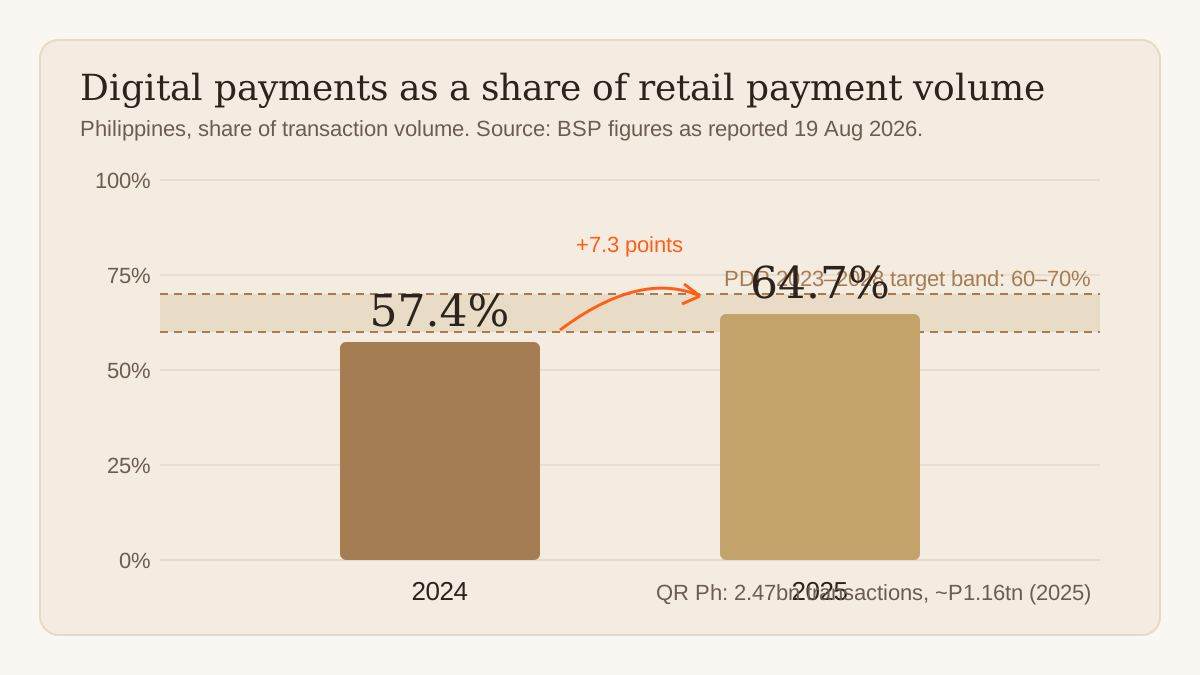
- Digital payments reached 64.7% of retail payment volume in 2025, and QR Ph overtook card transactions for the first time, so payment integration is now a baseline feature rather than a differentiator.
- The Anti-Financial Account Scamming Act (RA 12010) and BSP Circular No. 1213 have raised the security bar for anything that touches a financial account, with fraud-management upgrades due by June 2026.
- The eGovPH super app passed 40 million users in March 2026 and is tied to the national ID, making government-grade identity verification a realistic integration target.
- Google's Play billing changes (announced 24 June 2026) and Android developer verification (first markets by 30 September 2026) will alter app-store economics and distribution, though the Philippine rollout dates are not yet fixed.
- Under the Philippine IP Code, a commissioned developer keeps the copyright in the code unless the contract says otherwise, which is the single most common gap in Philippine app development agreements.
2Trend 1: Payments move inside the app, and QR Ph becomes the default
The clearest data point for 2026 planning comes from the Bangko Sentral ng Pilipinas. According to BSP figures reported by the Daily Tribune on 19 August 2026, digital payments accounted for 64.7% of total retail payment volume in 2025, up from 57.4% in 2024, placing the country inside the 60–70% target range set in the Philippine Development Plan 2023–2028. The same report noted that QR Ph transactions exceeded debit and credit card transactions for the first time, reaching 2.47 billion transactions worth about P1.16 trillion in 2025, that PESONet volumes overtook cheques, and that merchant locations accepting electronic payments grew 36.3% in the year.
Two regulatory developments sit behind those numbers. Interoperability means a QR Ph merchant code or an InstaPay rail reaches most of the market without separate wallet integrations. Pricing has also moved: the Tribune report cites BSP Circular No. 1238, which requires inter-institution transfer fees to be reasonable and not materially higher than in-house transfer fees, after which several large banks waived InstaPay and PESONet fees.
- 64.7%
share of retail payment volume that was digital in 2025 (BSP, reported 19 Aug 2026) - 2.47 billion
QR Ph transactions in 2025, worth about P1.16 trillion - +36.3%
growth in merchant locations accepting electronic payments in 2025 - ~90%
of Philippine app installs in 2024 were on Android (AppsFlyer, 2025 edition)
Legal implication: you are integrating with a regulated system
A business that embeds payments in its app is not itself a payment system operator, but it is contracting with one. The merchant agreement with the acquiring bank, wallet or aggregator will allocate chargeback risk, set settlement timing, impose data-handling rules and reserve a right to suspend the merchant, and it should be read alongside the app's own user terms so that the refund process a customer sees matches what the partner will support. Businesses that handle customer funds beyond simple checkout, such as stored balances or peer transfers, should take advice early on whether that activity requires its own BSP registration, because the answer changes the architecture.
3Trend 2: Security expectations are now set by AFASA, not by the developer
The Anti-Financial Account Scamming Act, Republic Act No. 12010, was signed on 20 July 2024 and is listed among the banking laws on the BSP's official register, which also carries an AFASA booklet with the implementing rules dated 18 June 2025. The BSP's implementing circular, Circular No. 1213, took effect on 25 June 2025. As GMA News reported on 11 June 2025, covered BSP-supervised institutions were given until June 2026 to upgrade their fraud management systems so that they address behavioural anomalies, blacklist screening, geolocation monitoring and changes to mobile devices or account information, and to limit reliance on SMS and email one-time passwords in favour of stronger multi-factor authentication such as biometrics, passwordless methods and adaptive authentication.
This matters to a retailer, logistics firm or clinic because the institutions processing their payments pass those requirements down the chain. Payment partners now ask merchants about device binding, session management, token storage and whether login still depends on SMS OTP alone; an app designed in 2023 around SMS codes is a weaker onboarding candidate in 2026. The policy context is covered in our article on how banks and telcos share liability for SIM-swap fraud.
4Trend 3: Super apps, mini-apps and the eGovPH effect
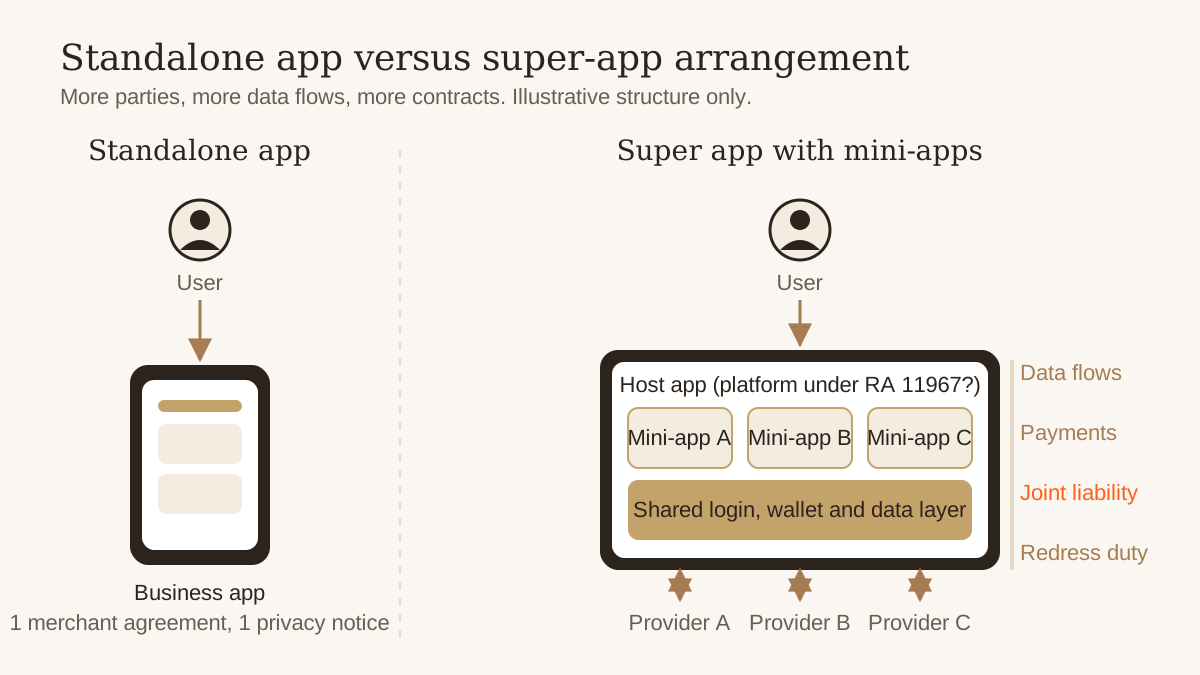
The super-app model, in which one host application exposes dozens of third-party services as embedded mini-apps, is no longer only a fintech story in the Philippines. The government's own eGovPH Super App was formally launched by President Marcos together with the first Bagong Pilipinas eGovPH Serbisyo Hub on 18 July 2025, as reported by the Manila Bulletin, with the stated aim of letting citizens apply for permits, renew licences and settle fees from one application. By 24 March 2026 the Department of Information and Communications Technology reported 40 million users, said the app connects to more than 1,000 government systems, and set a target of 60 million users by 2028. DICT also stated that linking the app to the national ID had helped remove fake accounts.
For private businesses the trend runs in two directions: building a mini-app inside a wallet or marketplace host, trading control for distribution, or building a host app that aggregates partner services, such as a property developer bundling utilities, concierge and payments into a resident app. Both involve more parties, data flows and terms of service than a standalone app.
Legal implication: platform liability under the Internet Transactions Act
Republic Act No. 11967, the Internet Transactions Act of 2023, became fully enforceable when its transitory period ended on 20 June 2025, as reported by Newsbytes.PH; its implementing rules were issued on 24 May 2024 as Joint Administrative Order No. 24-03. The law gives digital platforms and e-marketplaces their own obligations: accessible complaint and redress systems, secure payment methods, data protection standards, and potential joint liability with sellers where a platform fails to act on illicit activity, with the DTI's E-Commerce Bureau able to issue subpoenas and order takedowns. A business hosting third-party mini-apps may be classified as a platform, and one distributing through another host should expect that host to impose compliance terms. The classification question should be settled before the architecture is, with input from corporate and commercial counsel.
5Trend 4: National ID verification becomes an integration target
The eGovPH figures sit on top of the Philippine Identification System. DICT's March 2026 statement put national digital ID coverage at roughly 90 million Filipinos, with the eGovPH app as the channel for presenting and verifying the ID digitally. A lending app, telco onboarding flow or rental platform that can verify a customer against a government record can cut fraud and speed up know-your-customer checks. How private-sector access to PhilSys verification services is provided, priced and conditioned in late 2026 should be confirmed with the Philippine Statistics Authority before a project is scoped around it; we could not verify the current terms as of the research date.
The legal framework for any such integration is the Data Privacy Act of 2012 (Republic Act No. 10173) and the issuances of the National Privacy Commission. Two recent NPC advisories are directly relevant to app teams. NPC Advisory No. 2024-04, dated 19 December 2024, sets out how the Act applies to artificial intelligence systems that process personal data. NPC Advisory No. 2025-02 on privacy engineering in the systems life cycle, summarised by Baker McKenzie on 18 September 2025, expects controllers and processors to identify a lawful basis and run a privacy impact assessment at the planning stage, to minimise data and build in encryption and access controls during design, to validate privacy controls before deployment, to avoid deceptive design and set protective defaults at launch, and to repeat impact assessments at least annually and whenever a major update, new vendor or change of purpose occurs.
- Identify the lawful basis for each category of personal data the app collects before the data model is finalised, not after.
- Complete a privacy impact assessment for the app and update it when identity verification, AI features or new vendors are added.
- Put a written data processing or outsourcing agreement in place with the developer, cloud host and any verification or analytics vendor.
- Default location tracking, marketing consent and saved payment details to off, consistent with the NPC's protective-defaults guidance.
- Prepare the breach notification workflow before launch; the 72-hour clock is explained in our Data Privacy Act breach notification checklist.
6Trend 5: AI-assisted development and on-device AI
Two different things are bundled under "AI in apps". The first is AI used to build the app: code assistants that generate boilerplate, tests and documentation and shorten development cycles for agencies competing on cost. The second is AI inside the app: recommendation engines, chat assistants, document scanning and, increasingly, models that run on the device rather than in the cloud. On-device inference keeps sensitive data local, which helps privacy, but it also moves model files and their licences into the shipped binary.
Legal implication one: who owns AI-generated code?
The Intellectual Property Code (Republic Act No. 8293) protects original works of authorship, and the prevailing practitioner view is that copyright attaches to the human contribution. Code produced wholly by a tool with no meaningful human selection or modification may have weak or uncertain protection, which matters when a business later asserts exclusivity or sells the company. The contractual answer is not to ban the tools but to require the developer to warrant non-infringement, disclose the AI tools used, keep a record of human review, and confirm that the tool's terms allow commercial use of outputs. Ownership of commissioned code is covered in Section 8.
Legal implication two: AI features and the NPC's expectations
NPC Advisory No. 2024-04 asks controllers deploying AI to explain in plain language what the system takes in, what it produces, what risks it carries and how a data subject can contest an outcome; to provide meaningful human intervention where automated decisions pose significant risk; to identify and reduce bias; to avoid overstating AI capability; and to exclude personal data unlikely to improve the system. A lending app that scores applicants or a recruitment app that ranks candidates falls squarely within it. The controller remains accountable even when development is subcontracted, so responsibility cannot be shifted to the developer by contract alone, although the contract should allocate the cost of remediation.
7Trend 6: App-store economics and distribution rules are shifting
The 15–30% platform commission was long treated as a fixed cost of mobile business. That assumption is weakening, although the Philippine position is unsettled. On 24 June 2026 Google announced that from 30 June 2026 it would separate its Play service fee from its billing fee, beginning in the United States, European Economic Area and United Kingdom. In those markets the service fee is 10% on a developer's first US$1 million in annual earnings regardless of billing method, a 5% billing fee applies only when Google Play's own billing system is used, and developers may offer alternative billing or link out to their own websites. Google said other markets would follow on a staggered timeline. As of the research date no Philippine effective date has been published, so Philippine launch budgets should assume existing Play fee tiers until Google confirms otherwise.
On the Apple side, the position is shaped by litigation. According to reporting on 14 August 2026, the United States Supreme Court declined to stay lower-court proceedings in Epic Games v. Apple while it reviews the contempt finding; the Ninth Circuit had upheld that finding but allowed a commission on external-link purchases limited to costs genuinely and reasonably necessary, and Apple proposed tiered rates of 15%, 10% and 5%. Those proceedings concern the US storefront. Philippine developers remain on Apple's standard worldwide terms, and the outcome of the Supreme Court review, expected in the October 2026 term, should be checked before any pricing decision relies on it.
Developer verification changes who can distribute an Android app at all
A separate Google change is less about fees and more about identity. As Technobaboy reported on 20 June 2026, Google's timeline has developer verification going live in Brazil, Indonesia, Singapore and Thailand by 30 September 2026, with worldwide expansion in 2027, and the requirement extends to apps distributed outside Google Play on certified Android devices, with Samsung, OPPO, vivo, Xiaomi and other stores also requiring it. The contractual point for Philippine businesses is that the verified developer account publishing the app should be the business's own, not the agency's, so the business is not locked out of its distribution channel if the relationship ends. Enterprise apps distributed to staff outside the store will also need a verification plan once the requirement reaches the Philippines.
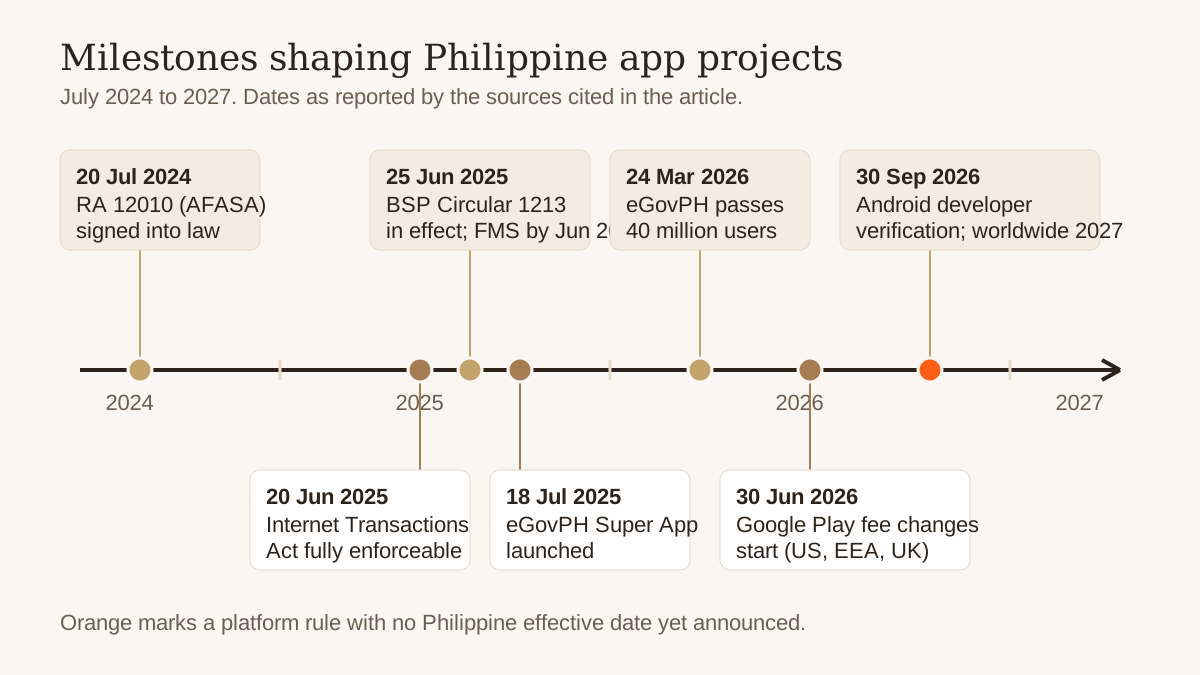
- RA 12010 (AFASA) signed into law, defining and penalising financial account scamming.
- Internet Transactions Act fully enforceable as the transitory period under RA 11967 ends.
- BSP Circular No. 1213 takes effect, with fraud-management upgrades due by June 2026.
- eGovPH Super App launched alongside the first Serbisyo Hub.
- eGovPH passes 40 million users; DICT targets 60 million by 2028.
- Google announces Play billing and fee changes, effective 30 June 2026 in the US, EEA and UK.
- Android developer verification live in Brazil, Indonesia, Singapore and Thailand; worldwide in 2027.
8Trend 7: Cross-platform frameworks, and the IP clause most contracts get wrong
Android's dominance in the Philippines is the reason cross-platform frameworks such as Flutter and React Native remain the default choice for budget-conscious builds. AppsFlyer's State of App Marketing in the Philippines, 2025 edition, put Philippine app installs at about 3.06 billion in 2024, up 25% year on year, with roughly 90% on Android but iOS installs growing about twice as fast and finance the largest category by volume. A business that must reach both operating systems with one team has strong commercial reasons to build once and deploy twice.
The same report ranked the Philippines eighth globally for install fraud, with Android fraud at 11% and iOS at 8% in the fourth quarter of 2024, so user-acquisition spend needs the same contractual protections as development spend, including measurement standards and clawback terms with agencies.
Who owns the app you paid for?
Section 178 of the Intellectual Property Code allocates copyright in commissioned works in a way that surprises many clients: where a work is created under a commission, the person who commissioned it owns the physical work, but the copyright remains with the creator unless there is a written stipulation to the contrary. For work created by an employee in the course of regularly assigned duties the employer owns the copyright, but an outside agency and its staff are not the client's employees. A Philippine business whose contract is silent on copyright may therefore own the delivered build but not the right to stop the agency reusing the code for a competitor. The fix is a written assignment of copyright in the deliverables, a licence to pre-existing agency components, a schedule of open-source components and their licences, and delivery of source code and build credentials in escrow or on milestone payment. Our intellectual property practice reviews these clauses alongside trademark filings for the app name and icon.
| Trend | Primary legal touchpoint | Contract clause to check |
|---|---|---|
| In-app payments (QR Ph, InstaPay) | Merchant agreement; BSP payment system rules | Chargeback allocation, settlement, suspension rights |
| Security to AFASA standard | RA 12010; BSP Circular No. 1213 | Authentication standard, pen-testing, remediation duty |
| Super app or mini-app | RA 11967 Internet Transactions Act | Platform classification, redress system, takedown cooperation |
| National ID verification | RA 10173; NPC Advisory 2025-02 | Lawful basis, PIA, data processing agreement |
| AI features and AI-built code | NPC Advisory 2024-04; RA 8293 | Human oversight, tool disclosure, non-infringement warranty |
| App-store fees and verification | Platform developer terms | Ownership of developer accounts, fee pass-through |
| Cross-platform build | RA 8293 Section 178 | Copyright assignment, open-source schedule, source escrow |
9Putting it together: a 2026 procurement checklist
None of these trends requires a business to become a regulated entity. They do require it to recognise that an app is now a regulated touchpoint for payments, identity and personal data, and to treat the development contract as the place where those risks are allocated rather than as a software purchase order. The questions below are the ones most often left unanswered until a dispute, a breach or an acquisition forces them.
- Does the contract assign copyright in all bespoke deliverables to the business in writing, and license any agency-owned components on terms that survive termination?
- Is the business, not the agency, the registered owner of the Apple developer account, the Google Play developer account and any upcoming Android developer verification?
- Has the authentication design been checked against what the chosen payment partner now requires after BSP Circular No. 1213, including alternatives to SMS OTP?
- Has a privacy impact assessment been completed, and does the architecture respect protective defaults for location, marketing and stored payment data?
- If the app hosts or sits inside a super app, has the Internet Transactions Act classification been confirmed and are complaint and redress channels in place?
- Have AI tools used in development been disclosed, and do the terms of any embedded AI model permit commercial, on-device distribution?
- Are acceptance criteria, warranty periods, support SLAs and source-code delivery tied to milestone payments rather than to goodwill?
Abanto Law Firm advises Philippine and foreign-owned businesses on technology procurement, data privacy and intellectual property, including the review and negotiation of app development, licensing and payment partner agreements. If you are scoping a build or renegotiating an existing one, our corporate law team can review the contract and compliance position, and you can reach us through our contact page to arrange an initial discussion.
10Frequently asked questions
Do Philippine businesses need a BSP licence to accept QR Ph or InstaPay payments in their app?
Accepting payments as a merchant through a bank, e-wallet or licensed payment aggregator does not by itself make the business a BSP-supervised institution; the licensed partner carries that status and passes obligations to the merchant by contract. The position changes if the app holds customer balances, issues stored-value credits or moves money between users, because those activities may fall within BSP payment system or e-money rules. The architecture should be reviewed against those rules before build, not after launch.
Who owns the source code of an app developed by an outside agency in the Philippines?
Under Section 178 of the Intellectual Property Code (RA 8293), copyright in a commissioned work stays with the creator unless there is a written stipulation to the contrary, even though the commissioning party owns the delivered work itself. A business that wants exclusive rights over its app code needs an express written assignment of copyright in the contract, together with a licence to any pre-existing agency components and a schedule of open-source dependencies and their licences.
What does the Anti-Financial Account Scamming Act require of a business app?
RA 12010, signed on 20 July 2024, and BSP Circular No. 1213, effective 25 June 2025, impose obligations directly on BSP-supervised financial institutions, including fraud management systems and stronger multi-factor authentication with less reliance on SMS and email one-time passwords, with upgrades due by June 2026. A non-financial business is affected indirectly: its payment partners will expect the app's login, device-binding and session controls to meet comparable standards as a condition of onboarding, and will look at those controls when a customer disputes a transaction.
Will Google's 2026 Play Store fee changes apply to apps sold in the Philippines?
Google announced on 24 June 2026 that its new service and billing fee structure, including a 10% service fee on the first US$1 million in annual earnings and the option of alternative billing or external links, would start on 30 June 2026 in the United States, European Economic Area and United Kingdom, with other markets to follow on a staggered timeline. As of 29 October 2026 no Philippine effective date had been published, so Philippine developers should plan on existing fee tiers until Google confirms a local rollout.
Can a business integrate the national ID into its app for customer verification?
The government has positioned the eGovPH Super App, which DICT reported had passed 40 million users in March 2026, as the channel for presenting and verifying the national ID digitally, and the Philippine Statistics Authority administers PhilSys verification services. The terms on which private businesses may access those services should be confirmed with the PSA. Any integration must also comply with the Data Privacy Act, including a documented lawful basis, a privacy impact assessment and a written processing agreement with every vendor that touches the identity data.
Does the Internet Transactions Act apply to a company that only runs its own app?
RA 11967, fully enforceable since 20 June 2025, applies to online merchants, e-marketplaces and digital platforms engaged in internet transactions with Philippine consumers. A business selling only its own goods or services through its own app is generally treated as an online merchant with disclosure and redress obligations. If the app hosts third-party sellers or mini-apps, it may be classified as a platform or e-marketplace, which carries additional duties and potential joint liability, so the classification should be confirmed before third-party services are added.
Sources and references
- BSP: Digital payments account for nearly two-thirds of retail volume — Daily Tribune (2026-08-19)
- Banking Laws (register listing R.A. 12010 and AFASA booklet with IRRs) — Bangko Sentral ng Pilipinas
- Financial institutions given until June 2026 to boost fraud management systems — GMA News (2025-06-11)
- 'Gov't now in 21st century': Marcos launches eGovPH Super App, one-stop service hub — Manila Bulletin (2025-07-18)
- DICT aims to reach 60 million eGovPH users by 2028 — Manila Bulletin (2026-03-24)
- Gov't starts enforcing liability rules for e-commerce firms as new law takes effect — Newsbytes.PH (2025-06-23)
- NPC Advisory No. 2024-04: Guidelines on the Application of the Data Privacy Act to Artificial Intelligence Systems Processing Personal Data — National Privacy Commission (2024-12-19)
- Philippines: NPC issues Guidelines on Privacy Engineering in Systems Life Cycle (Advisory No. 2025-02) — Baker McKenzie (2025-09-18)
- Expanding billing choice and updating fees on Google Play — Android Developers Blog (Google) (2026-06-24)
- Google sets timeline for Android sideloading changes (developer verification) — Technobaboy (2026-06-20)
- U.S. Supreme Court clears path for App Store commission showdown as Apple must defend its rates in lower court — MacDailyNews (2026-08-14)
- State of App Marketing in the Philippines – 2025 Edition — AppsFlyer
This article is for general informational purposes only and does not constitute legal advice. Laws, regulations, and regulatory requirements may change, and reading this article does not create an attorney-client relationship with Abanto Law Firm. Readers should consult qualified Philippine legal counsel regarding their specific circumstances.