Gaming Law & Compliance
E-Wallets and Online Gambling: BSP and PAGCOR Measures Reshaping Payments
The BSP cut e-wallet links to gambling sites in August 2025 and drafted dedicated-account rules; PAGCOR tightened age, KYC, ads and payment instruments. Here is what is in force and what is still proposed.

1Why e-wallets became the pressure point of Philippine gaming regulation
Until mid-2025 the fastest route from a Filipino player's pocket to a licensed online casino ran through a mobile wallet: super-app tiles opened PAGCOR-licensed sites, and the balance that paid for groceries could fund a bet in seconds. That convenience made e-wallets the first target when the political mood turned.
The scale explains the attention. At a Senate hearing on 14 August 2025, PAGCOR officials reported that electronic gaming had grown to 59.92 percent of the regulator's income as of June 2025, up from 18.98 percent four years earlier, according to GMA News coverage of the hearing. In the same session Senator Juan Miguel Zubiri cited gross gaming revenues for the segment of about ₱8 billion in 2022, ₱33.16 billion in 2023, ₱135.71 billion in 2024 and ₱106.53 billion in the first half of 2025 alone, as reported by GMA News. Those figures, combined with testimony from rehabilitation providers and complaints from religious groups, produced two parallel regulatory responses: PAGCOR tightened the conduct rules for its licensees, while the Bangko Sentral ng Pilipinas (BSP) moved on the payment rails themselves.
This article separates what is now in force from what remains a proposal as of the research date (29 October 2026), and sets out what licensed operators and their payment partners should already have changed. For the broader licensing picture, the firm's gaming license practice page and its guide to payment processing for licensed online casinos provide the background.
- The BSP's 14 August 2025 order removing gambling links and icons from e-wallets and other supervised apps is in force and was described by the BSP as an interim measure pending final rules.
- The BSP's draft Regulations on Online Gambling Payment Services (exposure draft, July 2025) would create dedicated gambling accounts, a 20 percent daily funding cap, a six-hour window and a 24-hour cooling-off period. Its final issuance could not be confirmed as of the research date.
- PAGCOR has separately removed out-of-home advertising, restricted broadcast ads, reaffirmed the 21-year minimum age, tightened KYC and, in December 2025, barred credit cards and cryptocurrency for bets.
- Operators and PSPs should plan for a direct-to-site funding model with enhanced identity checks, limits, disclosures and monthly reporting, rather than waiting for the rules to settle.
2PAGCOR's 2025 conduct measures: advertising, age, identity and payment instruments
PAGCOR is a government-owned corporation that both operates and regulates gaming under Presidential Decree No. 1869, as amended by Republic Act No. 9487. Its measures take the form of memoranda and directives to licensees rather than legislation, which means they bind operators through their license conditions and can be adjusted quickly.
Out-of-home and broadcast advertising
On 11 July 2025 PAGCOR issued a memorandum to all licensees, suppliers and electronic gaming administrators ordering the removal of all out-of-home gambling advertising by 15 August 2025, as reported by Asia Gaming Brief. The regulator also signed a memorandum of understanding with the Ad Standards Council, giving the council a pre-screening role over gaming promotions, and announced that gambling commercials would be barred during television prime time. By February 2026, PAGCOR chairman Alejandro Tengco was telling a Senate committee that the agency wanted a complete ban on iGaming advertising if that proved feasible, according to iGaming Business. Operators should read these measures alongside the firm's analysis of advertising restrictions for licensed online casinos.
Minimum age of 21 and restricted persons
The 21-year minimum is not new. PD 1869 and Malacañang Memorandum Circular No. 6 (2016) bar persons under 21, enrolled students, government officials directly connected with government operations, and members of the Armed Forces and the Philippine National Police from casino play, and PAGCOR applies the same policy to registration on licensed online platforms. What changed in 2025 was enforcement. At the 14 August 2025 Senate hearing, Mr Tengco said PAGCOR had forfeited roughly ₱129 million to ₱130 million in winnings from persons found to be barred, including government employees and under-21 players, while conceding that some minors register using fake identification, per GMA News.
Identity verification
Senators criticised the then-common practice of confirming age and employment status with a single click. PAGCOR has since required players to submit a government-issued ID and a real-time selfie before any deposit, in addition to name and contact details, as described in iGaming Business's February 2026 report. This aligns PAGCOR's expectations with the facial biometric verification in the BSP's draft rules, discussed below.
Credit cards and cryptocurrency
On 10 December 2025 PAGCOR announced that credit cards and cryptocurrencies may no longer be used to pay for bets on licensed platforms, citing the risk of "over-borrowing and impulsive behavior," and required licensees to offer self-exclusion and betting-limit tools, according to the Manila Bulletin. The announcement did not specify a transition date, so licensees should confirm the operative date and implementing guidance directly with their PAGCOR account officers.
3The BSP's 14 August 2025 order: what it did and did not do
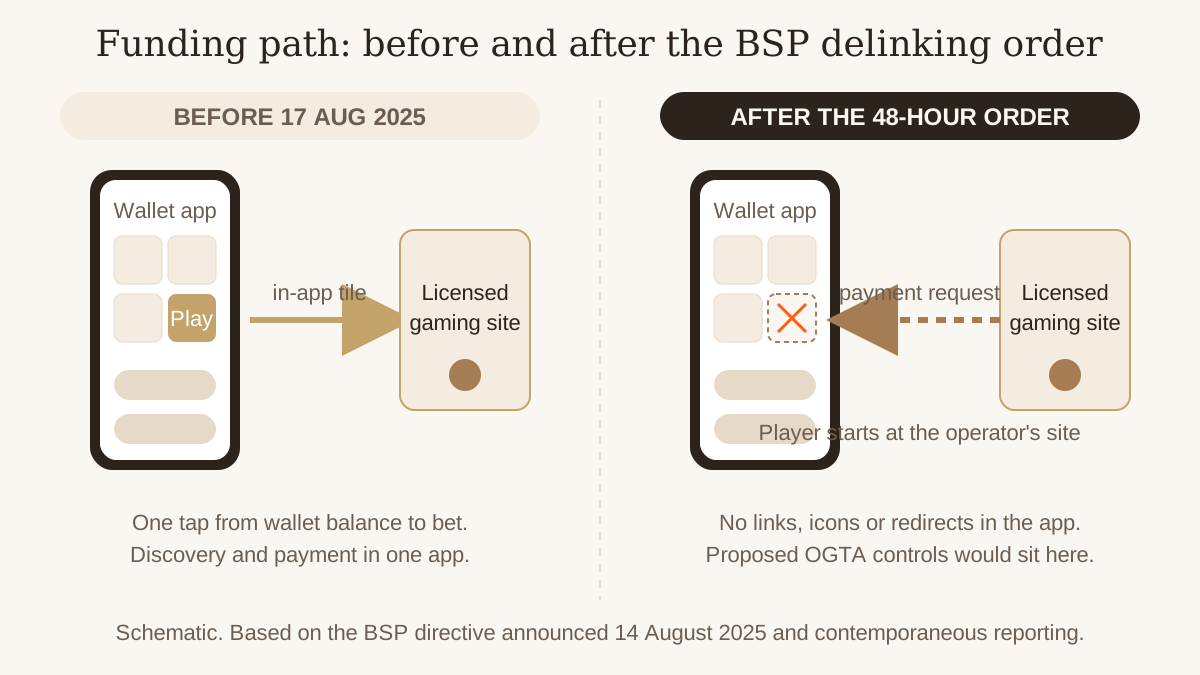
The decisive payments intervention came from the central bank. During a joint Senate hearing on 14 August 2025, BSP Deputy Governor Mamerto Tangonan announced that the Monetary Board had approved a directive requiring BSP-supervised institutions to take down in-app links and icons leading to online gambling platforms within 48 hours, with the window intended to let customers withdraw funds from gaming accounts, as GMA News reported. Committee chair Senator Erwin Tulfo warned that he would cite the official in contempt if links remained on Sunday morning.
The two largest wallets complied. Maya said in an advisory that it disabled links to gambling sites through its Games feature from 8 p.m. on Saturday 16 August 2025 and that it "fully support[s] the BSP's efforts"; GCash, operated by G-Xchange Inc., removed access through its GLife feature, per GMA News. Both companies had earlier told the committee they would comply as soon as the official directive arrived.
Three limits of the order matter for compliance planning:
- It targets discovery, not payment. The order removed in-app links, icons and redirects. It did not, on its own terms, prohibit a player from paying a licensed operator by opening the operator's site directly and selecting an e-wallet at checkout. Reporting at the time noted that payments made from outside the app were not covered.
- It is interim. The BSP described the suspension of in-app access as continuing until guidelines for online gambling payment services are finalised, as summarised in BusinessWorld's September 2025 analysis.
- It applies to all supervised institutions. The directive was addressed to BSP-supervised institutions generally, including banks with digital marketplaces, not only to e-money issuers.
The commercial effect was immediate. On 20 August 2025 Mr Tengco told a House appropriations briefing that online gambling transactions had fallen by roughly 50 percent in the days after delinking, according to GMA News. By October 2025 PAGCOR was reporting that monthly income had dropped to ₱2.9 billion in September from ₱5.7 billion in May, a 49 percent decline that officials attributed to the e-wallet changes, as Philstar.com reported on 22 October 2025. PAGCOR also said it was seeing players migrate to unlicensed sites that impose no minimum bets or top-up limits, a claim operators have echoed and which legislators have treated with caution.
4The BSP draft circular: dedicated gambling accounts, caps and cooling-off
The BSP first announced on 3 July 2025 that it would issue a circular restricting e-wallet access to online gambling, and published a draft titled Regulations on Online Gambling Payment Services for comment, with feedback from payment service providers and operators due by 25 July 2025, according to BitPinas. The exposure draft posted on the BSP website would insert a new Section 1106 into the Manual of Regulations for Payment Systems. Because the document is a draft, every figure below is a proposal unless and until a numbered circular is published.
The core architecture: the Online Gambling Transaction Account
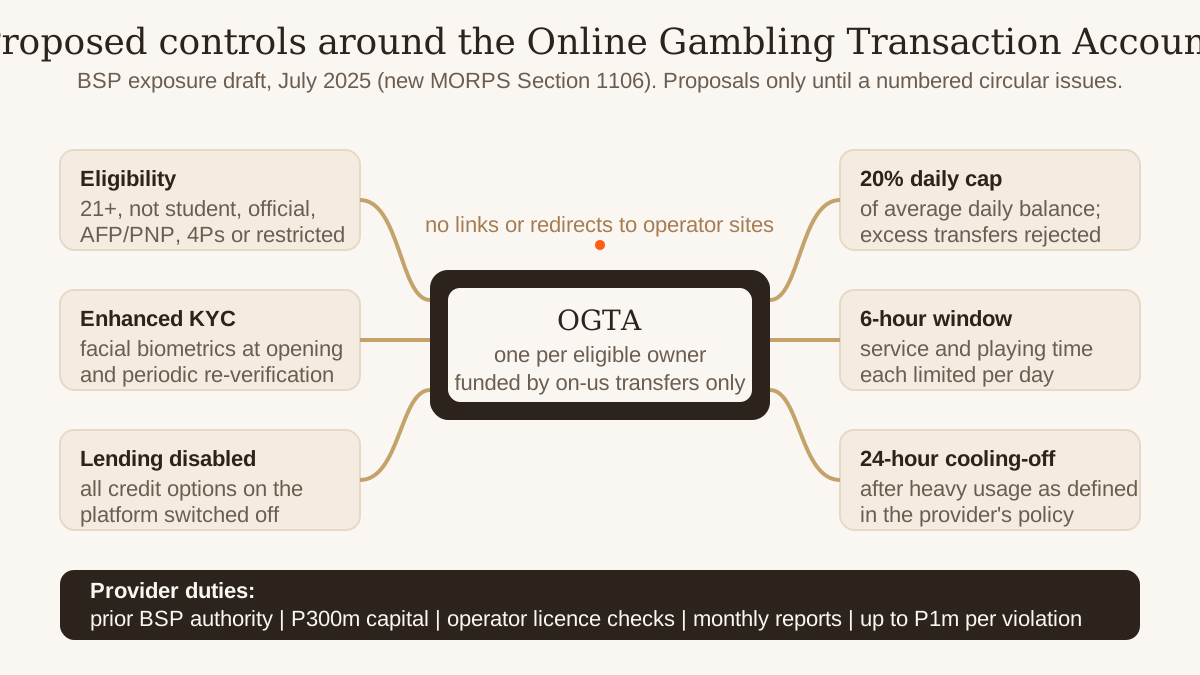
The draft's central device is the Online Gambling Transaction Account (OGTA), a separate account opened only at the request of an eligible account owner, funded exclusively by "on-us" transfers from that owner's primary account at the same provider, and limited to one per person. Transfers from a primary account to an OGTA, and transfers between the OGTA and the acquirer or aggregator of a licensed operator, are what the draft defines as "online gambling payment services." Providers would be barred from linking to operator websites or redirecting users to them, which would make the August 2025 delinking permanent.
| Proposed control (draft Section 1106) | What it would require | Who must act |
|---|---|---|
| Prior BSP authority (1106.3) | Approval before offering gambling payment services; composite supervisory rating threshold; minimum capitalisation of ₱300 million; AML/CTF and fraud management systems; board-level AML/CTF committee | PSPs and operators of payment systems |
| Eligible account owner (1106.1) | At least 21 years old; not a student, government official connected with government operations, AFP/PNP member, 4Ps beneficiary, person on PAGCOR's National Database of Restricted Persons or Gaming Employment License holder | PSP onboarding teams |
| Enhanced KYC (1106.5) | Facial biometric verification at OGTA opening and periodically thereafter | PSPs |
| Daily funding cap (1106.6a) | Transfers to the OGTA capped at 20 percent of the owner's average daily balance; excess rejected | PSPs |
| Transaction window (1106.6b, 1106.7c) | Gambling payment services available no more than six hours per day; owner-set playing-time limit also capped at six hours | PSPs, with operator cooperation |
| Cooling-off (1106.6c) | 24-hour block on further transfers after "heavy usage" as defined in the provider's Responsible Online Gambling Policy | PSPs |
| Lending severance (1106.6d) | All lending options on the same digital platform disabled once an OGTA exists | PSPs with embedded credit products |
| Operator due diligence (1106.4) | Online gambling operators treated as high-risk merchants: enhanced due diligence, beneficial ownership verification, proof of valid PAGCOR or other license | PSPs and acquirers |
| Reporting (1106.9) | Monthly or on-request reports on volumes and values, OGTA counts, first-time and recurring users, access frequency, age and economic class, and partner operators | PSPs |
| Sanctions (1106.10) | Up to ₱100,000 per day for continuing violations or ₱1 million per transactional violation; suspension, then revocation, of authority | PSPs |
The draft also prohibits provider employees from participating in online gambling, requires pop-up alerts and owner-set deposit limits, and gives existing providers six months from effectivity to secure authority or stop offering the service. Effectivity would follow 15 calendar days after publication.
5Where things stand as of 29 October 2026
Three strands need to be distinguished: measures in force, measures still proposed, and bills in Congress.
In force
The August 2025 delinking order remains the operative BSP measure for in-app access. Separately, a payments-industry summary of 2026 BSP issuances reports that BSP Circular No. 1237, on digital financial marketplaces operated by supervised institutions and said to have taken effect on 16 June 2026, bars such marketplaces from presenting online gambling products, per PayMongo's regulatory digest. The firm was unable to retrieve the circular's text from the BSP website at the research date, so the number, date and scope of that prohibition should be confirmed against the official issuance before being relied upon. PAGCOR's advertising, age, KYC and payment-instrument directives described in Section 2 are in force for licensees.
Still proposed
The BSP said in September 2025 that it was finalising the Regulations on Online Gambling Payment Services after consultation and would issue them "soon." As of the research date, the firm could not confirm that a numbered circular containing the OGTA framework had been published. PAGCOR, for its part, has been lobbying to have payment linking restored once stronger player safeguards are in place, with Mr Tengco telling a Senate committee in February 2026 that improved protections should persuade the BSP to allow it, according to iGaming Business. Readers should check the BSP's issuances page and PAGCOR's circulars for developments after this article's research date.
In Congress
Multiple bills were filed in the 20th Congress. Senator Risa Hontiveros filed a bill to ban online gambling access through e-wallets and super-apps, as noted in GMA News; Senator Zubiri filed an "Anti-Online Gambling Act of 2025" seeking a complete prohibition; and in the House, Representatives Jonathan Keith Flores and Chel Diokno filed measures to bar e-wallets from promoting gambling, impose betting limits or ban online gambling outright, as Philstar.com reported from the House games and amusements committee's 22 October 2025 hearing. None of these had been confirmed as enacted at the research date. A statutory ban or statutory betting limits would override both the PAGCOR and BSP frameworks described here.
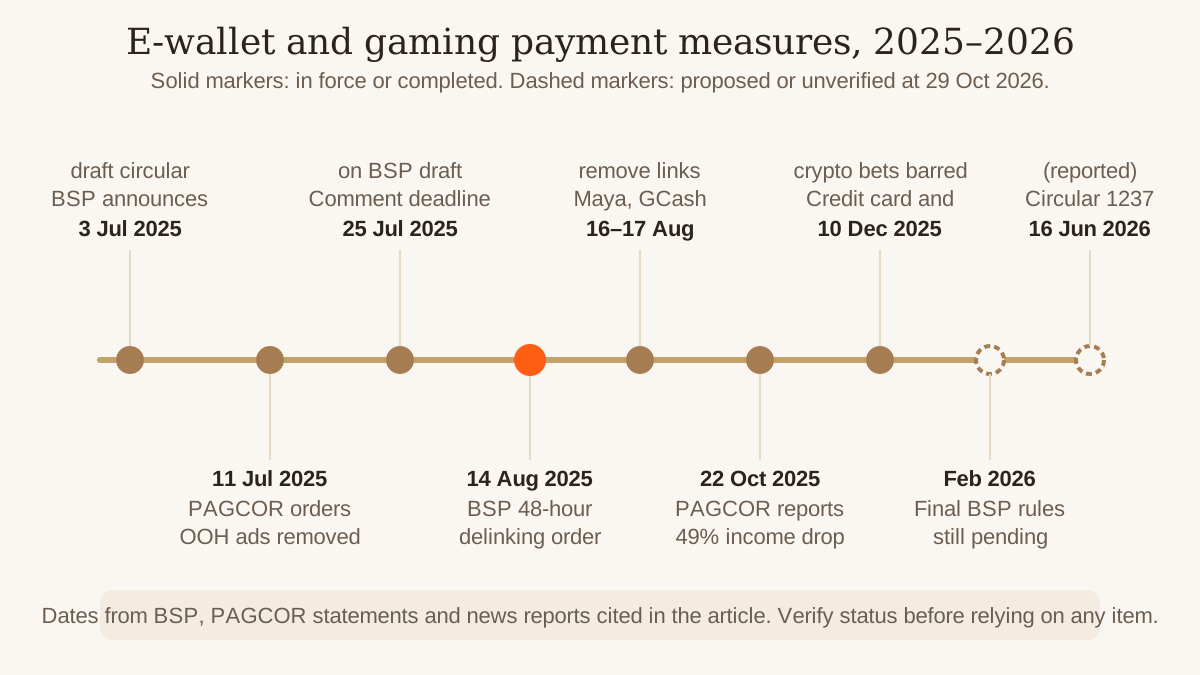
- BSP announces planned circular restricting e-wallet access to online gambling; exposure draft circulated for comment.
- PAGCOR orders removal of out-of-home gambling ads by 15 August 2025 and announces prime-time broadcast limits and an Ad Standards Council MoU.
- Comment deadline on the BSP draft Regulations on Online Gambling Payment Services.
- BSP 48-hour delinking order announced at joint Senate hearing; PAGCOR reports ₱129 million in forfeited winnings from barred players.
- Maya and GCash disable in-app gambling access ahead of the Sunday deadline.
- PAGCOR reports 49 percent income drop; House committee hears bills on e-wallets and betting limits.
- PAGCOR bars credit cards and cryptocurrency for bets and mandates self-exclusion and betting-limit tools.
- PAGCOR tells Senate it favours a full ad ban and seeks restoration of payment linking with stronger safeguards; BSP final circular still pending.
- Reported effectivity of BSP Circular No. 1237 on digital financial marketplaces, said to bar presentation of gambling products (to be verified against the official text).
6What licensed operators must change now
An operator holding a PAGCOR licence cannot control how the BSP regulates wallets, but it controls its own onboarding, cashier and marketing. The following adjustments respond to measures already in force and position the business for the OGTA model if it is adopted.
- Rebuild acquisition around direct access. With super-app tiles gone and out-of-home advertising prohibited, remaining lawful channels are the operator's own domain, pre-screened digital promotions and permitted broadcast slots outside prime time. Marketing plans and affiliate contracts should be re-papered to reflect Ad Standards Council pre-screening.
- Harden identity verification before first deposit. Government ID plus live selfie is now PAGCOR's baseline. Operators should also screen against PAGCOR's National Database of Restricted Persons and their own self-exclusion lists at registration and at each login, not only at withdrawal. The firm's guide to AML and KYC policies for online casinos covers thresholds and evidence retention.
- Remove prohibited instruments. Credit cards and cryptocurrency should be disabled at the cashier, and PSP contracts should be checked for any pass-through of card funding. Operators should document the date of removal and retain configuration evidence for PAGCOR audits.
- Deploy responsible-gaming tools that match the draft BSP standards. Owner-set deposit limits, session-time limits capped at six hours, voluntary breaks, self-exclusion and pop-up alerts are mandated by PAGCOR and mirrored in the BSP draft. Building them now avoids a second rebuild. See responsible gambling requirements and audit-proof implementation.
- Prepare for high-risk merchant due diligence. Under the draft, PSPs must verify an operator's beneficial owners and licence status before onboarding. Operators should keep an up-to-date licence certificate, key-person approvals and ownership chart ready for their acquirers.
- Disclose clearly. Player-facing terms should state the 21-year minimum, the restricted-person categories, the consequences of registering while barred (including forfeiture of winnings, as PAGCOR has applied), and how limits and cooling-off periods operate.
Operators should also avoid player communications that suggest routing around a provider's controls; such messaging risks being read as an inducement to breach BSP-mandated restrictions and could prejudice standing with both regulators.
7What e-money issuers, banks and payment aggregators must prepare
For BSP-supervised institutions the question is whether to serve the gambling segment at all. The draft circular makes that an opt-in requiring prior authority, and the compliance cost is substantial.
Authority and capital. A provider would need prior BSP authority, a qualifying supervisory rating, at least ₱300 million in capital and a board-level AML/CTF committee. Smaller e-money issuers and aggregators below the threshold should decide early whether to exit gambling merchants or restructure.
Product architecture. The OGTA requires a distinct ledger account, on-us funding only, a daily cap computed against average daily balance, time-window enforcement and an automated cooling-off trigger. Providers with embedded lending must be able to disable credit features the moment an OGTA is opened, with consequences for existing loan products.
Merchant onboarding. Operators would be high-risk merchants: enhanced due diligence, beneficial ownership verification and confirmation of licence validity with PAGCOR before activation, with periodic re-verification. Serving an unlicensed operator would be a breach in its own right.
Reporting and sanctions. Monthly reporting on volumes, user counts, first-time versus recurring users, access frequency, age and economic class, and partner operators requires data pipelines most providers do not maintain for a single merchant category. With penalties of up to ₱1 million per transactional violation, a configuration error affecting many users could be costly.
- ₱300 million
Proposed minimum capitalisation for providers offering gambling payment services (BSP draft, Sec. 1106.3) - 20%
Proposed daily OGTA funding cap, measured against the owner's average daily balance (Sec. 1106.6a) - 6 hours
Proposed maximum daily transaction window and playing-time limit (Secs. 1106.6b, 1106.7c) - ₱1 million
Proposed maximum penalty per transactional violation (Sec. 1106.10)
8Open questions and how to approach them
Several issues remain unresolved and will shape compliance planning through 2027.
Will the OGTA framework issue in its draft form? Industry groups have argued that strict limits could push players toward unlicensed sites, while rehabilitation providers have supported daily limits and cooling-off periods but warned they can be circumvented, as recorded in BusinessWorld's reporting. The final text may differ in the cap, the window or the eligibility list. Until it issues, operators should treat the draft as the likely direction of travel rather than a settled rule.
Will Congress pre-empt the regulators? A statutory ban would make the payment architecture moot for the domestic market; statutory betting limits or a mandated minimum top-up would require cashier redesign. Operators with multi-year investment plans should model both outcomes and consider how the 2024–2026 shift from offshore to domestic internet gaming licences has already changed the market.
How will PAGCOR and the BSP coordinate? PAGCOR has asked for payment linking to be restored under stronger safeguards, while the BSP's draft would bar linking outright. Operators should not assume links will return and should design acquisition on the premise that the player initiates every payment from the operator's own platform.
Licensed operators, e-money issuers and payment aggregators affected by these measures can contact Abanto Law Firm through the contact page for a review of onboarding flows, cashier configuration, player terms and regulator correspondence, or visit the firm's gaming licence and iGaming compliance service page for an overview of how the firm assists PAGCOR licensees and their payment partners.
9Frequently asked questions
Can Filipinos still use GCash or Maya to fund a PAGCOR-licensed online casino?
The BSP's 14 August 2025 order required e-wallets and other supervised institutions to remove in-app links and icons to gambling platforms, and Maya and GCash did so by 16–17 August 2025. The order addressed in-app access rather than every form of payment, so whether a particular wallet can still be selected as a payment method at an operator's checkout depends on that provider's own policies and contracts. The BSP's draft rules would permit gambling payments only through a dedicated Online Gambling Transaction Account at an authorised provider. Players and operators should check the provider's current terms rather than rely on earlier practice.
Is the BSP's 20 percent daily cap and six-hour window already the law?
No, not as far as the firm could confirm at the research date of 29 October 2026. Those figures come from the BSP's exposure draft Regulations on Online Gambling Payment Services, circulated for comment in July 2025. The BSP said in September 2025 that it was finalising the rules, but a numbered circular containing them could not be located. They should be treated as proposals until published, and the final text may differ.
What is the minimum age for online gambling in the Philippines?
Twenty-one. PAGCOR applies the 21-year minimum from Presidential Decree No. 1869 and Malacañang Memorandum Circular No. 6 (2016) to registration on licensed online platforms, and the BSP draft adopts the same age for eligibility to open a gambling transaction account. Students, government officials directly connected with government operations, AFP and PNP members, 4Ps beneficiaries and persons on PAGCOR's restricted-persons database are also excluded, and PAGCOR has forfeited winnings from players found to be barred.
Can a licensed operator still accept credit cards or cryptocurrency?
PAGCOR announced on 10 December 2025 that credit cards and cryptocurrencies may no longer be used to pay for bets on licensed platforms, and required operators to provide self-exclusion and betting-limit tools. The announcement did not state a transition date, so licensees should confirm the operative date and any implementing memorandum with PAGCOR. Separately, the BSP draft would disable lending products on a platform once a gambling account is opened, which would also prevent funding bets through embedded credit.
Do these measures apply to offshore or unlicensed gambling sites?
PAGCOR directives bind only its licensees, and the BSP draft would prohibit authorised providers from serving operators that cannot show a valid licence. Unlicensed sites are outside both frameworks, which is why PAGCOR and payment-industry groups have raised concerns about players migrating to them after delinking. Those sites are subject to blocking by the National Telecommunications Commission and to criminal enforcement, and dealing with them exposes players and payment partners to separate legal risk.
What should a payment aggregator serving gaming merchants do while the BSP rules are pending?
Assess whether the business can meet the proposed ₱300 million capital threshold and supervisory-rating requirement; confirm that every gaming merchant holds a current PAGCOR or other recognised licence and document beneficial ownership; remove any links or redirects to operator sites; and begin designing the data pipeline for monthly reporting on volumes, user counts and demographics. Firms that cannot meet the proposed conditions should plan an orderly exit from the segment rather than risk suspension once a six-month transition period begins.
Sources and references
- Exposure Draft: Circular on the Regulations on Online Gambling Payment Services — Bangko Sentral ng Pilipinas
- BSP gives e-wallets 48 hours to unlink from online gambling sites — GMA News Online (2025-08-14)
- PAGCOR: P129 million online gambling prizes of banned bettors voided — GMA News Online (2025-08-14)
- E-wallets unlink from online gambling platforms — GMA News Online (2025-08-17)
- PAGCOR: Online gambling transactions down 50% since e-wallets ban — GMA News Online (2025-08-20)
- PAGCOR revenue drops 49% after e-wallets cut gambling links — Philstar.com (2025-10-22)
- How the BSP's upcoming rules could make or break online gambling — BusinessWorld (2025-09-15)
- PAGCOR orders immediate removal of gambling billboards, tightens ad rules — Asia Gaming Brief (2025-07-11)
- PAGCOR blocks credit card, digital currency for gambling payments — Manila Bulletin (2025-12-10)
- PAGCOR to implement stronger Philippines iGaming regulations — iGaming Business (2026-02-11)
- BSP sets deadline for feedback on new online gambling rules — BitPinas (2025-07-15)
- BSP Updates 2026: What's New for Philippine Merchants — PayMongo (industry blog) (2026-08-05)
This article is for general informational purposes only and does not constitute legal advice. Laws, regulations, and regulatory requirements may change, and reading this article does not create an attorney-client relationship with Abanto Law Firm. Readers should consult qualified Philippine legal counsel regarding their specific circumstances.