Gaming Law & Compliance
Illegal Online Gambling Enforcement in the Philippines, 2025–2026
Site blocking, payment delinks, influencer prosecutions and the Anti-POGO Act have reshaped enforcement. Here is how each channel works and what a licensed operator should keep on file.

1Why enforcement against illegal online gambling hardened in 2025–2026
For most of the past decade, enforcement against unlicensed online gambling in the Philippines was a background activity: PAGCOR referred domains for blocking, telcos restricted them, and the sites reappeared under new names. That changed in mid-2025. PAGCOR data presented to the Senate showed 32.1 million electronic gaming player registrations from January to May 2025, up from 8.2 million in all of 2024. A wave of Senate bills, hearings and executive directives followed, and the agencies that police the digital space — the Department of Information and Communications Technology (DICT), its Cybercrime Investigation and Coordinating Center (CICC), the National Telecommunications Commission (NTC), the PNP Anti-Cybercrime Group (PNP-ACG) and the Presidential Anti-Organized Crime Commission (PAOCC) — became central actors alongside PAGCOR.
Two features of the current approach matter for anyone operating in or around the sector. First, enforcement is now multi-channel: the same operator can be hit by an NTC blocking directive, a payment delink, an app-store removal, a social-media takedown and a criminal referral in the same month. Second, the line between a "legitimate" and an "illegal" platform is being drawn in public, at hearings and in agency press releases, often on the basis of what documentation an operator can show. This article explains how each enforcement channel works as of 29 October 2026, what the law behind it is, and what a licensed operator should keep ready so that its own brands, domains and affiliates are not swept into an illegal-gambling action.
- Site blocking runs through a PAGCOR–CICC/DICT–NTC chain and is measured in tens of thousands of domains, but the CICC itself says 95–97% of illegal sites are hosted offshore and resurface quickly.
- The BSP's 14 August 2025 order removing in-app gambling links from e-wallets was the single most consequential 2025 measure; PAGCOR reported transactions on licensed sites fell roughly 50% within days.
- Influencer and affiliate promotion is now a criminal-referral matter: the CICC has endorsed influencers to the PNP-ACG citing PD 1602, RA 10175 and estafa.
- Republic Act No. 12312 (Anti-POGO Act of 2025) and the April 2026 inter-agency SOP give offshore-gaming enforcement a permanent statutory footing; a general Online Gambling Regulatory Act (Senate Bill No. 57) remained a bill as of the research date.
- A licensed operator's best defence is a maintained evidence file: licence documents, an approved brand and domain inventory, affiliate contracts and geo-blocking logs.
2The legal foundation: what makes an online gambling site "illegal"
Philippine law does not have a single online gambling statute. Illegality is established by the absence of authority from a body empowered to grant it, combined with penal provisions written for gambling generally. The main pieces are:
- Presidential Decree No. 1602 (1978), which prescribes penalties for illegal gambling and remains the workhorse charging provision. It is the statute the CICC has cited when endorsing influencers and operators for prosecution.
- Republic Act No. 9287 (2004), which increased penalties for illegal numbers games such as jueteng and masiao; it is relevant where an online product mimics a numbers game.
- Republic Act No. 10175 (Cybercrime Prevention Act of 2012). Section 6 provides that crimes defined in the Revised Penal Code and special laws, when committed through information and communications technologies, carry a penalty one degree higher.
- PAGCOR's charter (Presidential Decree No. 1869, as amended by Republic Act No. 9487), which gives PAGCOR authority to license and regulate games of chance, and under which the current Electronic Games and remote gaming licences are issued. For how those licences are structured, see our guide to the PAGCOR remote gaming licence.
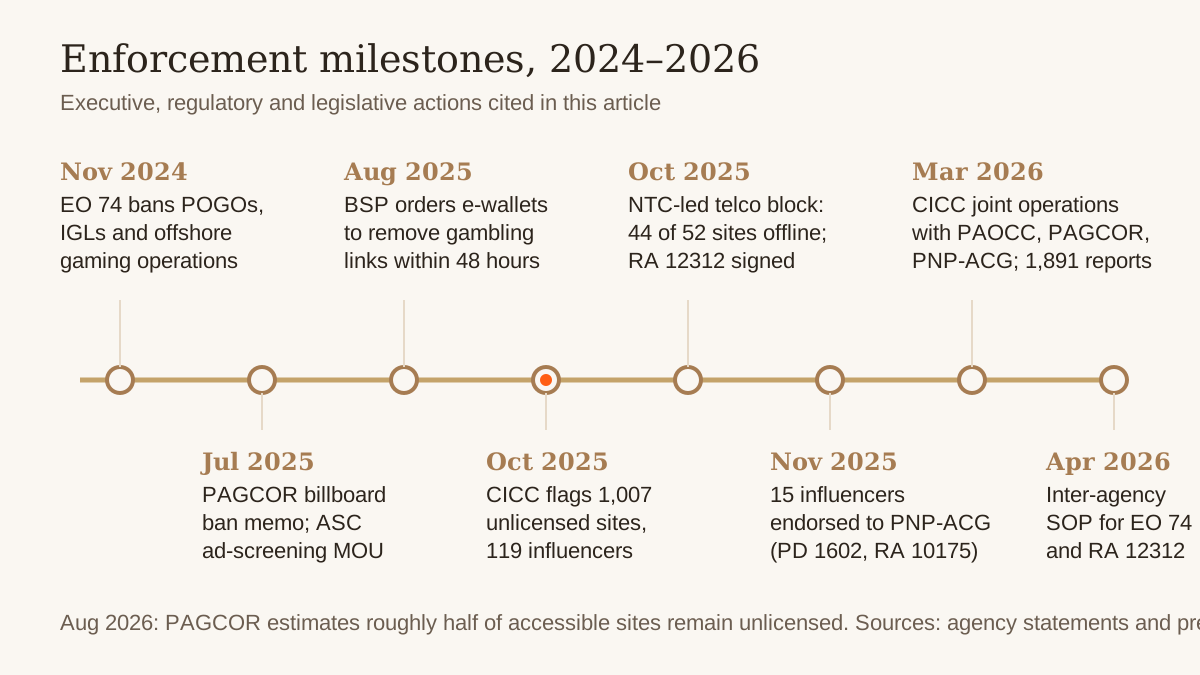
- Executive Order No. 74 (signed 5 November 2024), which banned Philippine Offshore Gaming Operators, Internet Gaming Licensees and other offshore gaming operations, ordered them to cease by 31 December 2024, and created a PAOCC-chaired technical working group on anti-illegal offshore gaming with the DOJ as vice chair.
- Republic Act No. 12312 (Anti-POGO Act of 2025), which made the offshore ban statutory. As reported by the Philippine Star on 30 October 2025, it prohibits establishing or operating offshore gaming, accepting bets for it, acting as a POGO service provider, or allowing premises or digital platforms to be used for it; penalties run from six to eight years' imprisonment and fines of P300,000 to P15 million for a first offence, rising to twelve years and P50 million for a third. Violations are predicate offences under the Anti-Money Laundering Act.
3Site blocking: how a domain goes from detection to an NTC directive
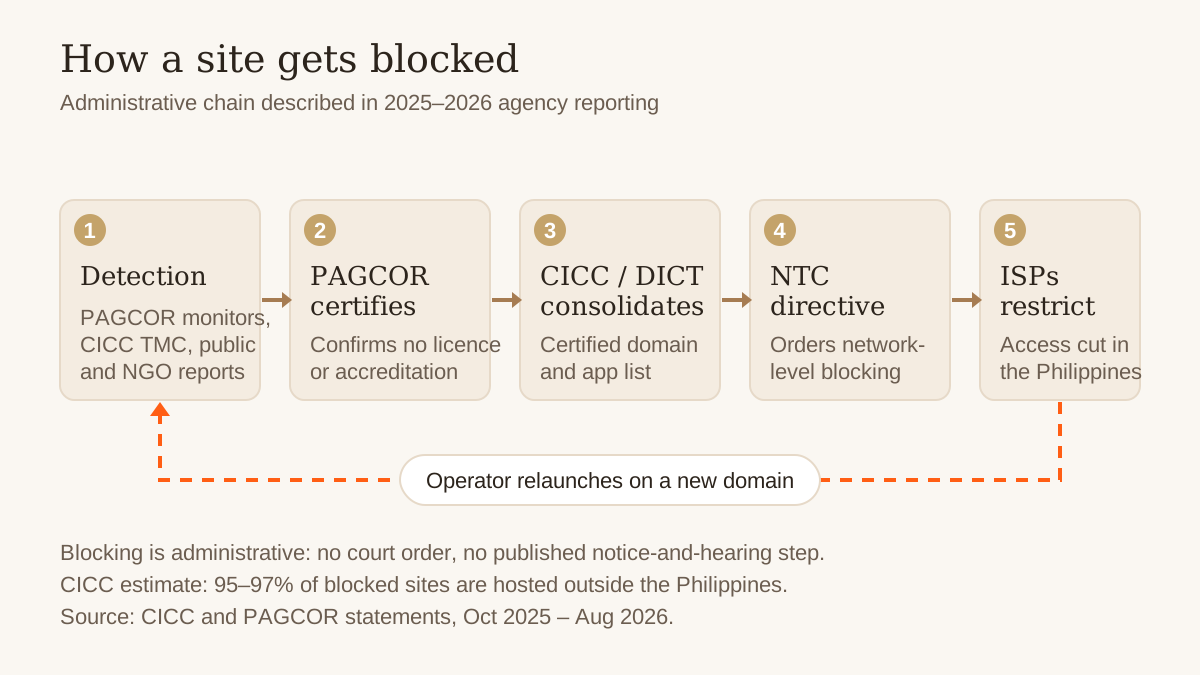
Blocking is administrative, not judicial. The chain, as described by PAGCOR and the CICC in 2025–2026 reporting, runs as follows. PAGCOR's monitoring unit, the CICC's Threat Monitoring Center and civil-society reporters (notably the group Digital Pinoys) identify domains and apps offering gambling. PAGCOR confirms that the operator holds no licence and certifies the list. The CICC, under DICT, consolidates the certified list and the NTC directs internet service providers to apply network-level restrictions. In an operation reported on 2 October 2025, the NTC-led directive saw PLDT/Smart, Globe, Converge and DITO render 44 of 52 identified sites inaccessible, with the CICC noting that several operated disguised as livestreaming or entertainment apps.
The reported figures show both the scale and the limits of the method:
- 5,793 of 7,747
illegal sites PAGCOR reported blocked by July 2024 (about 75%), per figures given to a Senate committee - 44 of 52
sites taken offline across four telcos in the NTC-led operation reported 2 October 2025 - ~10,000
cumulative sites the CICC said it had shut down as of October 2025 - 50,000+
sites the CICC told a Senate hearing it had blocked, as reported 18 February 2026 - 95–97%
share of blocked sites the CICC says are hosted outside the Philippines - ~50/50
PAGCOR's August 2026 estimate of the licensed-to-unlicensed split among sites accessible in the country
The weakness is persistence. Testifying in February 2026, CICC Executive Director Renato Paraiso acknowledged that blocked operators reappear under new domains or server locations, and proposed "cyber diplomats" and expanded mutual legal assistance treaties covering cybercrime. PAGCOR Chairman Alejandro Tengco made the same point to DZRH on 26 August 2026: operators relaunch by changing a letter or adding a number to the domain. He also noted that illegal operations were estimated at more than 90% of the market when he assumed office, so the current 50/50 estimate represents progress rather than failure.
Senate Bill No. 57 would formalise this process. Its Sections 13 and 18 provide for regulatory authorities to issue "disabling orders" against unlicensed platforms, implemented by the NTC through ISPs, with intermediaries required to remove violating content within 24 hours and DICT monitoring compliance. Until a law of that kind is enacted, blocking rests on the agencies' general mandates and inter-agency cooperation rather than on an express statutory procedure with defined notice and appeal rights.
4Payment chokepoints: the BSP order and what followed
Blocking addresses access. Payment controls address money, and in 2025 they proved more immediately disruptive. At a Senate inquiry on 14 August 2025, Bangko Sentral ng Pilipinas Deputy Governor Mamerto Tangonan confirmed that the BSP had that morning directed BSP-supervised financial institutions to remove in-app links and icons to online gambling platforms within 48 hours. GCash suspended gaming access through its GLife feature on 16 August; Maya disabled its "The Games" feature the same weekend.
The directive applied to licensed and unlicensed platforms alike, because it targeted the e-wallets' own product integrations rather than individual merchants. Its effect on the regulated market was immediate. PAGCOR Chairman Tengco told a House appropriations briefing on 20 August 2025 that transactions on licensed online gambling platforms had dropped by roughly 50% in the first days after the delink, based on PAGCOR's own observations. He also said fewer than 40% of operators accessible to Filipinos were licensed, with the rest operating offshore.
Senators pressed for more. Senator Sherwin Gatchalian called for a full delinking of e-wallets and bank accounts from betting, and on 18 August 2025 urged PAGCOR, DTI and DICT to order the removal of gambling links embedded in messaging and e-commerce apps, naming Viber, Telegram and Lazada. His Senate Bill No. 57 would go further, prohibiting e-wallets and similar non-bank channels for funding and withdrawals altogether and requiring AMLC-compliant channels with a P10,000 minimum initial cash-in. For licensed operators, the practical lesson is that payment rails are now a regulatory variable, not just a commercial one. Payment partners now ask licensed operators for the same AML, KYC and source-of-funds evidence that regulators do.
5Advertising, influencers and app stores
The third enforcement channel targets promotion. PAGCOR moved first against outdoor advertising: a memorandum dated 7 July 2025 directed licensees, suppliers, system administrators and venue operators to inventory all billboard and out-of-home gambling ads by 16 July and remove them by 15 August 2025, with only institutional and responsible-gaming campaigns permitted thereafter, subject to approval. On 16 July 2025, PAGCOR and the Ad Standards Council signed a memorandum of understanding adding gambling to the ASC's must-screen categories, so that licensees' advertisements require ASC clearance before publication. Our piece on advertising restrictions for licensed online casinos sets out the current rulebook in detail.
Influencer promotion of unlicensed sites has been treated as a criminal matter rather than an advertising-standards matter. The sequence reported in 2025–2026 was:
- CICC ends "appeals" to influencers. The CICC said it would stop issuing appeals to endorsers of illegal sites and instead send demand letters warning of criminal charges, and would ask platforms to remove offending channels (AGB, 13 July 2025).
- 1,007 unlicensed sites and 119 influencers flagged. The CICC Threat Monitoring Center reported 1,007 sites operating without PAGCOR accreditation, 146 of them tied to illegal online sabong, and 119 influencers promoting them through livestreams and referral links (Newsbytes, 2 October 2025).
- 15 influencers endorsed to the PNP-ACG for case build-up. The CICC cited PD 1602, RA 10175 and Article 315 of the Revised Penal Code (estafa) as the bases for possible charges (Newsbytes, 13 November 2025).
- Ten influencers referred for prosecution. The CICC confirmed it had referred cases against ten influencers to the PNP-ACG; some accounts were taken down, and first-time offenders reportedly pledged to support responsible-gaming initiatives (Diskurso, 16 March 2026).
App-store removal is the least transparent channel. PAGCOR told the Senate in 2024 that it had asked Google Play and Apple's App Store to remove illegal apps, and in October 2025 DICT and the CICC said they would ask both companies to delist the apps covered by the NTC operation. Neither Apple nor Google publishes Philippine-specific removal statistics, and as of the research date no public record confirms how many requests were granted. Operators of licensed real-money apps should note that both stores require evidence of licensing for the territories where an app is distributed, and that a mistaken takedown is far easier to reverse when that evidence is already on file with the store.
6Inter-agency operations, prosecution and the April 2026 SOP
Blocking and delinking are measures against access; the agencies have also moved toward building criminal cases. On 16 March 2026, the CICC announced it had logged 1,891 reports of illegal online gambling in the first three months of 2026 and had formalised joint operations with PAOCC, PAGCOR, the PNP-ACG and Digital Pinoys. Under the arrangement, the CICC supports PAOCC case build-up with digital forensics and leads blocking of sites flagged by PAGCOR and PAOCC. PAOCC Executive Director Benjamin Acorda described closer coordination as necessary to dismantle operations and act against cybercrime syndicates.
On 22 April 2026, agencies signed an Inter-Agency Standard Operating Procedure implementing Executive Order No. 74 and Republic Act No. 12312, at a ceremony presided over by Executive Secretary Ralph Recto. According to Malacañang, the SOP designates PAOCC as lead coordinating agency, has the Department of Justice assign prosecutors early in case build-up, assigns financial and corporate intelligence to the AMLC and SEC, and sets rules for evidence handling, asset preservation and disposal of seized properties. Although written for offshore gaming, the SOP is the most detailed public description of how illegal-gambling raids are meant to proceed, and licensed operators whose premises or staff might be mistaken for an offshore operation should understand it.
7The legislative track: bills, hearings and what is still pending
Enforcement in 2025–2026 has been driven as much by Congress as by the agencies. The Senate Committee on Games and Amusements opened its inquiry on 14 August 2025 with four bills, three resolutions and a privilege speech before it. The measures divide into two camps:
| Approach | Principal measure | Core features | Status as of 29 Oct 2026 |
|---|---|---|---|
| Regulate strictly | Senate Bill No. 57 (Online Gambling Regulatory Act), Sen. Gatchalian, filed July 2025 | Licensing only by PAGCOR and other statutory authorities; age 21; biometric KYC and MFA; P10,000 minimum cash-in; no e-wallet funding; ASC-style ad limits; NTC disabling orders with 24-hour intermediary compliance; 6–8 years' imprisonment for facilitating unlicensed gambling, 2–4 years for advertising it | Pending in committee as of the research date; confirm current status with the Senate Legislative Information System |
| Prohibit | Total-ban bills filed by Senators Zubiri, Go and Tulfo, July 2025 | Prohibition of online wagering; PAGCOR said it would implement whatever Congress enacts | Pending; Malacañang said in 2025 a ban needed thorough study |
| Offshore ban (enacted) | Republic Act No. 12312 (Anti-POGO Act of 2025) | Statutory ban on offshore gaming; licence revocation; AMLA predicate; forfeiture; PAOCC-DOJ-DICT-DILG oversight committee | In force; implemented by the 22 April 2026 inter-agency SOP |
A second round of hearings in February 2026 produced the "50,000 sites" testimony and Senator Gatchalian's criticism that blocking alone is insufficient. As of 29 October 2026, no general online gambling regulatory statute had been identified as enacted; readers should verify the status of Senate Bill No. 57 and its House counterparts directly with the Senate and House legislative information systems before relying on any provision described here. PAGCOR's position, stated repeatedly, is that it supports stricter regulation and would enforce a ban if one is legislated.
8What a licensed operator should keep ready
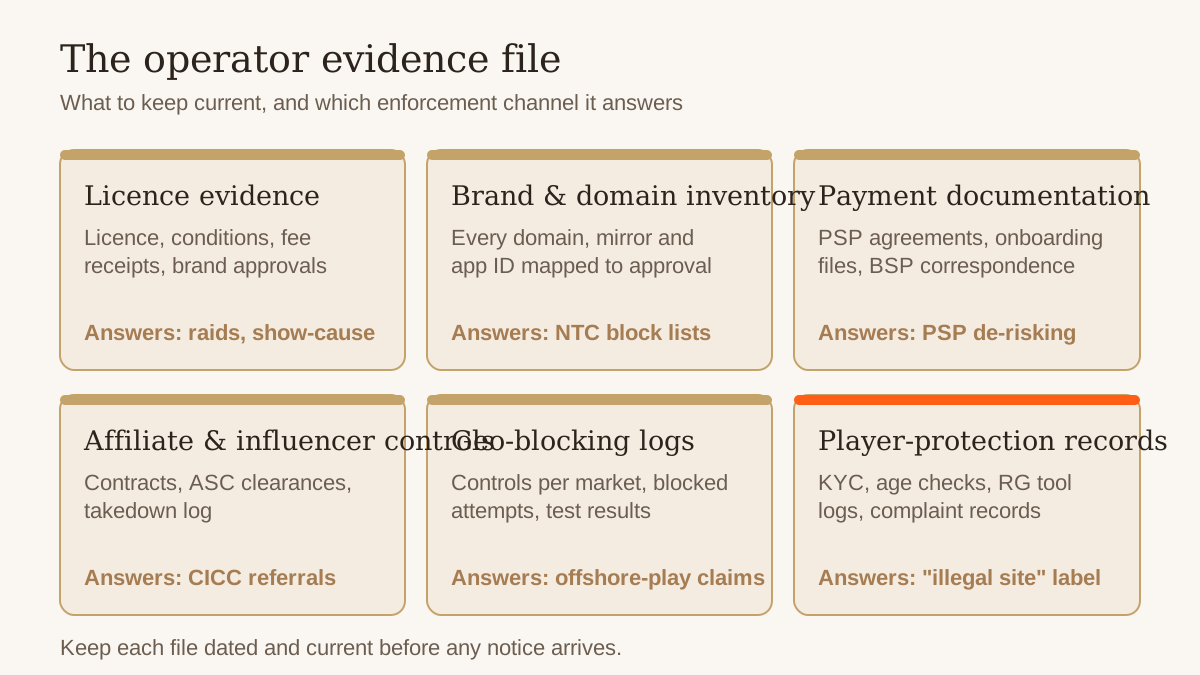
Every channel described above works from lists: lists of domains, apps, merchant accounts, advertisers and influencers. A licensed operator is swept into an enforcement action when one of its assets appears on a list and it cannot immediately prove authority. The remedy is an evidence file maintained continuously, not assembled under pressure. At minimum it should contain:
- Licence evidence. The current PAGCOR licence or certificate of accreditation, the licence conditions, proof of fee payments and any amendments, together with the regulator's letters approving each brand.
- Brand and domain inventory. A dated register of every domain, subdomain, mirror and app bundle identifier the operator uses, mapped to the PAGCOR brand approval that covers it, with registrar records showing the operator or a disclosed affiliate as registrant. Unregistered mirrors are the commonest reason a licensed brand ends up on a block list.
- Payment-channel documentation. Merchant agreements, PSP onboarding files and BSP-related compliance correspondence, so that a payment partner's de-risking decision can be answered with evidence rather than assertion.
- Affiliate and influencer controls. Signed contracts with every affiliate and content creator, the ASC clearance for each campaign, pre-approval records for creatives, a takedown log showing how quickly non-compliant promotions were removed, and evidence that no affiliate promotes unlicensed brands alongside the operator's. Our article on affiliate compliance explains the contract terms that matter.
- Geo-blocking and access logs. Documentation of the geolocation controls applied to each market, retained logs of blocked access attempts and periodic test results, demonstrating that the operator accepts play only where it is licensed to do so. Our guide to geo-blocking and market restrictions covers the technical and evidentiary standard.
- Player-protection evidence. KYC and age-verification records, responsible-gaming tool logs and complaint handling records; these are what PAGCOR cites as missing from illegal sites, and an operator that cannot produce them looks like one.
- A contact protocol. Named points of contact at PAGCOR, the PSP and the app stores, and an internal procedure for responding within hours to a blocking notice, store takedown or media inquiry.
Operators should also monitor the lists themselves. The CICC publishes crackdown figures, PAGCOR maintains its licensee directory, and both agencies have encouraged the public to check licensing status on PAGCOR's website before playing. A licensed operator that checks its own entries, and the absence of its domains from blocked-site reporting, catches errors early.
9Outlook and next steps
The direction of policy is consistent: more agencies, more channels and a stronger statutory base, with the open question being whether Congress chooses strict regulation or prohibition. Either outcome increases the value of documentation. Under Senate Bill No. 57, disabling orders would acquire a statutory procedure and intermediaries a 24-hour compliance clock; under a ban, the distinction between an operator that lawfully wound down and one that continued would turn entirely on records. In the meantime, the CICC's own figures show that blocking is a volume exercise that depends on PAGCOR certification, which means a mistaken certification is both possible and correctable.
Abanto Law Firm advises licensed and prospective online gaming operators on PAGCOR licensing, brand and domain approvals, affiliate and advertising compliance, and responses to blocking, payment and takedown actions. If your platform has received a notice, or you want an evidence file reviewed before one arrives, see our gaming licence practice or contact the firm to arrange a consultation.
10Frequently asked questions
Who actually blocks illegal gambling websites in the Philippines?
No single agency does. In current practice PAGCOR certifies that a site is unlicensed, the Cybercrime Investigation and Coordinating Center under the DICT consolidates the certified list, and the National Telecommunications Commission directs internet service providers to restrict access at network level. The CICC reported in February 2026 that more than 50,000 sites had been blocked this way, while acknowledging that most are hosted offshore and reappear under new domains.
Is it a crime to promote an unlicensed online gambling site on social media?
Enforcement agencies treat it as one. Since November 2025 the CICC has endorsed influencers to the PNP Anti-Cybercrime Group for case build-up, citing Presidential Decree No. 1602 on illegal gambling, Republic Act No. 10175 (which raises penalties for offences committed through ICT) and Article 315 of the Revised Penal Code on estafa. Whether a particular promotion is punishable depends on the facts, and courts had not, as of the research date, issued reported decisions on these referrals. Licensed operators should also note that PAGCOR requires Ad Standards Council clearance for their own advertising.
Did the BSP ban e-wallets from processing gambling payments?
Not entirely. On 14 August 2025 the Bangko Sentral ng Pilipinas directed supervised institutions to remove in-app links and icons to online gambling platforms within 48 hours; GCash and Maya complied by 16 August. This removed gambling from the e-wallets' own product menus for licensed and unlicensed platforms alike. A broader prohibition on using e-wallets to fund gambling is proposed in Senate Bill No. 57 but had not been enacted as of 29 October 2026.
Can a licensed operator's domain be blocked by mistake, and what can it do?
Yes. Blocking lists are built from detection reports and PAGCOR certification, and an undisclosed mirror domain or an affiliate's landing page can be listed. There is no published notice-and-hearing procedure for administrative blocking. The practical remedy is to present the licence and brand approval to PAGCOR, ask it to withdraw the certification to the CICC, and keep a record of the revenue impact. Maintaining a complete, dated domain inventory mapped to brand approvals is the best way to make that correction fast.
Does the Anti-POGO Act of 2025 affect locally licensed online gaming operators?
Republic Act No. 12312 is directed at offshore gaming operations, meaning platforms serving players outside the Philippines. It does not revoke PAGCOR's domestic electronic gaming or remote gaming licences. It does, however, prohibit allowing premises or digital platforms to be used for offshore gaming and treats violations as money-laundering predicate offences, so a domestic licensee that shares infrastructure, staff or payment channels with an offshore operation faces exposure. The April 2026 inter-agency SOP governs how such cases are investigated.
Has the Philippines passed a law regulating online gambling generally?
As of 29 October 2026, no. Online gambling is regulated through PAGCOR's charter and licence conditions, with illegality determined by the absence of PAGCOR authority and penalised under PD 1602 and related laws. Senate Bill No. 57, the proposed Online Gambling Regulatory Act, and several total-ban bills were filed in July 2025 and have been the subject of hearings, but their current status should be confirmed with the Senate and House legislative information systems.
Sources and references
- BSP orders e-wallets to remove online gambling links — The Philippine Star (2025-08-15)
- PAGCOR: Online gambling transactions down 50% since e-wallets ban — GMA News Online (2025-08-20)
- Telcos work together to block 44 illegal gambling sites — PEP.ph (2025-10-02)
- CICC flags over 1,000 illegal gambling sites, 100+ influencers in crackdown — Newsbytes.PH (2025-10-02)
- CICC moves to prosecute influencers pushing illegal gambling — Newsbytes.PH (2025-11-13)
- Marcos signs law banning POGOs (Republic Act No. 12312) — The Philippine Star (2025-10-30)
- Executive Order No. 74, s. 2024 — The LawPhil Project (Arellano Law Foundation) (2024-11-05)
- Senate Bill No. 57 — Online Gambling Regulatory Act (20th Congress) — Office of Senator Win Gatchalian (2025-07-02)
- The Philippines CICC proposes new measures amid challenge of controlling illegal gambling sites — Focus Gaming News (2026-02-20)
- Nearly 1,900 illegal online gambling reports logged in first 3 months — CICC — Manila Bulletin (2026-03-16)
- Palace believes signed rules to bury POGO, prevent its return — Manila Bulletin (2026-04-22)
- PAGCOR: 50 percent of online gaming sites accessible in PH are illegal — DZRH News (2026-08-26)
This article is for general informational purposes only and does not constitute legal advice. Laws, regulations, and regulatory requirements may change, and reading this article does not create an attorney-client relationship with Abanto Law Firm. Readers should consult qualified Philippine legal counsel regarding their specific circumstances.