Gaming Law & Compliance
Foreign Investors in Philippine Gaming Tech: Ownership Rules and Incentives
Suppliers can be fully foreign-owned; operators cannot. A guide to the 13th Negative List, Anti-Dummy Law, SEC beneficial-ownership rules, CREATE MORE incentives and the red flags left by the offshore gaming ban.

1Why the first question is "operator or supplier?"
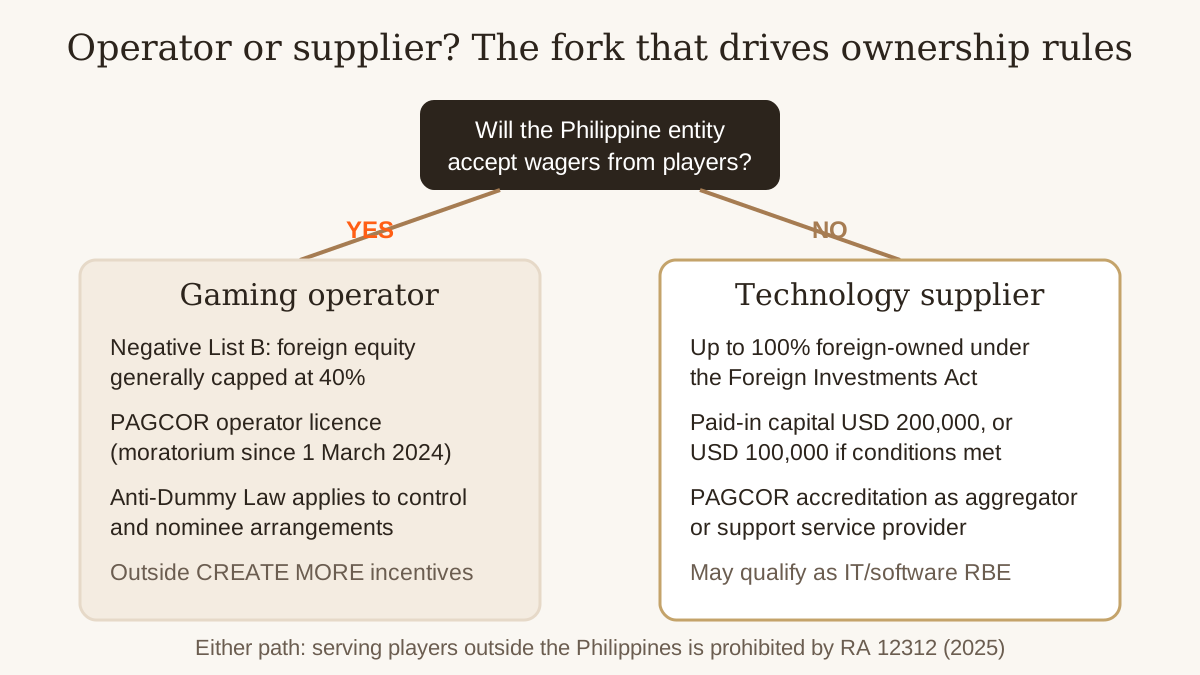
Foreign founders looking at the Philippine gaming-technology market usually arrive with one of two business models. The first is to operate: to hold a licence from the Philippine Amusement and Gaming Corporation (PAGCOR) and take wagers from players in the Philippines. The second is to supply: to build platforms, game content, aggregation layers, payment or KYC tooling, live-studio technology or data services that licensed operators use. Philippine law treats these two models very differently, and most of the ownership, incentive and immigration analysis flows from that single choice.
Operating a gambling business is a nationalised activity that sits in the Foreign Investment Negative List. Supplying technology to a gambling business is, in general, an ordinary commercial activity that a wholly foreign-owned Philippine corporation can carry on, provided it meets the Foreign Investments Act capitalisation rules and obtains the PAGCOR accreditation that B2B suppliers now need. That difference decides whether a foreign group can own 100 percent of its Philippine company, whether it can register for tax incentives, and how exposed it is to the Anti-Dummy Law.
The backdrop matters too. Between 2024 and 2026 the Philippines dismantled the offshore gaming sector through an executive order, a statute and an inter-agency enforcement plan, and regulators, banks and counterparties now assess every gaming-adjacent investor against that history. This article maps the rules as of 29 October 2026 and flags the points that still need confirmation. It complements the firm's guide to how PAGCOR, CEZA and APECO licence paths differ.
- Gambling operations remain a 40 percent foreign-equity activity on the Negative List; technology supply is not, so suppliers can generally be 100 percent foreign-owned.
- The 13th Negative List (Executive Order No. 113, 13 April 2026) kept the core gaming restriction while liberalising other sectors.
- CREATE MORE (Republic Act No. 12066, November 2024) offers a 20 percent corporate income tax rate under enhanced deductions and a 50 percent work-from-home allowance to registered business enterprises, but gambling operations are not an incentivised activity.
- Offshore gaming is banned by EO 74 (2024) and criminalised by RA 12312 (23 October 2025); any structure that serves foreign players from Philippine infrastructure is a red flag, not a grey area.
- Nominee shareholdings to work around the 40 percent cap expose investors to the Anti-Dummy Law and to SEC beneficial-ownership penalties that increased from 1 January 2026.
2The Foreign Investments Act and the 13th Negative List
The Foreign Investments Act of 1991 (Republic Act No. 7042), as amended most recently by Republic Act No. 11647 (approved 2 March 2022), sets the default rule: non-Filipinos may own up to 100 percent of a domestic enterprise unless the activity appears on the Foreign Investment Negative List. A "Philippine national" for these purposes is a corporation at least 60 percent of whose outstanding capital stock entitled to vote is owned by Filipinos. The Act also reserves micro and small domestic market enterprises with paid-in capital below USD 200,000 to Filipinos. That floor drops to USD 100,000 where the enterprise uses advanced technology as determined by the Department of Science and Technology, is endorsed as a startup or startup enabler under the Innovative Startup Act, or employs a majority Filipino workforce of at least 15 direct employees.
On 13 April 2026 President Marcos signed Executive Order No. 113, promulgating the 13th Regular Foreign Investment Negative List and replacing the 12th list issued under EO 175 (2022). The order was published in mid-April 2026 and took effect fifteen days later, in the first days of May 2026. Law-firm summaries of the new list, such as the one published by Cruz Marcelo & Tenefrancia, describe the 13th list as consolidating earlier liberalisation (renewable energy, telecommunications subject to reciprocity, retail trade, government procurement) rather than reopening the core restrictions. Gambling stays in List B, which is the part of the list reserved for reasons of security, defence, health, morals and the protection of small enterprises, with foreign equity generally capped at 40 percent. The 12th list framed the entry as gambling "except those covered by investment agreements with PAGCOR"; investors should have counsel confirm the exact wording carried into the 13th list before relying on it.
Three consequences follow:
- Operators: a company that will hold the PAGCOR licence and take wagers should be a Philippine national, with at least 60 percent of voting stock in Filipino hands, unless a PAGCOR investment agreement applies, as in integrated-resort structures negotiated case by case.
- Suppliers: a platform provider, game studio, aggregator or support-service provider that does not itself accept bets is not on the list and may be 100 percent foreign-owned, subject to the capitalisation rules and to any sector rule for the particular service (for example, payment services regulated by the Bangko Sentral ng Pilipinas).
- Export enterprises: a studio that exports at least 60 percent of its output may register with the Board of Investments as an export enterprise and avoid the domestic-market capital floors, provided domestic sales stay under 40 percent.
3The Anti-Dummy Law and the SEC's 2026 beneficial-ownership rules
The temptation for a foreign investor in a 40 percent sector is to find Filipino partners who hold shares in name only. The Anti-Dummy Law (Commonwealth Act No. 108, as amended by Presidential Decree No. 715) makes that a crime for both sides. It penalises a Filipino who permits his or her name or citizenship to be used to evade a nationality requirement, and a foreigner who uses it, and it separately prohibits foreigners from intervening in the management, operation or control of a nationalised business beyond what their equity allows. Foreigners may sit on the board in proportion to their shareholding, but a 40 percent shareholder who in practice runs a gaming operator's day-to-day business is at risk. Penalties include imprisonment and fines, and arrangements that merely simulate compliance are treated as void.
Enforcement has become easier because the SEC can now see who stands behind the shares. On 23 December 2025 the Commission announced SEC Memorandum Circular No. 15, Series of 2025, the Beneficial Ownership Disclosure Rules of 2026, effective 1 January 2026. The rules apply to domestic and foreign corporations, partnerships and one-person corporations; set a 20 percent threshold for Category A beneficial owners, with further categories (A to I) capturing control through other means; make nominee reporting mandatory; and move filings to a dedicated digital registry that will replace the beneficial-ownership section of the General Information Sheet. Fines for stock corporations start at PHP 50,000 for a first violation, false beneficial-ownership information can draw fines of up to PHP 2 million and dissolution, and responsible officers who make false declarations face fines of up to PHP 1 million and a five-year disqualification from serving as directors or officers. In November 2025 the SEC revoked the registration of two construction companies for failing to disclose a beneficial owner.
For a gaming group, these rules interlock with PAGCOR's own probity regime. According to the Philippines chapter of the Chambers Gaming Law 2025 guide (updated 25 November 2025), PAGCOR requires a notarised beneficial-ownership declaration, personal disclosure sheets for directors and shareholders, third-party probity checks taking roughly 30 to 45 working days, prior Board approval for changes resulting in more than 50 percent ownership or voting control, and reporting of ownership changes within set periods. A nominee arrangement must therefore survive two disclosure regimes, each with its own sanctions; the firm's article on key persons and fit-and-proper checks covers the PAGCOR side.
4Public Service Act amendments and other sector rules that touch gaming infrastructure
Gaming-technology companies frequently run or lease infrastructure that sits in other regulated sectors. The Public Service Act, as amended by Republic Act No. 11659 (approved 21 March 2022), narrowed the constitutional 40 percent cap to a closed list of "public utilities": electricity distribution and transmission, petroleum pipelines, water and sewerage pipelines, seaports and public utility vehicles. Telecommunications and most other public services fell outside that list and became open to full foreign ownership, with two important qualifications. Telecommunications and other services the President designates as "critical infrastructure" are subject to a reciprocity rule, so a foreign national may not own more than 50 percent unless its home country grants Filipinos similar rights. Entities controlled by foreign governments or foreign state-owned enterprises may not own capital in a public utility or critical infrastructure at all, apart from a collective 30 percent allowance for sovereign wealth and independent pension funds.
A game studio or platform company is not itself a public service, but a group that wants to own its connectivity, data-centre or payments layer should check whether that activity triggers the Public Service Act, National Telecommunications Commission rules or Bangko Sentral licensing as an operator of payment systems. Advertising is a separate trap: the Constitution caps foreign equity in advertising at 30 percent and the 13th list keeps that entry in List A, so a foreign-owned affiliate-marketing or media-buying business serving gaming brands must analyse whether its activities fall within regulated "advertising".
5Incentives: CREATE MORE, PEZA and the Board of Investments
The incentive conversation for gaming technology is, in substance, a conversation about software and IT services, not gambling. Republic Act No. 12066, the CREATE MORE Act, was signed in November 2024 (the signing ceremony was reported on 11 November 2024; the text published on LawPhil carries an approval date of 8 November 2024). It amended the National Internal Revenue Code to make the post-CREATE incentive system more usable. Its implementing rules were signed by the Departments of Finance and Trade and Industry on 17 February 2025, as reported by the Philippine Daily Inquirer.
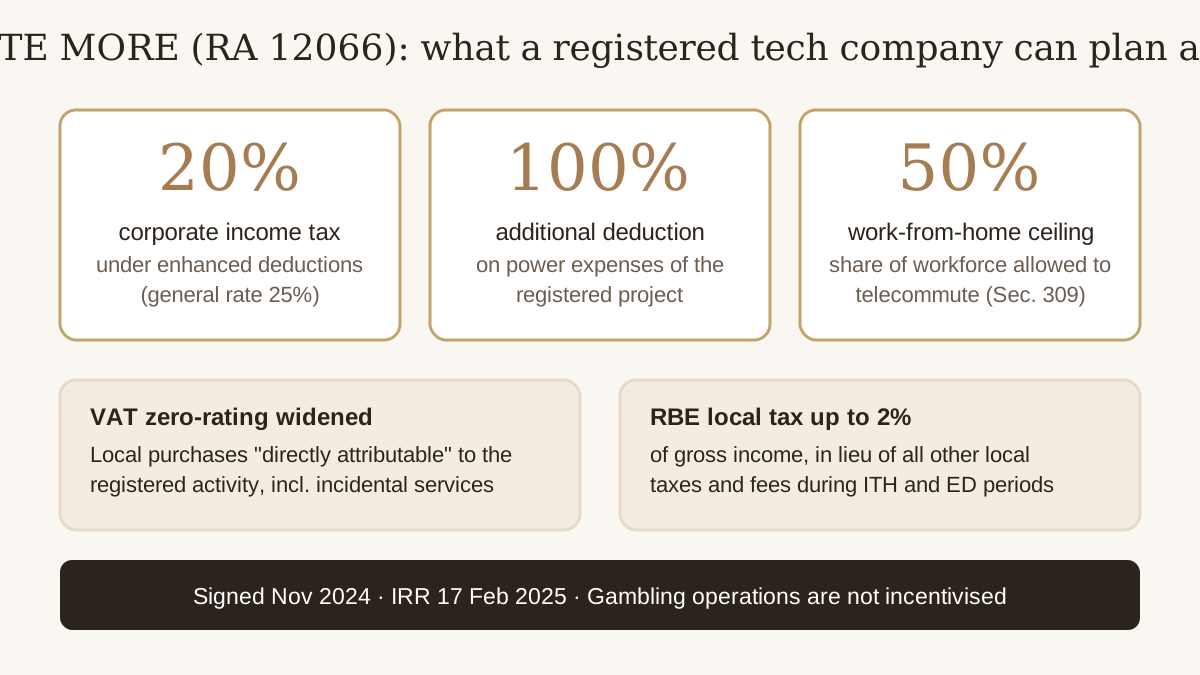
The headline features for a technology company registered with an investment promotion agency (IPA) such as the Philippine Economic Zone Authority (PEZA) or the Board of Investments (BOI) are:
- 20% corporate income tax
for registered business enterprises (RBEs) under the enhanced deductions regime, instead of the general 25 percent rate - 100% additional deduction
on power expenses of the registered project, up from 50 percent - Up to 2% local tax
an RBE local tax on gross income that LGUs may impose in lieu of all other local taxes and fees during ITH and enhanced-deduction periods - 50% work-from-home
RBE telecommuting programmes may cover up to half the workforce without losing incentives
Other changes matter for structuring. RBEs may elect the special corporate income tax or enhanced deductions directly, without first passing through an income tax holiday. VAT zero-rating on local purchases now covers goods and services "directly attributable" to the registered activity, including incidental services such as security, consultancy and marketing. IPAs may approve incentives for projects with investment capital of PHP 15 billion or less, with larger projects going to the Fiscal Incentives Review Board. Export projects approved by an IPA receive four to seven years of income tax holiday followed by ten years of special rate or enhanced deductions. BOI registration does not require an ecozone location, one reason the Inquirer reported more than 440 companies applying to move from PEZA to BOI in early 2025.
Two cautions apply. Incentives are available only for activities in the Strategic Investment Priority Plan; software development and IT services have historically qualified, while gambling operations have not been treated as a priority activity, so a studio developing games for export is a conventional candidate and a company that intends to take bets is not. And because the preferential rate applies only to income from the registered project, groups that combine supply and operation in one entity lose that clarity; the operator side is taxed through PAGCOR fees and a franchise-type regime instead.
6The offshore gaming wind-down: EO 74, RA 12312 and the 2026 enforcement plan
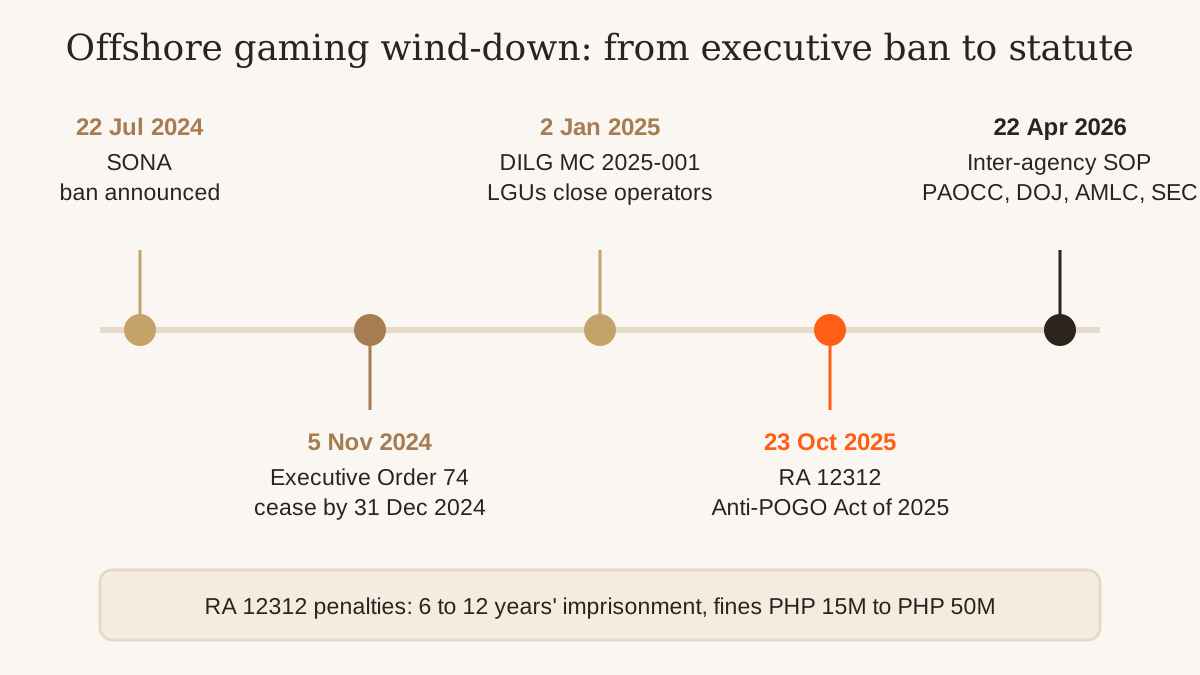
No foreign investor can assess Philippine gaming without understanding the end of the Philippine Offshore Gaming Operator (POGO) sector. After the President announced a ban in his July 2024 State of the Nation Address, Executive Order No. 74 (signed 5 November 2024) ordered all POGOs, Internet Gaming Licensees and other offshore gaming operators, together with their accredited service providers, to cease operations by 31 December 2024, barred PAGCOR from issuing or renewing offshore licences, and created inter-agency working groups on enforcement and worker reintegration. The order defined offshore gaming as live-streamed casino games, RNG games and sports betting offered exclusively to players outside the Philippines, and excluded online games of chance run within PAGCOR-licensed casinos and integrated resorts. The Department of the Interior and Local Government followed with Memorandum Circular No. 2025-001 (2 January 2025) directing local governments to refuse permits.
Congress then converted the executive policy into permanent law. Republic Act No. 12312, the Anti-POGO Act of 2025, was approved on 23 October 2025. It declares offshore gaming unlawful, repeals the POGO tax law (RA 11590), withdraws PAGCOR's authority to license offshore gaming, and prohibits not only operating or taking bets but also acting as a gaming content provider or service provider to offshore gaming, running a hub, possessing equipment and aiding or abetting through concealed companies or false documents. Penalties start at six to eight years' imprisonment and a fine of at least PHP 15 million for a first offence, rising to twelve years and PHP 50 million for a third; responsible officers, directors and beneficial owners are liable; convicted foreign nationals are deported after serving sentence and permanently barred; and violations are predicate offences under the Anti-Money Laundering Act. On 22 April 2026 the Presidential Anti-Organized Crime Commission, Department of Justice, Anti-Money Laundering Council, SEC and other agencies signed inter-agency standard operating procedures for implementing EO 74 and RA 12312, with officials telling reporters that at least 100 rogue operators were believed still to be running clandestinely, according to a report carried by The Star from Philippine news agencies.
The lesson is precise. The ban targets serving players outside the Philippines from infrastructure inside it. A foreign-owned studio licensing content to PAGCOR-licensed domestic operators is on the lawful side of that line; a "technology company" whose servers, staff or payment flows support an offshore betting site is within RA 12312's prohibited acts, and the aiding-and-abetting clause reaches those who register concealing companies or lease premises and systems for the purpose. The firm's article on the IGL-versus-POGO policy shift traces the history in more depth.
- SONA announcement. The President announces a ban on offshore gaming operations.
- Executive Order No. 74. Immediate ban on POGO, internet gaming and other offshore gaming; cease-operations deadline of 31 December 2024.
- DILG MC 2025-001. Local governments ordered to refuse permits and close remaining operators.
- Republic Act No. 12312. Anti-POGO Act of 2025 criminalises offshore gaming and its service providers.
- Inter-agency SOP. PAOCC, DOJ, AMLC and SEC sign procedures for asset preservation, prosecution and victim protection.
7The PAGCOR layer: accreditation, moratorium and ownership approvals
Even a 100 percent foreign-owned supplier cannot simply sign contracts with Philippine operators. The Chambers guide cited above records that PAGCOR replaced its supplier-registration model with mandatory accreditation: gaming aggregators (including game content providers) and support service providers (payment channels, KYC and membership systems, customer service, testing laboratories) must be accredited before transacting with any licensee, a foreign provider must either establish a local presence or appoint an accredited exclusive distributor, and operators were permitted to use only accredited providers after 31 March 2026. Accreditation involves SEC and tax registration, local officers and offices, and probity checks on directors, key officers and significant shareholders.
Capacity is constrained. PAGCOR Chairman Alejandro Tengco told a House appropriations hearing in August 2025 that the regulator had enforced a moratorium on new online gaming licences since a board resolution of 1 March 2024 and was processing only applications filed before that date, as reported by the Inquirer. In a May 2026 interview with iGB, Mr Tengco said PAGCOR was capped at 70 online licensees with 63 active, that large international game suppliers were negotiating to come under PAGCOR licensing, and that first-quarter 2026 online gross gaming revenue had fallen 23 percent year on year after the central bank ordered e-wallet apps to remove links to gaming sites. The Chambers guide adds that B2B accreditations supporting online gaming were themselves under a moratorium at the time of writing, so licence or accreditation availability is a fact to confirm with PAGCOR, not an assumption.
Ownership changes after licensing need their own planning. Prior PAGCOR Board approval is required where a transaction results in more than 50 percent ownership or voting control, changes must be reported within short windows, and newly licensed or accredited entities face a lock-up on transfers without written approval. Venture-style cap tables with options and convertible notes should be modelled against these rules before funding closes; see the firm's note on change of control and share transfers after a gaming licence.
8People and money: visas, repatriation and tax treaties
Foreign executives and engineers need a lawful basis to work. The two routes most relevant to gaming technology are the 9(g) pre-arranged employment visa, issued by the Bureau of Immigration on the strength of an Alien Employment Permit from the Department of Labor and Employment, and the Special Investor's Resident Visa (SIRV) administered by the Board of Investments under Book V of the Omnibus Investments Code, which has historically required a minimum investment of USD 75,000 in eligible enterprises. Because RA 12312 revoked visas and work permits tied to offshore gaming and bars new ones for that purpose, immigration officers examine gaming-adjacent employers closely; a supplier should be able to show its domestic, PAGCOR-accredited client base. Current SIRV thresholds should be confirmed with the BOI.
Getting money out is as important as getting it in. Foreign equity and loans should be registered with the Bangko Sentral ng Pilipinas (through a Bangko Sentral Registration Document) if the investor wants to purchase foreign exchange from the banking system to repatriate capital and remit dividends; unregistered investments can still be repatriated, but only with foreign exchange sourced outside the banks. Dividends paid to a non-resident foreign corporation are subject to a 25 percent final withholding tax under the Tax Code, reduced to 15 percent where the investor's home country allows a tax-sparing credit, and further reduced under many of the Philippines' bilateral tax treaties, typically to 10 or 15 percent, subject to the Bureau of Internal Revenue's treaty-relief procedures. Licence fees paid by a Philippine operator to a foreign supplier raise separate royalty withholding and VAT questions, and whether a platform fee is a royalty or a service fee can change the result.
9Comparing the structures
The table summarises how the main structures compare. It is a planning aid, not a transaction-specific opinion, and the PAGCOR column depends on licence and accreditation availability at the time of application.
| Structure | Maximum foreign equity | PAGCOR requirement | Incentive eligibility | Main red flags |
|---|---|---|---|---|
| Domestic online gaming operator (takes bets from players in the Philippines) | 40% under Negative List B, unless covered by a PAGCOR investment agreement | Operator licence; subject to moratorium and 70-licensee cap as reported in 2025–2026 | Not an SIPP priority activity; taxed through PAGCOR fees and franchise-type regime | Nominee shareholders (Anti-Dummy Law); foreign side controlling management; undisclosed beneficial owners |
| Game studio or platform developer (B2B, serving licensed Philippine operators) | 100%, subject to USD 200,000 / USD 100,000 paid-in capital rules | Accreditation as gaming aggregator or support service provider | Eligible to apply as IT or software RBE with PEZA or BOI if activity is SIPP-listed | Any revenue from offshore players; unaccredited supply after 31 March 2026 |
| Export-oriented studio (60%+ of output sold abroad) | 100%, BOI registration as export enterprise | Accreditation only if it sells to Philippine licensees | Strong candidate for ITH and enhanced deductions; export VAT zero-rating | Domestic sales exceeding 40%; content ultimately used by offshore gambling sites (RA 12312) |
| Foreign supplier with accredited local distributor (no Philippine entity) | Not applicable | Distributor holds accreditation and bears PAGCOR obligations; up to five distributorships per accredited party | None in the Philippines | Royalty withholding and VAT on fees; loss of control over compliance; distributor probity |
| Representative or regional operating headquarters | 100% | None unless it transacts with licensees | Limited; ROHQ regime narrowed under CREATE | Cannot earn Philippine income (representative office); scope creep into supply |
- Decide whether the Philippine entity will ever accept wagers; if not, keep that out of its primary purpose and contracts.
- Size paid-in capital against the USD 200,000 or USD 100,000 Foreign Investments Act floors, or plan for BOI export registration.
- Map every shareholder and controller for the SEC's 2026 beneficial-ownership registry and PAGCOR's personal disclosure sheets before incorporation.
- Confirm with PAGCOR whether the relevant licence or accreditation window is open, and model change-of-control approvals into the cap table.
- Screen customers, landlords and payment partners against RA 12312 exposure, and document the screening.
- Register foreign capital with the Bangko Sentral and confirm treaty relief procedures before the first dividend or licence fee.
Abanto Law Firm advises foreign and domestic clients on entity structuring, Negative List compliance, PAGCOR licensing and accreditation, and the tax and immigration questions that follow. Investors weighing a Philippine gaming-technology venture can review the firm's gaming licence practice or contact the firm to discuss a proposed structure before capital is committed.
10Frequently asked questions
Can a foreign company own 100 percent of a Philippine online gaming operator?
Generally no. Gambling remains in List B of the Foreign Investment Negative List, most recently reissued as the 13th list under Executive Order No. 113 (13 April 2026), with foreign equity capped at 40 percent. The 12th list carved out activities covered by investment agreements with PAGCOR, a route used for integrated resorts and negotiated case by case. A company that holds the licence and takes wagers should therefore be at least 60 percent Filipino-owned in voting stock unless such an agreement applies, and the SEC's control test looks through layered holdings and side agreements.
Does the 40 percent cap apply to game studios, platform providers and other B2B suppliers?
Not as a rule. A supplier that does not accept bets is engaged in ordinary software, content or service activity and may be 100 percent foreign-owned under the Foreign Investments Act, provided it meets the paid-in capital floor of USD 200,000 for a domestic market enterprise (USD 100,000 where it uses advanced technology, is an endorsed startup or employs at least 15 direct Filipino employees as a majority of its workforce) or registers with the BOI as an export enterprise. It must still obtain PAGCOR accreditation as a gaming aggregator or support service provider before transacting with licensees, and its directors and significant shareholders undergo probity checks.
What incentives can a foreign-owned gaming-technology company obtain under CREATE MORE?
If the company registers with an investment promotion agency such as PEZA or the BOI for an activity listed in the Strategic Investment Priority Plan, typically software development or IT services, Republic Act No. 12066 offers a 20 percent corporate income tax rate under the enhanced deductions regime, a 100 percent additional deduction on power costs, VAT zero-rating on local purchases directly attributable to the registered activity, an RBE local tax of up to 2 percent in lieu of other local taxes, and permission to run up to 50 percent of the workforce on telecommuting. Gambling operations themselves are not an incentivised activity, so an operator cannot access these benefits for its wagering income.
Is any form of offshore gaming still permitted for foreign investors in the Philippines?
No. Executive Order No. 74 (5 November 2024) ordered all POGOs and Internet Gaming Licensees to cease by 31 December 2024, and Republic Act No. 12312, the Anti-POGO Act of 2025 (approved 23 October 2025), made offshore gaming and the provision of content, technology, premises or other services to it criminal offences punishable by six to twelve years' imprisonment and fines from PHP 15 million to PHP 50 million, with deportation of convicted foreign nationals. The ban targets games offered to players outside the Philippines from Philippine-based infrastructure; licensed domestic online gaming and supply to licensed domestic operators remain lawful.
What are the risks of using Filipino nominee shareholders to meet the 60/40 requirement?
The Anti-Dummy Law (Commonwealth Act No. 108) criminalises both the Filipino who lends his or her name and the foreigner who uses it, and separately bars foreigners from managing a nationalised business beyond their proportional board representation. Since 1 January 2026 the SEC's Beneficial Ownership Disclosure Rules (Memorandum Circular No. 15, Series of 2025) require nominee reporting and impose fines of up to PHP 2 million and possible dissolution for false beneficial-ownership information, with officer fines of up to PHP 1 million and a five-year disqualification. PAGCOR separately requires notarised beneficial-ownership declarations and probity checks, so a nominee structure is likely to be detected and can cost the licence.
Sources and references
- Executive Order No. 113, s. 2026 — Promulgating the Thirteenth Regular Foreign Investment Negative List — Office of the President (via LawPhil) (2026-04-13)
- Philippines Issues 13th Foreign Investment Negative List: A Calibrated Expansion of Foreign Investment Opportunities — Cruz Marcelo & Tenefrancia
- Republic Act No. 11647 — Amending the Foreign Investments Act of 1991 — Congress of the Philippines (via LawPhil) (2022-03-02)
- Republic Act No. 11659 — Amending the Public Service Act — Congress of the Philippines (via LawPhil) (2022-03-21)
- What to know about SEC's new beneficial ownership rules — The Philippine Star (2025-12-24)
- Republic Act No. 12066 — CREATE MORE Act — Congress of the Philippines (via LawPhil) (2024-11-08)
- Executive Order No. 74, s. 2024 — Immediate Ban of Philippine Offshore Gaming, Internet Gaming, and Other Offshore Gaming Operations — Office of the President (via LawPhil) (2024-11-05)
- Republic Act No. 12312 — Anti-POGO Act of 2025 — Congress of the Philippines (via LawPhil) (2025-10-23)
- Govt agencies sign regulations to end Philippine offshore gaming operations for good — The Star (Malaysia) / Philippine news agencies (2026-04-23)
- Gaming Law 2025 — Philippines — Chambers and Partners Practice Guides (2025-11-25)
- Pagcor: No new online gaming licenses since March 2024 — Philippine Daily Inquirer (2025-08-20)
- PAGCOR chairman Tengco cementing legacy with three more pillars — iGB (iGaming Business) (2026-05-27)
This article is for general informational purposes only and does not constitute legal advice. Laws, regulations, and regulatory requirements may change, and reading this article does not create an attorney-client relationship with Abanto Law Firm. Readers should consult qualified Philippine legal counsel regarding their specific circumstances.