Gaming Law & Compliance
Legal Checklist for Launching a Mobile Gaming Platform in the Philippines
From SEC incorporation and PAGCOR accreditation to Apple Guideline 5.3 and Google Play's country list, the legal workstream a mobile real-money gaming launch needs to clear before go-live, as of October 2026.

1Why a mobile launch in the Philippines is a licensing project first
A real-money or hybrid gaming app aimed at Philippine players is not primarily a software release. It is the public-facing end of a regulatory structure that must already exist before the first build is uploaded. Under the Philippine Amusement and Gaming Corporation (PAGCOR) framework that took effect on 2 October 2025, the mobile app is legally an Online Gaming Platform (OGP): an adjunct channel through which players registered with a licensed gaming venue can remotely access electronic games supplied by an accredited Gaming System Administrator (GSA). Both the venue licence and the GSA accreditation must be in place, and both carry obligations that shape product decisions such as age gates, deposit flows and marketing.
This checklist walks through the pre-launch legal workstream in the order a project team usually needs to run it: the corporate vehicle and probity checks, the PAGCOR authorisation path, technical certification, player onboarding, payments and anti-money laundering (AML), app-store policy, and marketing and go-live obligations. It reflects the position as of 29 October 2026 and distinguishes rules already in force from proposals still before Congress.
- PAGCOR's domestic model is venue-anchored: a mobile OGP must be tied to a licensed gaming venue and an accredited GSA, with player registration and bets limited to the Philippines.
- Minimum player age on PAGCOR-regulated platforms is 21, and KYC (government ID plus a selfie) is required before the first deposit.
- Apple's Guideline 5.3.4 and Google Play's gambling policy both require local licensing, geo-restriction and a free download; as of the research date, Google Play lists the Philippines for lotteries only.
- E-wallet in-app links to gambling were removed on BSP instruction in August 2025, and PAGCOR prohibits credit cards and cryptocurrency for betting, so payment design needs early legal input.
- Budget for the Performance Cash Deposit and, from 1 July 2026, the Minimum Guaranteed Fee for GSAs.
2Step 1: Corporate vehicle, key persons and probity
Only a corporation registered with the Securities and Exchange Commission (SEC) may apply for GSA accreditation, according to the Regulatory Framework for the Accreditation of Gaming System Administrators (Revision No. 0). Foreign suppliers of gaming systems or game content either apply for accreditation as business-to-business (B2B) providers or contract an accredited local corporation to represent them. The practical consequence is that the entity that will own the app, hold the PAGCOR certificate and contract with venues should be incorporated early, with a capital structure that can absorb regulatory deposits.
The same framework sets probity standards: the applicant must be of good repute, must not be associated with persons of poor repute or unsatisfactory financial resources, must have sufficient experience to manage gaming operations, and must be of stable financial standing with a satisfactory corporate structure. Applicants bear the cost of a third-party probity checker who reports on the identity, finances, integrity, competence and criminal history of each key official. PAGCOR separately issued a memorandum on 10 September 2025 implementing its Probity Checking Framework. Our guide on key persons and fit-and-proper checks explains how to prepare directors and beneficial owners for this stage.
Ongoing corporate housekeeping is also regulated. A GSA must report any change in ownership, or any change or addition to its board, to PAGCOR's Electronic Gaming Licensing Department (EGLD) within 15 calendar days, and must file by 31 May each year a valid mayor's permit, its latest SEC General Information Sheet and an authorised-signatory form. The certificate of accreditation cannot be transferred by sale, succession or gift without prior board consent.
3Step 2: Choosing the PAGCOR authorisation path
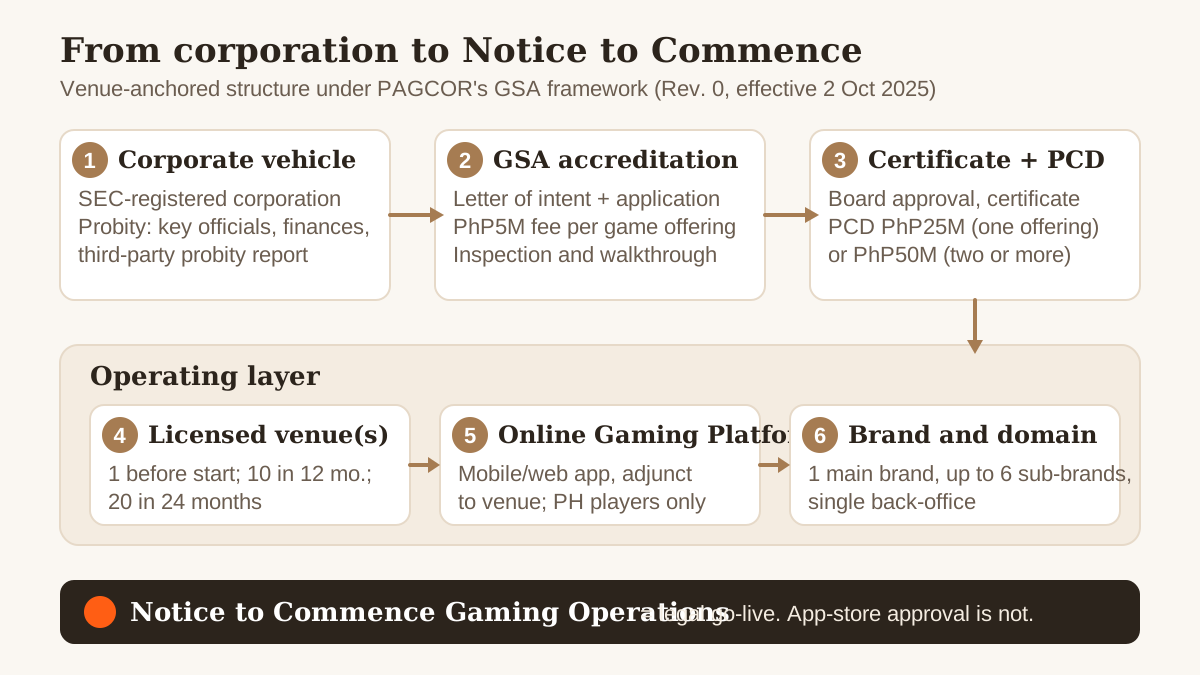
PAGCOR's Electronic Gaming Licensing Department regulates domestic electronic gaming by game offering: traditional bingo, electronic bingo, electronic casino games, sports betting, specialty games, online poker and numeric games. Accreditation is granted separately for each game offering, and the application proceeds through a letter of intent to the PAGCOR Chairman, the application form and documentary requirements, payment of a non-refundable accreditation fee, an ocular inspection with a walkthrough of the gaming system and platform, probity compliance, a recommendation to the PAGCOR Board, issuance of the certificate, posting of the Performance Cash Deposit (PCD) and, finally, a Notice to Commence Gaming Operations.
Two structural rules matter most for a mobile-first business. First, the OGP is an adjunct to land-based venues: a newly accredited GSA must establish or contract at least one operational gaming venue before commencing, at least ten within twelve months and twenty within twenty-four months, with a penalty of PhP200,000 per lacking venue per month. Second, only registered players of PAGCOR-licensed venues may use the OGP, and the system must not allow registration or accept bets from outside the Philippines. An app designed for offshore audiences falls under a different and now heavily restricted regime following the 2024 offshore gaming ban, and is outside the scope of this checklist.
Brand and domain control is also regulated. Each GSA registers one main brand (a single-word name with a specific root) and one main domain across all approved game offerings, may add up to six sub-brands that visibly carry the main brand, and must route all other URLs back to the registered domains. All platforms, including sub-domains, must record transactions in a single back-office. On 6 July 2026 PAGCOR issued a memorandum introducing a Unified Gaming License for gaming venue operations as an alternative to the per-game standard licence; the Schedule of Regulatory Fees as of 2 July 2026 prices both routes.
| Item (PAGCOR schedule, 2 July 2026) | Fee | Validity / basis | Performance Cash Deposit |
|---|---|---|---|
| GSA accreditation | PhP5,000,000 per game offering | Per certificate | PhP25M (one game offering); PhP50M (two or more) |
| Gaming Venue Operator, standard licence: e-bingo, e-casino, traditional bingo | PhP300,000 per game offering | 3 years; renewal PhP200,000 every 2 years | PhP1M e-bingo; PhP500,000 e-casino and traditional bingo |
| Gaming Venue Operator, standard licence: sports betting, specialty, numeric, online poker | PhP200,000 per game offering | 2 years; renewal PhP200,000 every 2 years | PhP100,000 to PhP200,000 per offering |
| Gaming Venue Operator, Unified Gaming License | PhP1,200,000 | 3 years; renewal PhP800,000 every 2 years | PhP2M per gaming venue |
| Minimum Guaranteed Fee (GSAs) | PhP3M to PhP10.5M per month by category and tranche | From 1 July 2026 (first tranche); 1 January 2027 (second) | Not applicable |
The Minimum Guaranteed Fee deserves its own budget line. PAGCOR's board approved it on 4 December 2025 and the EGLD issued the implementing memorandum on 15 December 2025; after two deferrals, the 21 May 2026 memorandum fixed the first tranche at 1 July to 31 December 2026 (PhP9 million per month for GSAs with electronic casino games against a PhP30 million minimum monthly GGR, PhP3 million for GSAs without) and the second tranche from 1 January 2027 (PhP10.5 million and PhP4 million respectively). PAGCOR's share of gross gaming revenue is set in the separate Regulatory Framework for Fees and Rates on Gaming Venue Operations. For a fuller treatment of cost planning see our gaming licence practice page.
4Step 3: Technical certification of the platform and games
PAGCOR evaluates the electronic gaming system, the OGP and each game before approval, and it borrows recognised laboratory standards to do so. The GSA framework requires certification from a reputable, independent gaming laboratory that the system meets Chapter 3 of GLI-19 (Standards for Interactive Gaming Systems, Version 3.0) or equivalent chapters of GLI-11, GLI-23 or GLI-15 depending on the product. Where a random number generator is used, a laboratory certificate must confirm RNG compliance with GLI-19 Chapter 3, and each game's return-to-player percentage must be certified as within the PAGCOR-prescribed range. The framework allows the system certificate to be submitted within three months of commencing live operations if the application has been lodged, but the RNG and RTP certificates are expected up front.
Integration is tested separately. The GSA must submit an integration-testing certificate from a PAGCOR-accredited Independent Game Testing Laboratory confirming that each game runs reliably on its system with correct data extraction and report generation, together with a notarised agreement with the game content provider. The names of accredited laboratories appear in PAGCOR's list of Support Service Providers. Systems must capture and report all data, be auditable, implement cybersecurity controls, process heavy transaction loads without delay, and integrate PAGCOR's National Database of Restricted Persons (NDRP) through PAGCOR's API. Live dealer content for electronic casino, specialty, bingo, numeric and poker offerings must be streamed from a studio located in the Philippines. Our article on RNG certification and independent labs covers how to sequence lab work against a release schedule.
- Laboratory certificate for the gaming system and OGP (GLI-19 Chapter 3 or equivalent), or proof of operation in another jurisdiction plus a pending application.
- RNG certificate and per-game RTP certificate from an independent laboratory.
- Integration-testing report from a PAGCOR-accredited laboratory for every game on the platform.
- Single back-office covering the main domain and all sub-domains, with approved test accounts for PAGCOR's production walkthrough.
- NDRP API integration and documented cybersecurity controls.
- Philippine-based live studio and Permit to Hold where live-dealer games are offered.
5Step 4: Age gating, KYC and responsible gaming tools
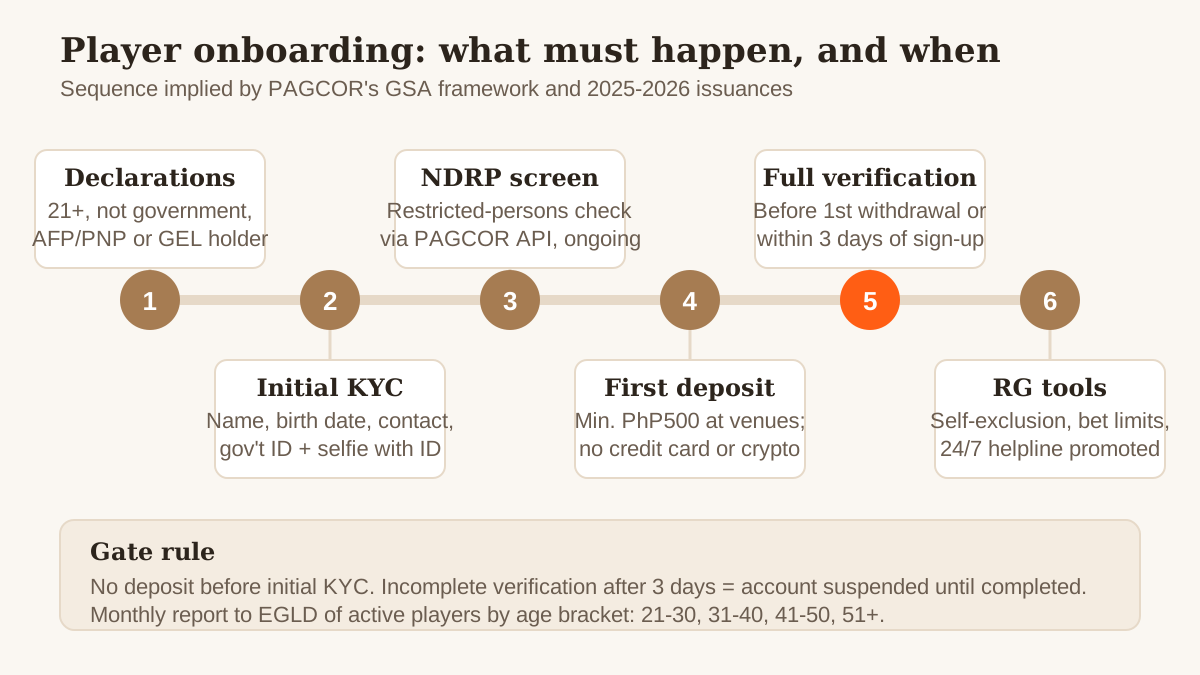
The player-onboarding flow is where product and compliance teams most often collide, so it helps to start from the rule text. Only persons aged 21 and above may register on a PAGCOR-regulated system, and the OGP must require prospective players to confirm that they are at least 21, that they are not government officials or employees connected with government operations, members of the Armed Forces or the Philippine National Police, and that they do not hold a Gaming Employment License. Persons listed in the NDRP may not be registered and existing accounts must be suspended or cancelled when they appear on it. PAGCOR's Responsible Gaming Code of Practice (Version 6.0) also bars students of any Philippine school, college or university regardless of age.
KYC is continuous. At registration the platform must collect full name, date of birth, contact details, a valid government-issued ID and a selfie of the player holding that ID (or an EGLD-approved equivalent). PAGCOR's Electronic Gaming Licensing Department told a Senate hearing in February 2026 that this initial KYC must be completed before any deposit, closing a loophole that had allowed play before verification. Full identity verification must then be completed before the first withdrawal or within three days of sign-up, whichever comes first; accounts that miss the deadline are suspended until verification is complete. The 11 November 2025 memorandum on amended regulatory frameworks reduced the minimum initial deposit on registration at licensed venues from PhP1,000 to PhP500.
Responsible gaming tooling is a licence condition rather than a nice-to-have. PAGCOR stated on 10 December 2025 that licensed operators must offer self-exclusion and betting limits, and the Code of Practice prescribes self-exclusion periods of six months, one year or five years (the first six months irrevocable), family exclusion, operator-initiated exclusion, staff training and incident logging. In April 2026 PAGCOR reminded all licensees to monitor the NDRP, keep its data confidential and strictly enforce KYC, and in May and June 2026 it issued memoranda on the 24/7 National Problem Gambling Helpline, which licensees are expected to promote. A GSA must also report monthly to the EGLD the number of active registered players by age bracket (21 to 30, 31 to 40, 41 to 50, 51 and above), which means age data must be structured from day one.
- 21
Minimum age to register on PAGCOR-regulated platforms (GSA framework; RG Code of Practice v6.0) - 3 days
Maximum period to complete full KYC after sign-up, or before first withdrawal if earlier - PhP500
Minimum initial deposit on registration at licensed venues since the November 2025 amendments - 6 months
Shortest self-exclusion option, irrevocable once elected
6Step 5: Payments, AML and data privacy
Payment design changed sharply in 2025. On 14 August 2025 the Bangko Sentral ng Pilipinas (BSP) ordered BSP-supervised institutions to remove in-app links and icons to online gambling platforms within 48 hours, and GCash and Maya complied. PAGCOR followed by delinking e-wallets from licensed platforms, a measure its Chairman described in December 2025 as having softened third-quarter revenues but as necessary for traceability and AML. In the same statement PAGCOR confirmed that credit cards and cryptocurrencies may not be used for betting on licensed platforms. A launch plan should therefore assume that players will fund accounts through channels that are not promoted inside e-wallet apps, and should document how each payment partner is onboarded; our note on payment processing and PSP onboarding sets out the due-diligence file regulators expect.
Anti-money laundering obligations attach by statute. Republic Act No. 10927 (2017) designated casinos, expressly including internet-based casinos, as covered persons under the Anti-Money Laundering Act, with a covered-transaction threshold for casino cash transactions of more than PhP5,000,000 in a single transaction, and suspicious-transaction reporting regardless of amount. The GSA framework requires compliance with Anti-Money Laundering Council rules as supervised by PAGCOR's Anti-Money Laundering Supervision and Enforcement Department, with penalties under the Regulatory Framework for Offenses and Penalties (Revision No. 3, approved 6 November 2025, which now also covers B2B providers and provides for forfeiture of the PCD).
Data privacy is treated as a licence matter too: the framework obliges GSAs to comply with the Data Privacy Act of 2012 (Republic Act No. 10173) and places supervision with PAGCOR's information-technology data privacy section. A mobile platform that collects government IDs, selfies, device identifiers and transaction histories is processing sensitive personal information at scale, so a data protection officer, National Privacy Commission registration where required, a privacy notice tailored to the app, vendor contracts with KYC and payment providers, and a breach-notification playbook should be ready before launch. See our guide to NPC registration and data privacy controls for licensed operators.
7Step 6: Apple App Store and Google Play gambling policies
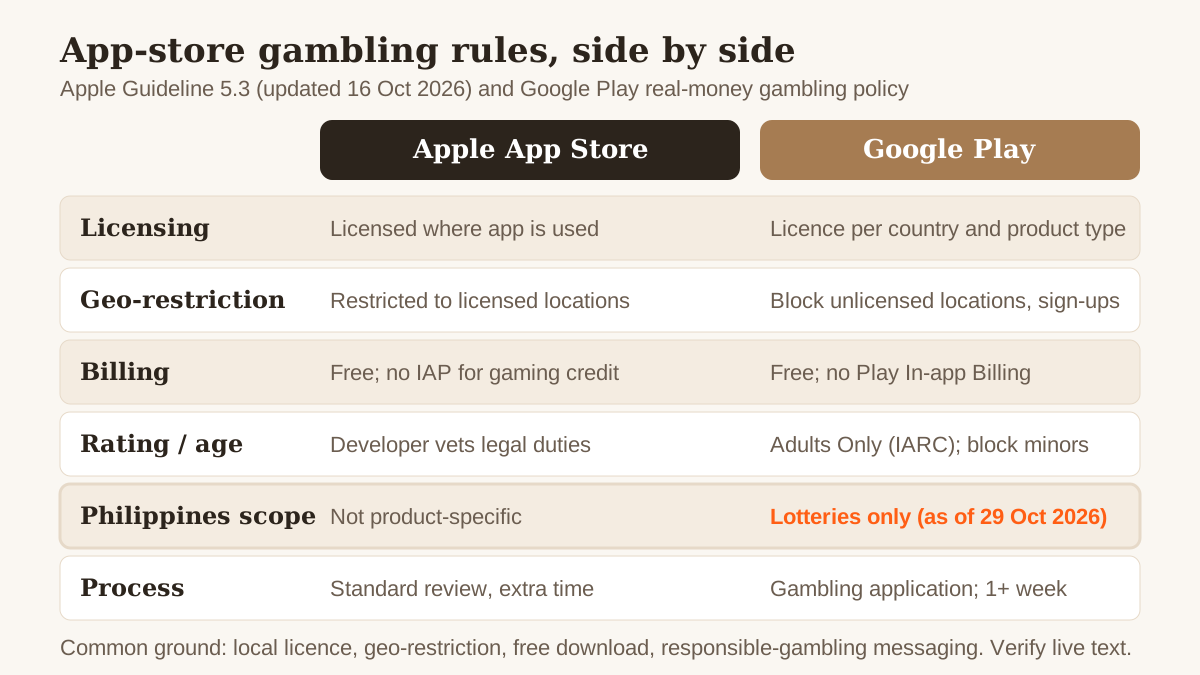
Store policy is the step most often underestimated, because it is decided by private platforms applying their own rules on top of Philippine law. Apple's App Store Review Guidelines (last updated 16 October 2026) warn in Section 5.3 that gaming, gambling and lotteries are among the most regulated offerings and that developers should expect extra review time. Guideline 5.3.3 prohibits using in-app purchase to buy credit or currency for real-money gaming, and Guideline 5.3.4 requires that apps offering real-money gaming such as sports betting, poker, casino games or horse racing hold the necessary licensing and permissions in the locations where the app is used, be geo-restricted to those locations, and be free on the App Store. Lottery apps must involve consideration, chance and a prize, and illegal gambling aids such as card counters are not permitted. In practice, reviewers may ask for the PAGCOR certificate, the registered brand and domain, and evidence of geo-restriction.
Google Play's Real-Money Gambling, Games, and Contests policy treats gambling apps as an exception to a general prohibition. A developer must complete Google's gambling application for each market, category and app; be a licensed or governmental operator in that market; hold a licence covering each product type; prevent under-age use; block access from unlicensed locations; distribute the app free without Google Play In-app Billing; carry an Adults Only or equivalent IARC rating; and display responsible-gambling information in the listing and in the app. An app previously rated below Adults Only cannot be converted and must ship under a new package name. The gambling application form states that certification and review take at least a week and that a copy of the gambling licence must be attached.
The market-specific detail is decisive for Philippine projects. As of the research date, Google's country-by-country gambling requirements list the Philippines among the countries where licensed gambling apps may be distributed, but the permitted product type for the Philippines is lotteries only, with the PAGCOR Responsible Gaming Portal cited as the responsible-gambling resource. On a plain reading, a PAGCOR-regulated electronic casino or sports betting app cannot currently be listed on Google Play for Philippine users as a gambling app, whereas Apple's guideline does not restrict product types if licensing and geo-restriction are satisfied. Operators should confirm the live text of both policies and plan distribution, including whether a web-based platform will serve Android players, with this asymmetry in mind rather than discovering it at review.
| Requirement | Apple App Store (Guideline 5.3) | Google Play (gambling policy) |
|---|---|---|
| Licensing | Necessary licensing and permissions where the app is used | Licence per country and per product type; copy attached to application |
| Geo-restriction | Must be geo-restricted to licensed locations | Must block access and sign-ups from unlicensed locations |
| Pricing and billing | Free on the App Store; no IAP for real-money gaming credit | Free to download; no Google Play In-app Billing |
| Age and rating | Legal obligations vetted by developer | Prevent under-age use; Adults Only / IARC equivalent rating |
| Philippines product scope (29 Oct 2026) | Not product-specific | Lotteries only, per country requirements page |
| Pre-approval process | Standard review, with extra time flagged | Separate gambling application per market, category and app; at least one week |
8Step 7: Marketing rules, go-live obligations and the pre-launch timeline
Marketing of a PAGCOR-regulated OGP is governed by Annex D of the GSA framework. General announcements may be published on mass media and the internet without prior approval, but on social media a GSA may use only one official account per platform, disclosed to the EGLD, with an audience filter limited to persons aged 21 and above. Specific promotions may be published only through the registered closed group, official website or the OGP itself. All content must carry the under-21 prohibition logo and the slogan "Gambling for 21 years old and above only. Gambling can be addictive. Know when to stop.", and must not target minors, suggest that skill assures a win, present gambling as a way to make money, or mislead on odds and prizes. Promotions above prescribed prize thresholds require prior EGLD approval. Outside the framework, PAGCOR recommended in July 2025 that the Ad Standards Council stop online gaming advertising during the 5:30 to 8:30 p.m. broadcast window, ordered gambling billboards and transit advertising removed, and said in February 2026 that it was still considering a wider advertising ban.
Legislative risk should be tracked alongside. Bills filed in the 20th Congress in July 2025 would, among other things, set the online gambling age at 21 by statute, prohibit e-wallet linkage, impose minimum cash-in amounts and restrict advertising near schools and places of worship; a separate Senate measure proposed a total ban, which PAGCOR opposed in favour of stricter regulation. The Senate Committee on Games and Amusement held hearings in February 2026. As of the research date none of these bills had been confirmed as enacted in the sources reviewed, and their status should be checked with the Senate and House legislative information systems before any statement to investors or partners.
- PAGCOR position on regulation. PAGCOR publicly opposes a total ban and announces advertising restrictions with the Ad Standards Council and a 24/7 helpline plan.
- BSP e-wallet order. BSP-supervised institutions told to remove in-app gambling links within 48 hours.
- GSA framework effective. Revision No. 0 of the Regulatory Framework for the Accreditation of Gaming System Administrators, including KYC, 21+ and marketing annex.
- Amended frameworks. Fees and Rates Rev. 4, Offenses and Penalties Rev. 3 and Gaming Venue Operations Rev. 0 implemented; minimum deposit cut to PhP500.
- Minimum Guaranteed Fee memorandum. Later deferred on 30 March and 21 May 2026.
- MGF first tranche begins. Runs to 31 December 2026; second tranche from 1 January 2027.
- Unified Gaming License memorandum. Alternative licensing approach for gaming venue operations; fee schedule updated 2 July 2026.
- Apple guidelines updated. Current text of Section 5.3 as cited in this article.
For sequencing, most projects find that incorporation, probity and the PAGCOR application run in parallel with laboratory testing, because the ocular inspection and walkthrough require a working system in a live production environment with PAGCOR test accounts. Store submissions should wait until the certificate of accreditation and registered brand and domain exist, since both Apple and Google will ask for them. The Notice to Commence is the legal go-live trigger; app-store approval is not.
Abanto Law Firm advises operators, platform providers and investors on PAGCOR accreditation, venue licensing, app-store compliance, AML and data privacy for mobile and online gaming products. If you are planning a launch, our gaming licence team can map your product against the current rules and prepare the application file; you can reach us through our contact page.
9Frequently asked questions
Can I launch a real-money gaming app in the Philippines without a land-based venue?
Not under the current domestic PAGCOR framework. The Online Gaming Platform is an adjunct channel for registered players of PAGCOR-licensed gaming venues, and a newly accredited GSA must have at least one operational venue before commencement, ten within twelve months and twenty within twenty-four months. A GSA may contract licensed Gaming Venue Operators rather than build venues itself, but the venue link must exist.
What is the minimum age for players on a PAGCOR-regulated mobile platform?
Twenty-one. The GSA framework and the Responsible Gaming Code of Practice limit registration to persons aged 21 and above, and the app must collect an express age declaration plus confirmations that the player is not a government official or employee connected with government operations, a member of the Armed Forces or police, or a Gaming Employment License holder. Students of Philippine schools are also excluded. Pending bills would put the threshold into statute; as of the research date it rests on PAGCOR's rules.
Will Apple and Google approve a PAGCOR-licensed casino or sports betting app?
Apple's Guideline 5.3.4 permits real-money gaming apps that hold the necessary licences, are geo-restricted to licensed locations and are free to download, with no in-app purchase of gaming credit. Google Play requires a separate gambling application per market and product type and, as of 29 October 2026, lists the Philippines for lotteries only. A casino or sports betting app therefore faces a materially different path on Android than on iOS. Neither store's approval substitutes for PAGCOR's Notice to Commence.
What KYC must be completed before a player can deposit?
Full name, date of birth, contact details, a valid government-issued ID and a selfie of the player holding that ID (or an approved equivalent), which PAGCOR told the Senate in February 2026 must be satisfied before any deposit. Full verification must follow before the first withdrawal or within three days of sign-up, whichever is earlier, failing which the account is suspended. Players must also be screened against the National Database of Restricted Persons through PAGCOR's API.
Which payment methods can a licensed platform accept?
PAGCOR has stated that credit cards and cryptocurrencies may not be used for betting on licensed platforms, and since August 2025 BSP-supervised e-wallets have removed in-app links to gambling platforms, with PAGCOR delinking e-wallets from licensed operators. Funding channels must be documented for AML purposes because internet-based casinos are covered persons under the Anti-Money Laundering Act as amended by Republic Act No. 10927. The position may change if the BSP permits relinking.
How much should we budget for PAGCOR fees before go-live?
Under PAGCOR's schedule as of 2 July 2026, GSA accreditation costs PhP5,000,000 per game offering plus a Performance Cash Deposit of PhP25 million (one offering) or PhP50 million (two or more). Gaming Venue Operators pay PhP200,000 to PhP300,000 per game offering under a standard licence or PhP1,200,000 for a Unified Gaming License, each with its own deposit. From 1 July 2026 GSAs also owe the Minimum Guaranteed Fee of PhP3 million to PhP9 million per month, rising in January 2027, on top of PAGCOR's GGR share, laboratory and probity costs.
Sources and references
- App Store Review Guidelines, Section 5.3 Gaming, Gambling, and Lotteries — Apple Developer (2026-10-16)
- Real-Money Gambling, Games, and Contests policy — Google Play Developer Policy Center
- Gambling apps: country and region requirements (Philippines: lotteries) — Google Play Console Help
- Gambling Application Form (supported countries and requirements) — Google Play Console Help
- Regulatory Framework for the Accreditation of Gaming System Administrators, Revision No. 0 — PAGCOR Electronic Gaming Licensing Department (2025-10-02)
- Schedule of Regulatory Fees as of July 02, 2026 — PAGCOR (2026-07-02)
- Memorandum on the Implementation of Amended and New Regulatory Frameworks for Electronic Gaming Operations — PAGCOR Electronic Gaming Licensing Department (2025-11-11)
- Memorandum on Extension of the Effectivity of the Minimum Guaranteed Fee for Gaming System Administrators — PAGCOR Electronic Gaming Licensing Department (2026-05-21)
- Responsible Gaming Code of Practice, Version 6.0 — PAGCOR
- PAGCOR enhances responsible gaming safeguards amid digital play growth — PAGCOR (2025-12-10)
- BSP orders e-wallets to remove online gambling links — The Philippine Star (2025-08-15)
- Republic Act No. 10927: An Act Designating Casinos as Covered Persons under the Anti-Money Laundering Act — LawPhil (Arellano Law Foundation) (2017-07-14)
This article is for general informational purposes only and does not constitute legal advice. Laws, regulations, and regulatory requirements may change, and reading this article does not create an attorney-client relationship with Abanto Law Firm. Readers should consult qualified Philippine legal counsel regarding their specific circumstances.