Gaming Law & Compliance
Online Gambling Bills in the Philippine Congress: What Operators Should Do
A neutral status report on the total-ban, age-21, e-wallet and advertising bills pending in the 20th Congress, the regulator actions already in force, and a scenario-based compliance roadmap for licensed operators.

1Why the 20th Congress matters to every licensed operator
Since the 20th Congress opened on 30 June 2025, the Philippine Senate and House of Representatives have received an unusually dense cluster of bills aimed at online gambling. Some would prohibit it outright and criminalise placing a bet. Others would keep the licensed market but raise the minimum age to 21, cut off e-wallet funding, impose deposit floors, or ban advertising altogether. A separate strand would restructure the Philippine Amusement and Gaming Corporation (PAGCOR) by separating its regulatory and operating functions.
As of the research date (29 October 2026), none of these measures has been reported as enacted. They have nonetheless changed regulator behaviour: PAGCOR tightened advertising and know-your-customer rules during the hearings, and the Bangko Sentral ng Pilipinas (BSP) ordered e-wallets to delink from gambling platforms in August 2025. For an operator holding or applying for a Philippine gaming licence, the question is which of several very different futures to plan for.
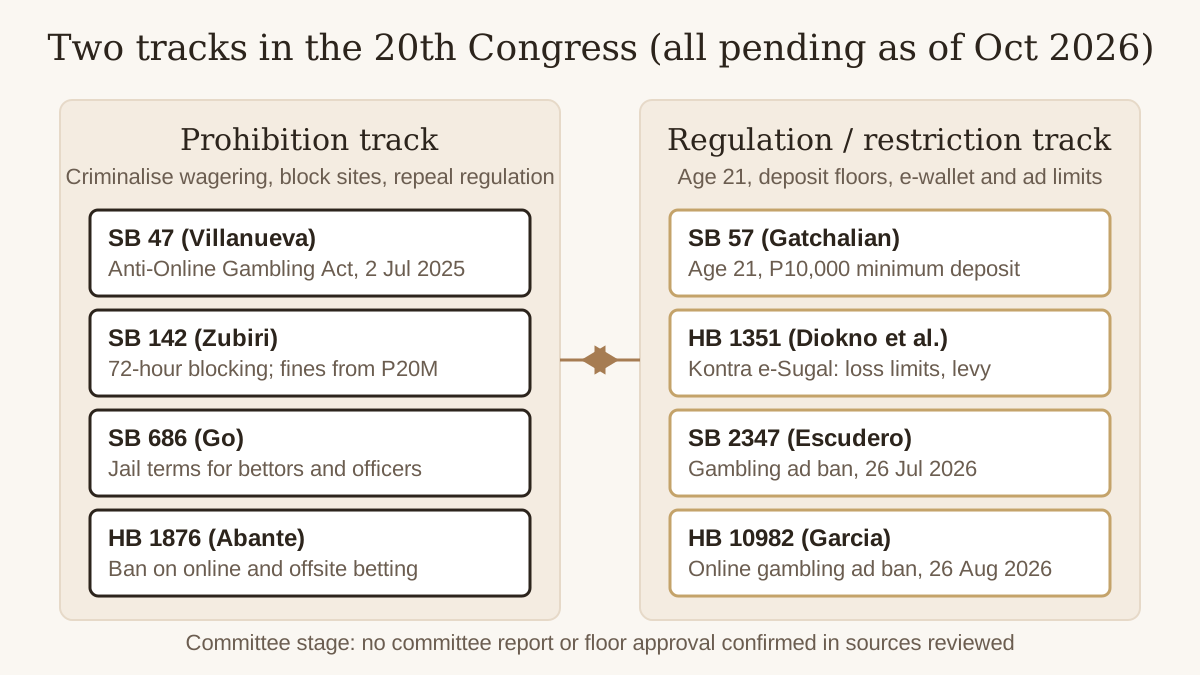
- Two legislative tracks are running in parallel: total prohibition (for example Senate Bill Nos. 47, 142 and 686) and stricter regulation (for example Senate Bill No. 57).
- Advertising is the most likely area of near-term change: ad-ban bills were filed in both chambers in mid-2026, and PAGCOR itself asked for a total broadcast ad ban in February 2026.
- Payments already changed without legislation: the BSP's August 2025 delinking order remains the single biggest operational shock of the period.
- Operators should build contingency clauses, a scenario-based compliance roadmap and an evidence trail now, rather than waiting for a committee report.
2What is actually law today, and what is only proposed
The legal baseline has not moved. PAGCOR continues to license and regulate domestic online gaming under its charter (Presidential Decree No. 1869, as amended by Republic Act No. 9487), and licensees operate under PAGCOR's regulatory frameworks and licence conditions rather than under a dedicated online gambling statute. The 2024–2026 shift away from offshore operators is covered in our companion piece on internet gaming licences versus POGOs; this article focuses on the domestic market that the current bills target.
Three categories of instrument are in play:
- Enacted law and binding issuances: PAGCOR's charter, licence conditions and circulars, and BSP directives to supervised institutions. These bind operators today.
- Regulator action taken during the debate: PAGCOR's order to remove gambling billboards by 15 August 2025, its broadcast ad time restrictions and its enhanced identity checks. Binding on licensees, adjustable without Congress.
- Proposed bills: everything in sections 3 to 5. A bill has no legal effect until it passes both chambers, is reconciled in bicameral conference and is signed or lapses into law.
3The Senate prohibition track
The prohibition bills share a design: criminalise online wagering, repeal any agency's authority to regulate it, and compel intermediaries to block access. They differ in penalties and enforcement mechanics.
Senate Bill No. 47 (Villanueva)
Senate Majority Leader Joel Villanueva's "Anti-Online Gambling Act" was introduced on 2 July 2025 and re-files a measure he first proposed in 2022. It would prohibit internet wagering and repeal laws read as authorising its regulation. PTV News reported on 15 August 2025 that it was among the Senate's top priority measures, and a 2026 trade report described the Committee on Games and Amusement as having resumed deliberations with many senators undecided between a ban and giving regulatory reforms time to work.
Senate Bill No. 142 (Zubiri)
Senator Juan Miguel Zubiri's "Anti-Online Gambling Act of 2025" was identified as Senate Bill No. 142 by SunStar in July 2025. According to Manila Bulletin, it would require ISPs, mobile operators and digital platforms to block gambling sites and remove apps within 72 hours of notice from the Department of Justice or PAGCOR, bar wallets and payment providers from processing gambling transactions, and impose escalating fines starting at ₱20 million for a first offence, rising to ₱100 million, permanent revocation and up to six years' imprisonment for executives on a third offence.
Senate Bill No. 686 (Go)
Senator Christopher "Bong" Go filed his own "Anti-Online Gambling Act of 2025", reported by GGRAsia on 18 July 2025 as Senate Bill No. 686. It would penalise bettors with one to six months' imprisonment or a fine of ₱100,000 to ₱500,000, impose up to five years on responsible corporate officers, and repeal regulatory authority over online gambling.
Other ban proposals
Senator Pia Cayetano filed a total-ban bill and Senator Raffy Tulfo announced one in July 2025; their bill numbers were not confirmed in the sources reviewed. Committee chair Senator Erwin Tulfo told reporters on 31 July 2025 that he personally favours a complete ban while doubting enforcement capacity.
| Measure | Author | Core proposal | Status reported (as of research date) |
|---|---|---|---|
| SB No. 47 | Sen. Joel Villanueva | Total ban; repeal of regulatory authority; penalties on bettors and officers | Filed 2 July 2025; committee deliberations reported, no committee report confirmed |
| SB No. 142 | Sen. Juan Miguel Zubiri | Total ban; 72-hour blocking; payment-provider prohibition; fines from ₱20M | Filed July 2025; pending in committee |
| SB No. 686 | Sen. Christopher Go | Total ban; imprisonment for bettors and officers | Filed July 2025; pending in committee |
| SB No. 57 | Sen. Sherwin Gatchalian | Regulate: age 21, ₱10,000 minimum deposit, e-wallet funding ban, ad distance rules | Filed 30 June 2025; pending in committee |
| SB No. 2347 | Sen. Francis Escudero | Nationwide gambling advertising ban | Reported filed 26 July 2026; pending |
| HB No. 1351 | Reps. Diokno, Cendaña, Ismulla | Regulate: age checks, loss limits, self-exclusion registry, harm levy | Filed July 2025; pending in committee |
| HB No. 1876 | Rep. Benny Abante | Ban on online gambling and offsite betting | Filed July 2025; pending in committee |
| HB No. 10982 | Rep. Karen Hope Garcia | Nationwide online gambling advertising ban; bonus and referral-code ban | Filed 26 August 2026; no hearing scheduled as of September 2026 reports |
4The Senate regulation track
The alternative camp accepts that online gambling will continue and seeks to make it harder to access for minors and low-income players. Its flagship is Senator Sherwin Gatchalian's Senate Bill No. 57, the "Online Gambling Regulatory Act", filed on the first day of the 20th Congress according to The Philippine Star. Its text, as published on the senator's website, would:
- bar anyone under 21 from registering or playing, with operators required to take "effective measures" to deny access;
- set a minimum initial deposit of ₱10,000 and minimum top-ups of ₱5,000 in multiples of that amount;
- prohibit funding and withdrawal through non-bank e-wallets and similar payment providers, and limit credit-based funding to low-risk accounts;
- keep gambling billboards, posters and fliers at least 200 metres from schools, places of worship and government offices, and ban promotion at educational, sports, cultural, religious and art events;
- impose six to eight years' imprisonment and fines of at least ₱10 million for facilitating unlicensed online gambling, with lesser penalties for advertising unlicensed platforms, and fines plus 61–90 day suspensions for licensed operators that breach ad rules;
- name PAGCOR, special economic zone authorities, TIEZA and freeport authorities as the regulatory authorities, with PAGCOR and the DICT to draft implementing rules.
Senator Gatchalian has argued that a total ban is "nearly impossible" to enforce and has said his office is drafting a separate bill for a gaming regulator distinct from PAGCOR's operating arm. SunStar reported regulation-oriented measures from Senators JV Ejercito and Risa Hontiveros (the latter focused on e-wallet and super-app access) and an advertising-ban bill from Senator Alan Peter Cayetano; their numbers were not confirmed in the sources reviewed.
In 2026 the advertising thread gained a new sponsor. Gambling.com reported on 1 September 2026 that Senator Francis Escudero filed Senate Bill No. 2347, the "Gambling Advertising Prohibition Act", on 26 July 2026. Even senators who have not endorsed prohibition are willing to legislate on marketing.
5House bills: restriction, prohibition and a 2026 advertising ban
The House has mirrored the Senate split. House Bill No. 1351, the "Kontra e-Sugal Act" filed by Akbayan Representatives Chel Diokno, Perci Cendaña and Dadah Ismulla, takes the regulatory route. As summarised by SunStar on 16 July 2025, it would require strict age verification, limit advertising, create a national self-exclusion registry, impose betting loss limits, set minimum player-protection standards, create a harm-mitigation levy, recognise gambling disorder as a public-health condition, and ban campaign contributions from gambling operators. On the prohibition side, GMA News reported on 15 July 2025 that Manila Representative Benny Abante's House Bill No. 1876 would ban online gambling and offsite betting, and that Lanao del Sur Representative Zia Adiong had also called for a total ban.
The most detailed 2026 filing is House Bill No. 10982, the "Online Gambling Advertising Prohibition Act of 2026", submitted to the House Secretariat on 26 August 2026 by Cebu Third District Representative Karen Hope Garcia, as reported by The Manila Times on 5 September 2026. Per Gambling.com's summary, it would ban online gambling advertising, endorsement and sponsorship across broadcast, print, billboards, social media, search, influencer and affiliate channels, and email or SMS; prohibit bonuses, free bets and referral codes; and ban cross-promotion between land-based brands and online casinos. Penalties would include fines of ₱500,000 to ₱10 million, licence suspension or revocation, up to three years' imprisonment, disgorgement of endorsement fees and ₱50,000 per day for non-compliant platforms and ISPs. As of early September 2026 no committee hearing had been scheduled.
Representative Garcia cited PAGCOR data showing electronic and online gaming generated ₱201.12 billion in gross gaming revenue in 2025, about 50.77 percent of the industry total. That figure explains the fiscal resistance to prohibition and why advertising restriction is emerging as the likeliest compromise.
6What the regulator and the executive have actually done
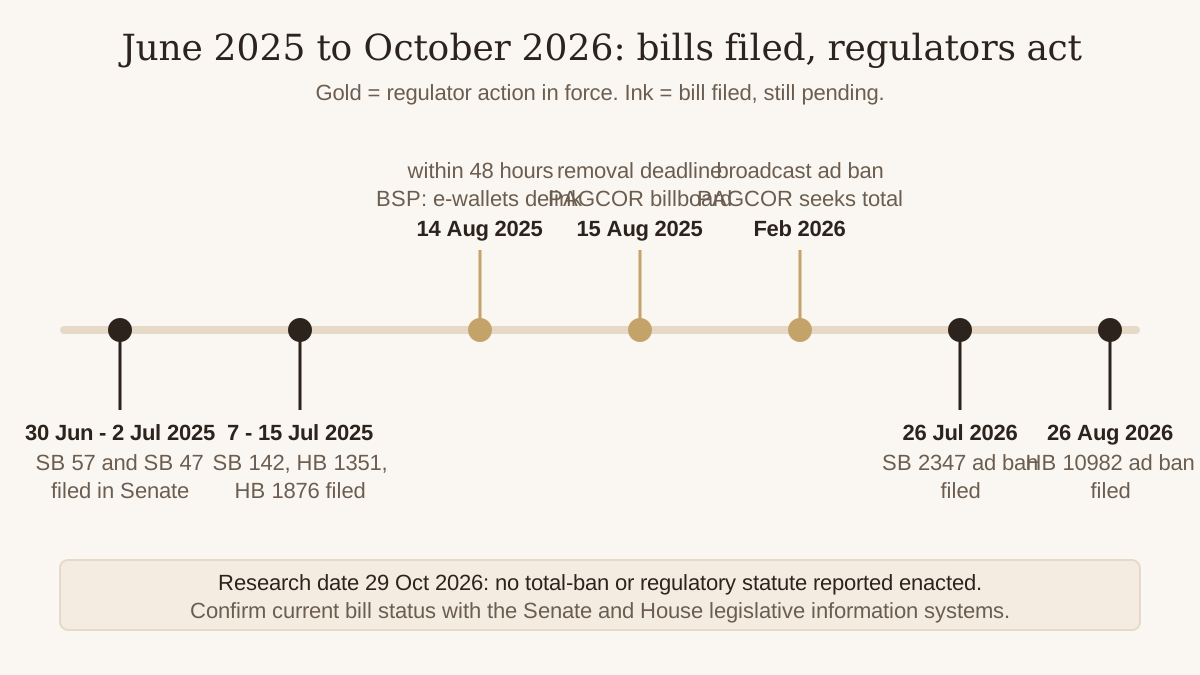
While Congress debated, two agencies acted. The most consequential step came from the central bank. On 14 August 2025, the day of the joint Senate hearing chaired by Senator Erwin Tulfo, the BSP ordered supervised financial institutions, including e-wallets, to remove in-app links and icons to online gambling platforms within 48 hours. The Philippine Star reported Deputy Governor Mamerto Tangonan's explanation that the window allowed consumers to withdraw funds before access was cut, and PTV News reported that the Monetary Board had approved the suspension. GCash and Maya confirmed compliance. The BSP had earlier, in July 2025, circulated a draft circular on gambling-related consumer protections for banks and e-money issuers. Six days after the delinking order, PAGCOR Chairman Alejandro Tengco told the House Committee on Appropriations that online gaming transactions had fallen by an estimated 50 percent.
PAGCOR's own position has been consistent: stricter regulation, not prohibition. At a Senate hearing on 14 August 2025 Tengco undertook to provide details on the roughly 70 online licensees. On 8 September 2025, in a speech published on PAGCOR's website, he backed tighter rules, urged "compliance by design", and cited electronic gaming GGR of ₱58.16 billion in 2023 rising to ₱154.51 billion in 2024. By February 2026, Yogonet reported, PAGCOR had gone further before the Senate Committee on Games and Amusement, asking for a complete ban on gambling advertising on radio and television, announcing that new registrants would need a valid government ID with real-time selfie verification, launching a 24/7 helpline, and floating the possible restoration of e-wallet access for licensed operators if safeguards proved effective. Tengco put registered online accounts at about 32 million, with about 10 million active.
“We support stricter regulations to protect our people.”
— Alejandro Tengco, PAGCOR Chairman and CEO, 8 September 2025
The executive branch has not endorsed prohibition. July 2025 reports indicated the Department of Finance was studying higher taxes on online gaming instead, and the July 2025 State of the Nation Address did not mention online gambling. Confirm whether any later executive issuance has altered this position.
- ₱154.51 billion
Electronic gaming GGR in 2024, per PAGCOR (8 Sept 2025) - ₱201.12 billion
E-games GGR in 2025 cited by Rep. Garcia from PAGCOR data - ~32 million / ~10 million
Registered and active online accounts, per PAGCOR (Feb 2026) - 48 hours
BSP deadline for e-wallet delinking, 14 Aug 2025
- 20th Congress opens. Gatchalian files SB 57 on day one; Villanueva's SB 47 introduced 2 July.
- Zubiri files Anti-Online Gambling Act (SB 142) among his ten priority measures; HB 1351 and HB 1876 filed in the House.
- Joint Senate hearing; BSP delinking order. E-wallets given 48 hours to remove gambling links.
- PAGCOR billboard deadline. Licensees required to dismantle out-of-home gambling ads.
- Senate Games and Amusement hearing. PAGCOR proposes total broadcast ad ban and ID-plus-selfie onboarding.
- SB 2347 (Escudero) filed seeking nationwide gambling advertising ban.
- HB 10982 (Garcia) filed in the House.
7Scenario planning: four futures and what each means operationally
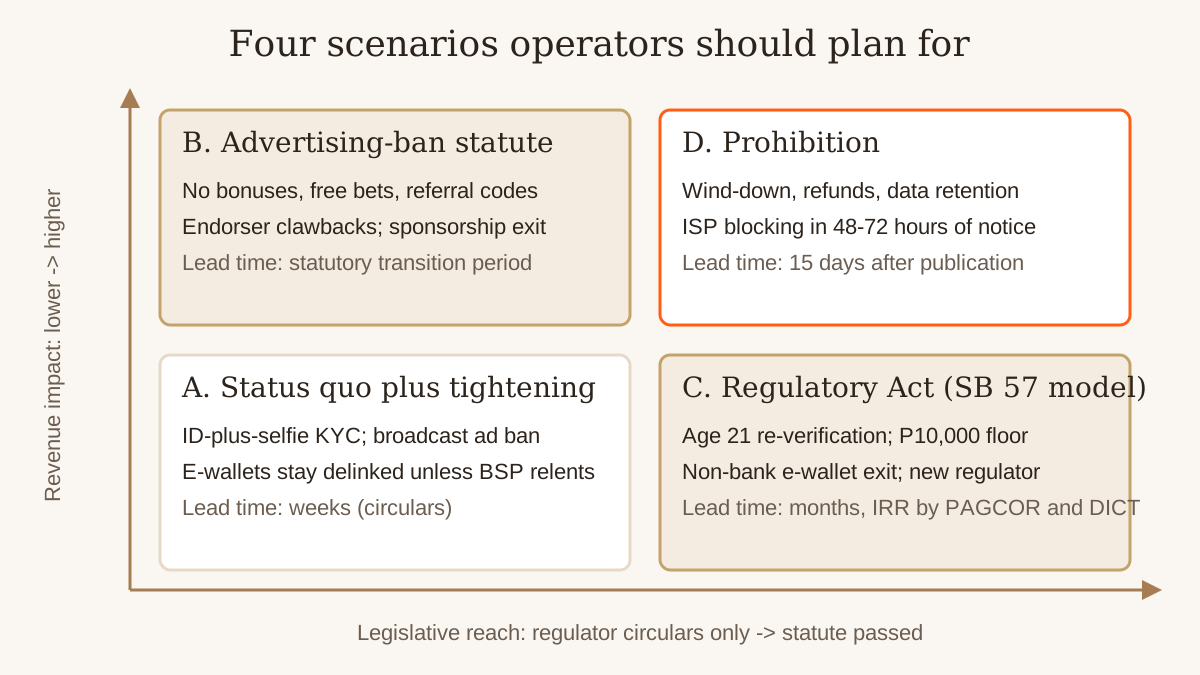
Because the bills point in different directions, one compliance plan is not enough. The table sets out four plausible scenarios through the end of the 20th Congress in 2028. It is a planning tool, not a prediction.
| Scenario | Trigger | Operational consequences | Lead time |
|---|---|---|---|
| A. Status quo plus regulator tightening | No bill reaches third reading; PAGCOR keeps issuing circulars | Broadcast ad ban, ID-plus-selfie KYC, affiliate controls; e-wallets remain delinked unless BSP relents | Weeks (circulars take effect quickly) |
| B. Advertising-ban statute | SB 2347 / HB 10982 or a substitute passes | Loss of bonuses, free bets, referral codes and sponsorships; endorser clawbacks; marketing spend redirected to retention and compliance | Typically a transition period set in the law or IRR |
| C. Regulatory Act (SB 57 model) | Regulation track consolidated into a substitute bill | Age 21 re-verification of the player base; ₱10,000 deposit floor; non-bank e-wallet exit; new regulator alongside PAGCOR | Months, with IRR drafting by PAGCOR and DICT |
| D. Prohibition (SB 47 / 142 / 686 model) | Ban bill passes both chambers and is signed | Wind-down of domestic operations; player refunds; data-retention and employee obligations; ISP blocking within 48–72 hours of notice | Effectivity 15 days after publication under most drafts |
Contract and licence clauses worth revisiting now
Each scenario stresses different agreements. Review with counsel at least:
- Change-in-law clauses in platform, game-provider and payment agreements, defining a qualifying change (statute, IRR, PAGCOR circular, BSP directive) and who bears compliance cost.
- Termination and suspension rights triggered by revocation, a statutory ban or a regulator-ordered pause, with notice periods shorter than the 48–72 hour blocking windows in the ban bills.
- Affiliate and influencer contracts, which HB 10982 would expose to penalties; add immediate take-down duties and fee clawbacks, consistent with our guide to advertising restrictions and affiliate governance.
- Payment-service agreements re-papered for bank-rail and card routes after the August 2025 delinking, using the diligence steps in our article on PSP onboarding for licensed online casinos.
- Player terms covering age re-verification, forced closure and refunds if a statutory age or deposit threshold arrives mid-relationship.
- Regulatory-event definitions in financing and shareholder documents, so a legislative ban does not trigger unintended defaults.
8A compliance roadmap for the next twelve months
Across scenarios A to C, the measures PAGCOR has already demanded or proposed (stronger identity verification, advertising discipline, responsible-gaming tooling and payment-channel hygiene) are the measures any regulatory statute would codify. Investing now reduces exposure under every scenario except prohibition, and even then a documented compliance record supports an orderly exit and limits officers' personal exposure.
- Map obligations by source. Keep a register separating PAGCOR licence conditions and circulars, BSP directives affecting payment partners, and pending bills, with dates and status, reviewed monthly while Congress sits.
- Stress-test onboarding against age 21 and ID-plus-selfie. PAGCOR announced ID-plus-selfie onboarding in February 2026 regardless of SB 57. Measure how many accounts would fail a 21-year threshold and plan communications and refunds.
- Audit every marketing channel against HB 10982's list (search, SMS, email, influencers, affiliates, sponsorships, cross-brand promotion) and decide which could be switched off within 30 days.
- Diversify funding rails lawfully. Work only through BSP-supervised institutions that have confirmed their own position; do not re-create wallet links through intermediaries.
- Prepare a wind-down playbook: player balance return, data retention under the Data Privacy Act, Labor Code obligations and notification duties to PAGCOR and counterparties.
- Engage with the process. Licensed operators have taken part in Senate hearings since August 2025; position papers that accept stricter regulation while documenting illegal offshore substitution risk have been received more seriously than defences of the status quo.
If your business holds or is applying for a PAGCOR online gaming licence and needs a structured review of its contracts, marketing and payment arrangements against these scenarios, Abanto Law Firm's gaming practice can help. Read more about our gaming licence and iGaming compliance services, see our step-by-step guide to the PAGCOR remote gaming licence application, or contact us to discuss a scenario-planning engagement.
9Frequently asked questions
Has the Philippines banned online gambling?
No. As of 29 October 2026, no total-ban bill has been reported as passed by both chambers or signed into law. Online gambling licensed by PAGCOR remains lawful for Philippine residents aged 18 and above. Several ban bills, including Senate Bill Nos. 47, 142 and 686, are pending in committee. Because the position can change quickly once a committee report is issued, confirm the current status before relying on this answer.
What is the difference between the Villanueva, Zubiri and Gatchalian bills?
Senate Bill No. 47 (Villanueva) and Senate Bill No. 142 (Zubiri) would prohibit online gambling entirely, with Zubiri's version adding 72-hour ISP blocking duties and corporate fines starting at ₱20 million. Senate Bill No. 57 (Gatchalian) would keep the licensed market but raise the minimum age to 21, require a ₱10,000 minimum initial deposit, prohibit non-bank e-wallet funding and impose advertising distance rules. The first two are prohibition bills; the third is a regulation bill.
Can e-wallets like GCash and Maya still be used for licensed online gambling?
Not through in-app links. On 14 August 2025 the BSP ordered supervised financial institutions, including e-wallets, to remove in-app links and icons to online gambling platforms within 48 hours, and both GCash and Maya confirmed compliance. This was a regulator directive, not a statute. PAGCOR has publicly floated restoring e-wallet access for licensed operators if stronger safeguards prove effective, but as of the research date no reversal had been confirmed. Operators should not attempt to re-create wallet access through intermediaries.
Is advertising for licensed online casinos already restricted?
Yes, by PAGCOR rather than by statute. PAGCOR required licensees to dismantle out-of-home gambling billboards by 15 August 2025 and restricted broadcast advertising to specified time windows. In February 2026 PAGCOR asked the Senate for a complete ban on radio and television gambling ads. Two 2026 bills, Senate Bill No. 2347 (Escudero) and House Bill No. 10982 (Garcia), would go further and ban online gambling advertising, sponsorship, bonuses and referral codes nationwide, but both remained pending as of the research date.
What should a licensed operator do while the bills are pending?
Build a scenario-based plan rather than waiting for a committee report. In practice this means auditing marketing channels against the proposed advertising bans, stress-testing onboarding against an age-21 and ID-plus-selfie standard, re-papering payment and affiliate contracts with change-in-law and termination clauses, and preparing a documented wind-down playbook for the least likely but most disruptive outcome. Most of these steps also satisfy requirements PAGCOR has already announced, so the investment is not wasted if no bill passes.
Would a ban affect offshore operators serving Filipinos?
The ban bills are drafted to reach them. Senate Bill No. 142, for example, would cover local and offshore sites, apps and platforms that accept wagers from Filipino users and would require ISPs and mobile operators to block them within 72 hours of notice. In practice, enforcement against unlicensed offshore sites is already a PAGCOR and DICT priority, and PAGCOR has told Congress that a majority of operators serving the market are unlicensed. A licensed operator's compliance record is its main differentiator in that environment.
Sources and references
- Act No. 47 on prohibition of online gambling was introduced to the Senate — Digital Policy Alert (2025-07-02)
- Senate Bill No. 57, Online Gambling Regulatory Act (bill text) — Office of Senator Win Gatchalian (2025-06-30)
- Bill seeks to ban online gambling tied to e-wallets — The Philippine Star (2025-07-01)
- PH online gambling ban pushed anew in House, Senate — GMA Integrated News (2025-07-15)
- House, Senate lawmakers seek ban, strict regulation vs online gambling — SunStar Manila (2025-07-16)
- Philippine senator submits bill to ban online gambling, proposes jail terms — GGRAsia (2025-07-18)
- BSP orders e-wallets to remove online gambling links — The Philippine Star (2025-08-15)
- Senators press for united action vs. online gambling 'crisis' — PTV News (2025-08-15)
- Philippine online gambling transactions fall 50% after e-wallets ban, PAGCOR CEO says — Focus Gaming News (2025-08-20)
- PAGCOR chief pushes for stricter regulation, not online gaming ban — PAGCOR (2025-09-08)
- PAGCOR pushes for tighter gambling rules, including total ad ban — Yogonet International (2026-02-16)
- Philippines Bill Would Ban Online Gambling Ads — Gambling.com (2026-09-01)
This article is for general informational purposes only and does not constitute legal advice. Laws, regulations, and regulatory requirements may change, and reading this article does not create an attorney-client relationship with Abanto Law Firm. Readers should consult qualified Philippine legal counsel regarding their specific circumstances.