Gaming Law & Compliance
Online Gaming License vs. Business Registration in the Philippines
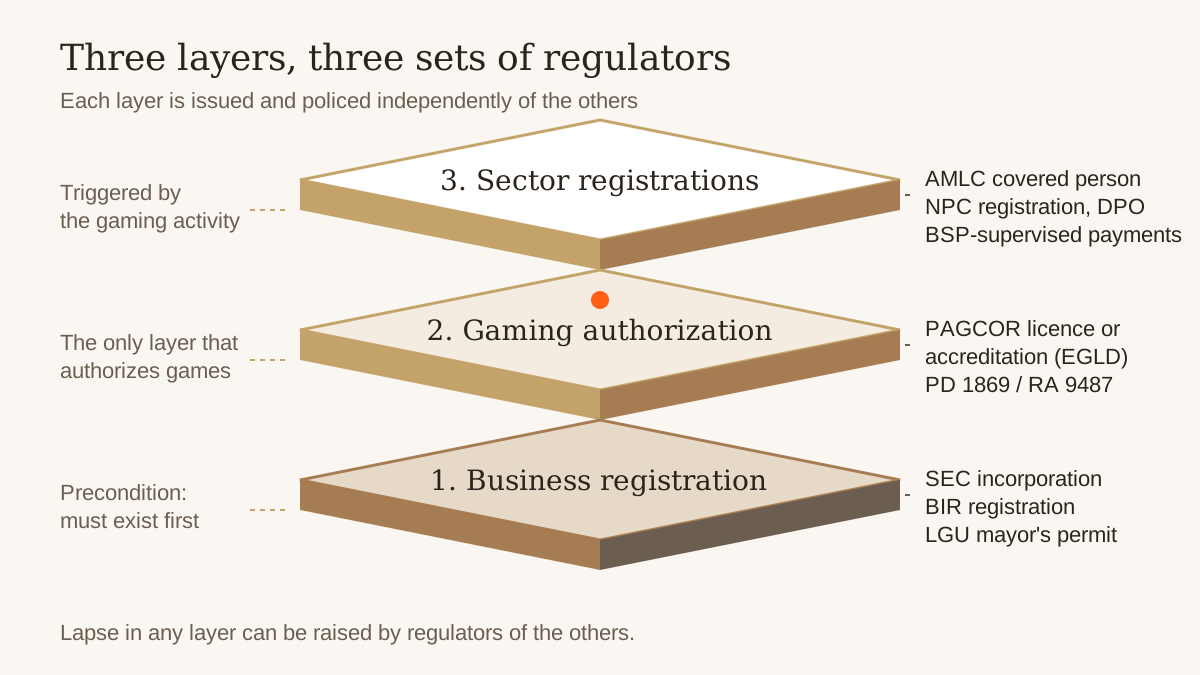
A Philippine online gaming app needs three layers of authorization: ordinary business registration, a PAGCOR license or accreditation, and sector registrations with the AMLC and NPC. Here is what each covers.

1Registered is not the same as licensed
A recurring misunderstanding among founders, foreign investors and even some technology vendors is that a Philippine company holding a Securities and Exchange Commission (SEC) certificate, a Bureau of Internal Revenue (BIR) registration and a mayor's permit is somehow cleared to run an online gaming app. It is not. Those documents confirm that a business exists and is paying its dues to the state and the city. They say nothing about whether that business may offer games of chance to the public. In the Philippines, that permission comes only from a gaming regulator, and for online gaming aimed at the domestic market the regulator is the Philippine Amusement and Gaming Corporation (PAGCOR).
The reverse mistake is just as common. Operators who have fought their way through PAGCOR due diligence sometimes assume the gaming authority "covers everything", and let their BIR, local government unit (LGU), Anti-Money Laundering Council (AMLC) or National Privacy Commission (NPC) obligations lapse. A gaming license does not suspend the tax code, the Local Government Code or the Data Privacy Act. Each layer is administered by a different agency, has its own renewal calendar, and can independently stop a business from operating.
This article separates the three layers, puts them side by side in a comparison table and a sequencing timeline, and closes with the PAGCOR developments of 2025 and 2026 that affect anyone planning to enter the market.
- SEC, BIR, DTI and LGU registrations create and tax a business; none of them authorizes gambling.
- Only PAGCOR (or a special economic zone authority acting under its own charter) can license or accredit online gaming operations, and PAGCOR acts through its Electronic Gaming Licensing Department (EGLD).
- Internet-based casinos are "covered persons" under the Anti-Money Laundering Act by virtue of RA 10927, which triggers separate AMLC registration and reporting.
- As of the research date (29 October 2026), PAGCOR's moratorium on new online gaming operator licenses, in place since 1 March 2024, had been publicly reaffirmed as recently as late August 2026.
- The layers are sequential in practice: a gaming applicant must already be an SEC-registered corporation, and a licensee must keep its tax and LGU standing current to remain in good standing with PAGCOR.
2Layer one: ordinary business registration
SEC incorporation (or DTI for sole proprietors)
Every Philippine corporation comes into existence through the SEC. Under Section 18 of the Revised Corporation Code (Republic Act No. 11232), a corporation acquires juridical personality only upon issuance of its certificate of incorporation. Section 12 of the same Code states that stock corporations are not required to have a minimum capital stock unless a special law provides otherwise, and Section 11 gives corporations perpetual existence by default.
Sole proprietors register a business name with the Department of Trade and Industry (DTI) instead of incorporating. For gaming, this distinction matters more than it might elsewhere. PAGCOR's current accreditation frameworks for online gaming participants are written for corporate applicants; the regulatory framework for B2B providers that took effect on 2 October 2025, as summarized by Chambers and Partners, provides that only duly registered corporations may apply. A DTI-registered sole proprietorship is not a realistic vehicle for an online gaming operation, and an SEC certificate is a precondition for, not a substitute for, the gaming application.
BIR registration
Section 236 of the National Internal Revenue Code, as amended by the Ease of Paying Taxes Act (Republic Act No. 11976, approved 5 January 2024), requires every person subject to internal revenue tax to register once with the appropriate Revenue District Office on or before the commencement of business. The amended Section 236 no longer carries the former annual registration fee paragraph, but the substantive obligations remain: a certificate of registration, registered books of accounts, authority to print or issue official receipts and invoices, and registration for each type of tax the business will pay.
LGU mayor's permit and local business tax
The Local Government Code of 1991 (Republic Act No. 7160) gives cities and municipalities the power to levy local business taxes and to issue, suspend and revoke business permits through the mayor's office. The mayor's permit is renewed annually, usually in January, and is conditioned on barangay clearance, fire safety, sanitary and zoning compliance. The permit allows the office to operate as a place of business; it does not and cannot authorize gambling, which is reserved by law to the national gaming franchises and regulators.
3Layer two: the PAGCOR gaming authorization
Where PAGCOR's power comes from
PAGCOR operates under Presidential Decree No. 1869, its charter, as amended by Republic Act No. 9487 (approved 20 June 2007). RA 9487 renewed PAGCOR's franchise for 25 years from the expiry of the original term on 11 July 2008, renewable for a further 25 years, and confirmed its authority to "authorize, license and regulate" games of chance, card games and number games. The same law carves out games already under other franchises or special laws (for example, those under Republic Act No. 7922 for the Cagayan Special Economic Zone) and games such as cockfighting that LGUs regulate. Only PAGCOR and the few bodies with their own statutory gaming mandate may grant a gambling authorization; an LGU, the SEC and the BIR are not among them.
What PAGCOR actually issues
PAGCOR does not issue one generic "online gaming license". The current structure, administered day to day by its Electronic Gaming Licensing Department (EGLD), distinguishes between several instruments:
- Licenses for remote gaming or online casino operators serving players inside the Philippines. These are the operator-level authorizations historically marketed under names such as e-games, e-bingo and, since 2023 and 2024, Internet Gaming Licenses; the firm's earlier piece on how Internet Gaming Licenses differ from the former POGO regime covers that history.
- Accreditation of Gaming System Administrators (GSAs), the entities that run the platform and games behind licensed venues and sites. PAGCOR's December 2025 list, cited by the Philippine Star, counted 65 accredited GSAs.
- Licenses for Gaming Venue Operators (GVOs) running PAGCOR-licensed physical sites.
- Accreditation of B2B providers: game aggregators, game content providers and support service providers such as payment channel, KYC, customer service and marketing vendors, under the Regulatory Framework for the Accreditation of Gaming Affiliates and Support Service Providers (Revision 1), effective 2 October 2025. That framework requires a PHP 1,000,000 performance cash deposit per accredited provider and a two-year accreditation term. Our analysis of when gaming suppliers need their own licenses goes into the supplier side.
Each instrument comes with probity checks on shareholders, directors and key officers, source-of-funds evidence, technical testing of the gaming system, and PAGCOR Board approval. None of that is replicated in SEC or BIR registration, which is why those registrations cannot stand in for the gaming authorization.
The moratorium on new operator licenses
Any entry plan must account for the fact that PAGCOR has not been accepting new online gaming operator applications for some time. PAGCOR Chairman Alejandro Tengco told a House appropriations hearing in August 2025 that a board resolution dated 1 March 2024 suspended new licenses for online gaming sites and apps and that only applications filed before that date were being considered, as reported by the Philippine Daily Inquirer on 20 August 2025. By 27 August 2026, Focus Gaming News reported that PAGCOR was retaining the freeze while the licensed market consolidated, with the number of licensed online gaming operators down from 74 to 48, and that PAGCOR was moving to remove licensees that held approvals without actively operating. As of the research date, the status of the moratorium should be confirmed directly with PAGCOR before any application budget is committed.
4Side by side: what each authorization covers
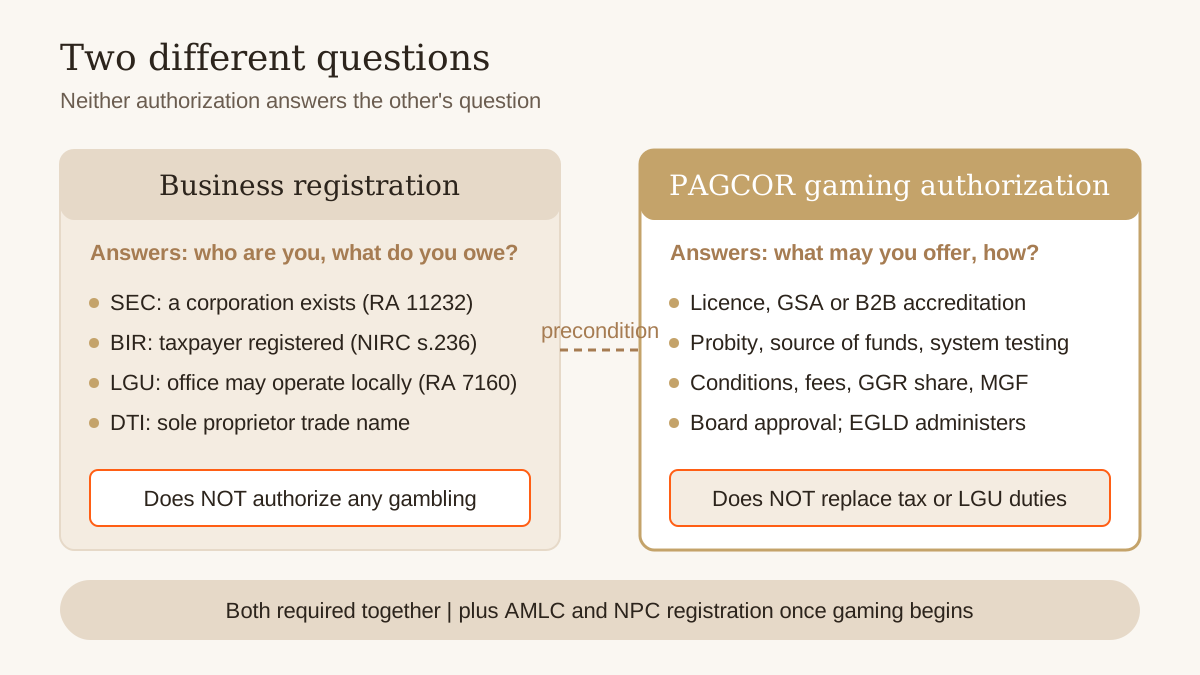
The table below sets out the function of each registration or license, the agency that issues it, what it proves and what it conspicuously does not prove. It is deliberately simplified; the gaming row in particular compresses several PAGCOR instruments.
| Authorization | Issuer | Legal basis | What it establishes | What it does not do |
|---|---|---|---|---|
| Certificate of incorporation | SEC | RA 11232, Sec. 18 | A corporation exists with stated purposes and officers | Does not authorize any regulated activity, including gaming |
| Business name registration | DTI | Act No. 3883, as amended | A sole proprietor may trade under a name | Not an acceptable vehicle for PAGCOR online gaming accreditation |
| Certificate of registration (BIR Form 2303) | BIR | NIRC Sec. 236, as amended by RA 11976 | The taxpayer is registered for income tax, VAT or percentage tax, withholding and other taxes | Does not settle PAGCOR franchise or regulatory fees; does not authorize gaming |
| Mayor's permit and local business tax receipt | City or municipality | RA 7160 | The office or venue may operate as a place of business locally | Cannot authorize gambling; renewed yearly regardless of gaming license status |
| Gaming license or accreditation | PAGCOR (EGLD, Board approval) | PD 1869 as amended by RA 9487; PAGCOR regulatory frameworks | The named entity may operate, administer or supply specified gaming products under stated conditions | Does not replace SEC, BIR, LGU, AMLC or NPC obligations |
| Covered-person registration | AMLC | RA 9160 as amended by RA 10927; ARI No. 1, s. 2024 | The casino is enrolled to file covered and suspicious transaction reports | Does not authorize gaming; is a consequence of being a casino, not a permission to be one |
| Data processing system registration | NPC | RA 10173; NPC registration circulars | The personal information controller is registered and has a designated DPO | No bearing on gaming or tax status |
Only the gaming row speaks to what games may be offered; every other row speaks to who the business is and what it owes. The AMLC and NPC rows exist because of the gaming activity, so a company that lets its PAGCOR status lapse does not escape them while it still holds player data or funds.
5Layer three: registrations triggered by the gaming activity
AMLC covered-person registration
Republic Act No. 10927, approved 14 July 2017, amended the Anti-Money Laundering Act of 2001 to designate casinos as covered persons. Its definition of a casino expressly includes casinos operated through remote communication, that is, internet-based casinos, and ship-based casinos. The law also set a casino-specific covered transaction threshold: a single casino transaction in excess of PHP 5,000,000, against the general PHP 500,000 threshold for other covered persons.
Being a covered person carries a registration duty that is separate from, and in addition to, SEC and PAGCOR registration. Under the AMLC Regulatory Issuance No. 1, Series of 2024 (Guidelines on Compliance Optimization and Registration System), issued 16 April 2024, casinos, including internet-based casinos, are listed among the designated non-financial businesses and professions that must register through the AMLC Online Registration System. New registrants in that category must complete registration before commencing operations, update the registration every two years, and notify the AMLC of changes in officers, offices and ownership within short deadlines. The issuance also contemplates that supervising authorities may make AMLC registration a condition of continued licensing. For the substantive reporting duties that follow, see the firm's guide to anti-money laundering duties for iGaming operators.
NPC registration and data protection officer
An online gaming app collects identity documents, financial details and behavioural data from thousands of players, which places it squarely within the Data Privacy Act of 2012 (Republic Act No. 10173). The NPC's registration regime, currently governed by NPC Circular No. 2022-04, requires personal information controllers and processors that meet its thresholds, including those processing sensitive personal information at scale or in sectors the Commission has flagged, to register their data processing systems and designate a data protection officer. The exact thresholds and renewal mechanics should be checked against the current text of the circular. We have covered the operational side in NPC registration and data privacy controls for licensed online casino operators.
Payment partners and the BSP connection
A gaming operator does not itself need a Bangko Sentral ng Pilipinas (BSP) license to accept deposits, but every realistic payment route runs through a BSP-supervised institution: a bank, an electronic money issuer or an operator of payment systems. Those institutions are themselves AMLC covered persons and will perform their own due diligence on a gaming merchant, typically requiring the PAGCOR license or accreditation certificate, the AMLC certificate of registration and the SEC and BIR documents. Since October 2025, PAGCOR has additionally required that payment channel providers serving its licensees be accredited as support service providers under the B2B framework. The EGLD memorandum published on 26 May 2026 set 31 May 2026 as the filing deadline for interim operation, 31 July 2026 as the deadline to complete accreditation, and 1 August 2026 as the date from which non-compliant gaming systems would be decommissioned. An unaccredited payment partner is therefore the licensee's compliance problem too.
6Sequencing: the order in which the layers are built
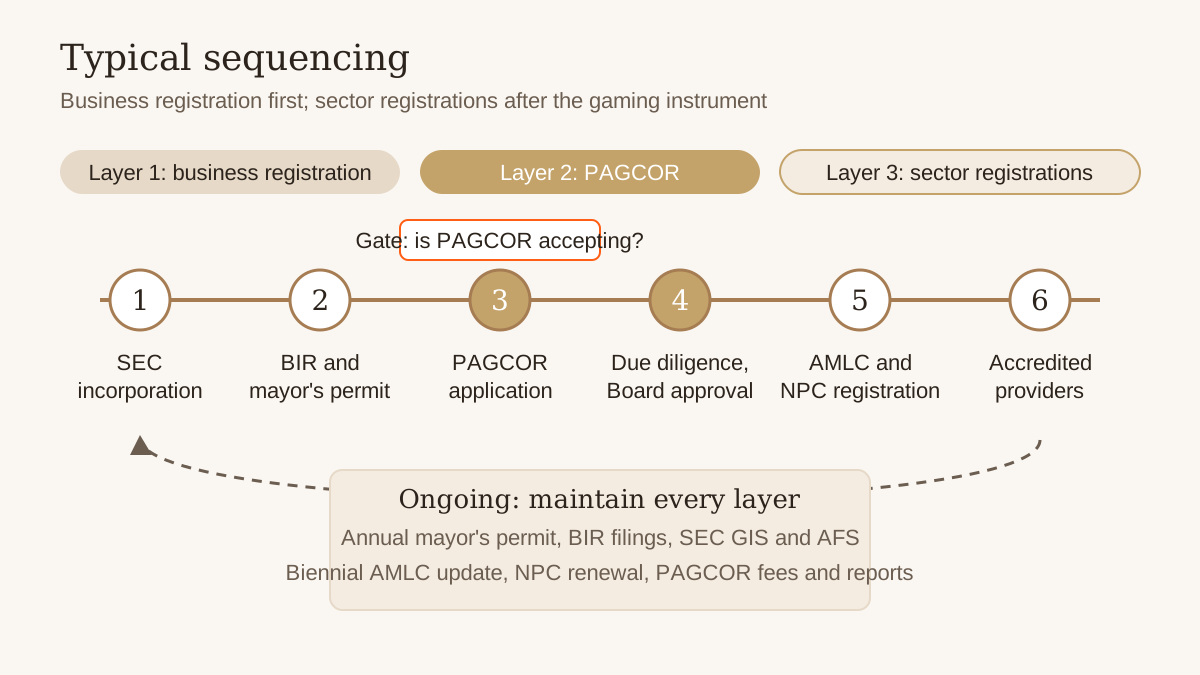
Because PAGCOR requires an existing Philippine corporation and most downstream registrations require the PAGCOR instrument, the layers fall into a fairly fixed order. Durations are indicative and depend on the applicant's readiness and on whether PAGCOR is accepting applications in the relevant category.
- Incorporate with the SEC. Articles of incorporation should carry a primary purpose that squarely describes the intended gaming or gaming-support activity, because PAGCOR reviews the charter documents and a mismatch invites a deficiency notice.
- Register with the BIR and secure the mayor's permit. These follow incorporation and must be in place before the company starts hiring, leasing or contracting. Both are ordinary business steps and neither depends on PAGCOR.
- Prepare the PAGCOR application. Letter of intent, company profile and business plan, personal disclosure sheets for shareholders, directors and key officers, source-of-funds evidence, AML, KYC, responsible gaming and information security frameworks, and system documentation. Industry guidance suggests engaging PAGCOR about six months before intended operations.
- PAGCOR due diligence and Board approval. Probity checks through a third-party checker, ocular inspection, technical testing of the gaming system, payment of the application fee and posting of the performance cash deposit. Licenses are generally issued provisionally first.
- Register as an AMLC covered person and with the NPC. AMLC registration must be complete before gaming operations begin; NPC registration and DPO designation should be done before live player data is processed.
- Onboard accredited payment, KYC and content providers. Each must hold its own PAGCOR accreditation under the B2B framework; the licensee is responsible for using only accredited providers.
- Maintain every layer. Annual mayor's permit renewal, BIR filings, SEC general information sheet and audited financial statements, biennial AMLC update, NPC renewal, PAGCOR reporting and fee payments, and PAGCOR approval for changes of control.
The firm's article on the online casino licensing timeline from company setup to go-live expands on realistic durations for each stage.
7Costs that attach to the gaming layer only
Ordinary business registration costs are modest and predictable: SEC filing fees scaled to authorized capital, documentary stamp tax, BIR registration formalities, and local business tax computed on gross receipts under the LGU's revenue code. The gaming layer is where the cost structure changes character. PAGCOR charges application fees, regulatory fees and a share of gross gaming revenue (GGR); Focus Gaming News reported in August 2026 that the e-gaming fee stands at 30 percent of GGR, with integrated resorts at 25 percent, and that neither rate was being changed.
In December 2025 PAGCOR added a fixed floor. A memorandum dated 15 December 2025 from the EGLD, approved by the PAGCOR Board on 4 December 2025 and reported by the Philippine Star on 29 December 2025, introduced a monthly minimum guaranteed fee (MGF) for accredited GSAs. In its first tranche the MGF was PHP 9,000,000 per month for GSAs offering electronic casino games (pegged to a PHP 30,000,000 minimum monthly GGR) and PHP 3,000,000 for those without (pegged to PHP 15,000,000), stepping up to PHP 10,500,000 and PHP 4,000,000 in a second tranche. The MGF was originally effective 1 April 2026; according to Asia Gaming Brief on 1 April 2026, the Board deferred it to 1 June 2026 by a memorandum dated 30 March 2026, citing economic conditions, and the EGLD was to decide before the deferment expired whether to proceed, adjust or lift the fee. The MGF is payable whether or not the operator's actual revenue reaches the threshold, which makes it a materially different kind of cost from any tax or permit fee in layer one.
- 30% of GGR
PAGCOR fee for e-gaming operators, as reported August 2026 - PHP 9M / month
First-tranche MGF for GSAs with electronic casino games (Dec 2025 memorandum) - PHP 1M
Performance cash deposit per accredited B2B provider (framework effective 2 Oct 2025) - 48
Licensed online gaming operators as of August 2026, down from 74
8What to watch, and how to approach it
Three developments could change the picture described here. The first is the moratorium itself, which PAGCOR has described as temporary but has kept in place for more than two and a half years; its lifting would reopen the operator-license layer to new applicants. The second is the proposed separation of PAGCOR's regulatory and operating functions. Asia Gaming Brief reported on 20 July 2026 that the Governance Commission for GOCCs was expected to send its recommendation to the Office of the President in August 2026 and that Chairman Tengco anticipated an executive order toward the end of 2026 leaving PAGCOR as a pure regulator. The third is pending legislation on online gambling in the 20th Congress, where several bills ranging from outright prohibition to tighter regulation have been filed; none had been enacted as of the research date, and the status of any bill should be confirmed with the Senate and House records before relying on it.
- Confirm which PAGCOR instrument your business model actually requires: operator license, GSA accreditation, or B2B accreditation.
- Check with PAGCOR whether applications in that category are being accepted before incurring set-up costs.
- Draft the SEC primary purpose to match the gaming activity, and keep the general information sheet and beneficial ownership declarations current, because PAGCOR reviews them.
- Calendar the AMLC biennial update, NPC renewal, annual mayor's permit and PAGCOR reporting dates together; a lapse in any one can be raised by the others.
- Verify that every payment, KYC and content vendor holds current PAGCOR accreditation and AMLC registration where applicable.
Abanto Law Firm advises Philippine and foreign clients on structuring, registration and PAGCOR applications across the operator, administrator and supplier categories. If you are deciding which authorization your project requires, or need to bring an existing company's registrations into line with a gaming application, you can read more about our gaming license services in the Philippines or contact the firm to arrange a consultation.
9Frequently asked questions
Can I run an online casino in the Philippines with just an SEC certificate and a mayor's permit?
No. SEC incorporation proves a corporation exists and the mayor's permit allows an office to operate locally. Neither confers any right to offer games of chance. Authority to operate online gaming for the Philippine market comes only from PAGCOR under Presidential Decree No. 1869 as amended by Republic Act No. 9487, or from a special economic zone authority acting under its own statute. Operating without that authorization is illegal gambling regardless of how complete the company's other registrations are.
Does a PAGCOR license exempt my company from BIR registration or local business tax?
No. PAGCOR's license fees and GGR share are regulatory charges owed to PAGCOR; they do not replace registration under Section 236 of the National Internal Revenue Code, tax returns, or local business taxes and the annual mayor's permit under the Local Government Code. The tax treatment of licensed operators has its own complexities, but the registration duty itself is unaffected by holding a gaming license.
Is an online gaming company really a "casino" for anti-money laundering purposes?
Yes. Republic Act No. 10927, approved 14 July 2017, defines casinos as covered persons under the Anti-Money Laundering Act and expressly includes casinos operated through remote communication, that is, internet-based casinos. Under AMLC Regulatory Issuance No. 1, Series of 2024, such casinos must register through the AMLC Online Registration System before commencing operations and keep that registration updated every two years.
Is PAGCOR accepting new online gaming operator applications in 2026?
Not according to the most recent public statements available at the research date. A PAGCOR board resolution dated 1 March 2024 suspended new online gaming operator licenses, and PAGCOR Chairman Alejandro Tengco reaffirmed the freeze at House budget hearings in August 2025 and again in August 2026, when licensed operators numbered 48. Applications filed before the cutoff continue to be processed. Because the position can change by board resolution at any time, applicants should confirm the current status directly with PAGCOR's Electronic Gaming Licensing Department.
Can a sole proprietorship registered with the DTI hold a PAGCOR online gaming accreditation?
In practice, no. PAGCOR's B2B accreditation framework effective 2 October 2025 provides that only duly registered corporations may apply, and PAGCOR's operator and GSA requirements likewise call for corporate charter documents, boards of directors and shareholder disclosures. Anyone planning a gaming or gaming-support business should incorporate with the SEC rather than rely on a DTI business name.
If a payment provider or game studio I use is not PAGCOR-accredited, is that my problem as the licensee?
Yes. Since the B2B framework took effect in October 2025, licensees and accredited gaming system administrators may use only accredited game content providers, aggregators and support service providers, including payment channel providers. PAGCOR's May 2026 memorandum warned that gaming systems from non-compliant providers would be decommissioned from 1 August 2026 and that administrators using them could face sanctions. Vendor accreditation checks therefore belong in the licensee's own compliance program.
Sources and references
- Republic Act No. 9487 (An Act Further Amending Presidential Decree No. 1869, the PAGCOR Charter) — The LawPhil Project (2007-06-20)
- Republic Act No. 10927 (Designating Casinos as Covered Persons under RA 9160) — The LawPhil Project (2017-07-14)
- Republic Act No. 11232 (Revised Corporation Code of the Philippines) — The LawPhil Project (2019-02-20)
- Republic Act No. 11976 (Ease of Paying Taxes Act) — The LawPhil Project (2024-01-05)
- Republic Act No. 7160 (Local Government Code of 1991) — The LawPhil Project (1991-10-10)
- AMLC Regulatory Issuance No. 1, Series of 2024: Guidelines on Compliance Optimization and Registration System — Anti-Money Laundering Council (copy hosted by ACAMS moneylaundering.com) (2024-04-16)
- Pagcor: No new online gaming licenses since March 2024 — Philippine Daily Inquirer (2025-08-20)
- PAGCOR retains freeze on new licences as online gaming operators fall to 48 — Focus Gaming News (2026-08-27)
- PAGCOR issues rules on accreditation of gaming affiliates and support providers under new regime — Chambers and Partners (2025-10-24)
- E-gambling operators must pay minimum guaranteed fee — The Philippine Star (2025-12-29)
- PAGCOR defers minimum guaranteed fee for online gaming operators until June 1st — Asia Gaming Brief (2026-04-01)
- PAGCOR to decommission non-compliant B2B gaming systems from August 1st — Asia Gaming Brief (2026-05-26)
This article is for general informational purposes only and does not constitute legal advice. Laws, regulations, and regulatory requirements may change, and reading this article does not create an attorney-client relationship with Abanto Law Firm. Readers should consult qualified Philippine legal counsel regarding their specific circumstances.